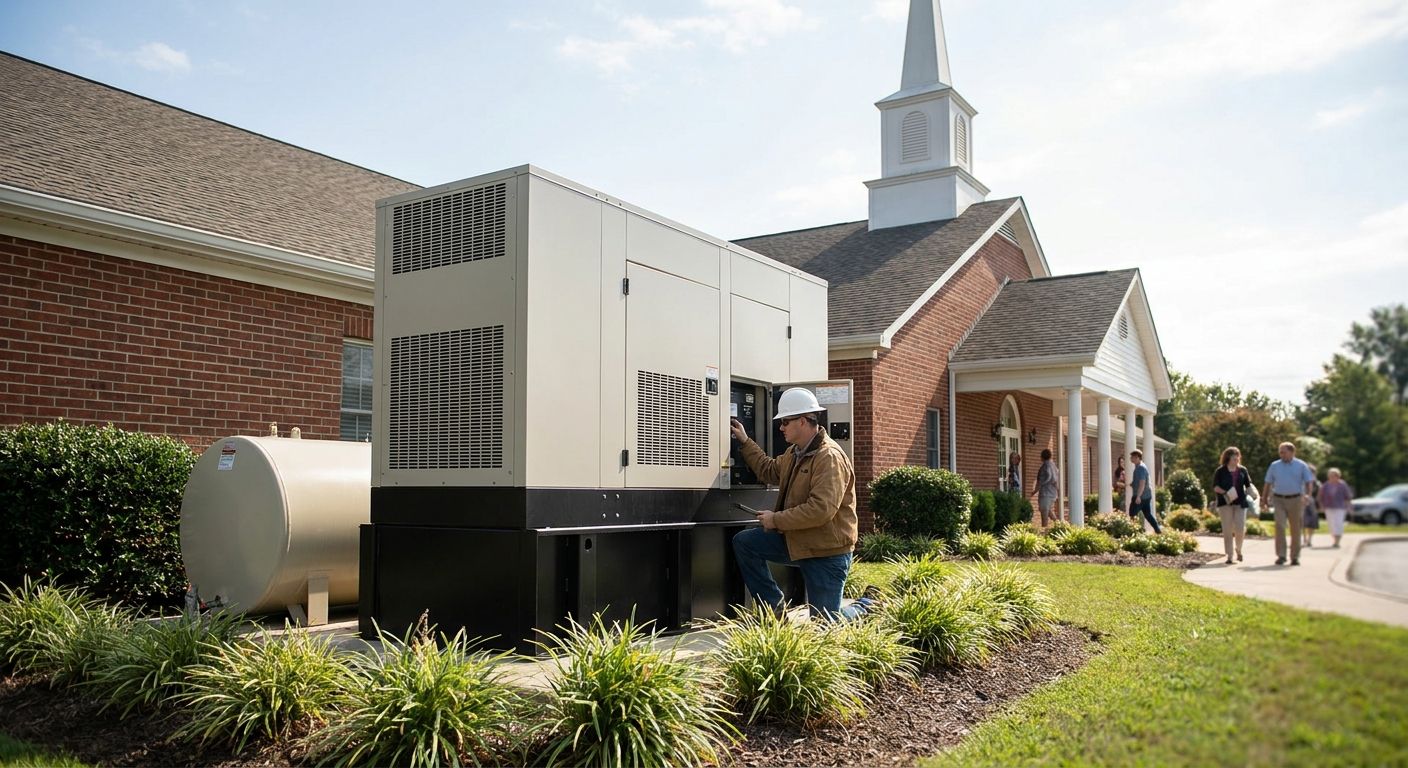
Coastal Alabama churches and community centers double as storm shelters, food distribution points, and gathering halls the moment the power goes out - which means the generator decision isn't optional once hurricane season hits. Best overall for churches and community buildings: Generac commercial standby units, for their range of sizes from a single chapel to a full campus. Best for quiet operation near residential neighbors: Kohler. Best budget-conscious option for smaller congregations: Honeywell. Best for compact fellowship halls and secondary buildings: Briggs & Stratton.
- Generac wins for full campuses with a sanctuary, fellowship hall, and commercial kitchen under one system.
- Kohler is the quietest option for churches with tight neighborhood setbacks.
- Honeywell fits smaller congregations that need reliable backup without commercial-scale sizing.
- Briggs & Stratton suits standalone fellowship halls or annex buildings on a separate meter.
- Sizing runs from roughly 22 kW for a small chapel to 150 kW or more for a multi-building campus.
Why this matters for 2026
A church that loses power during a named storm loses more than lights - it loses its ability to serve as a shelter, a food distribution site, or a place for the congregation to charge phones and check on neighbors. Baldwin County has seen this pattern repeat through multiple storm seasons, and 2026 isn't shaping up any differently along the Gulf Coast.
Unlike a house, a church building often runs a commercial kitchen, a fellowship hall HVAC zone, security systems, and a sanctuary sound system all on one panel. That load profile changes the sizing math completely compared to a residential generator installation for churches and community buildings job versus a standard home standby quote. Getting the size wrong in either direction either strands your building during the next outage or wastes money on capacity you'll never use.
Before you commit to a brand, review how you'll prepare your generator for hurricane season - fuel contracts, transfer switch testing, and maintenance windows all need to be locked in well before June.
What makes the best generator for a church or community building
- Load coverage for the whole facility - sanctuary lighting and sound, fellowship hall HVAC, and any commercial kitchen equipment, not just emergency circuits
- A properly rated automatic transfer switch - undersized switches are the most common failure point on multi-panel church buildings
- Fuel source that matches your site - propane, natural gas, or diesel depending on what's already run to the property
- Noise level appropriate for services - a unit running during a Sunday service or wedding needs to stay in the background, not compete with the sermon
- Salt air and corrosion resistance - anything within a few miles of the coast needs a housing rated for it
- A maintenance plan you'll actually keep - a standby unit that hasn't been tested since installation is a coin flip on the day you need it
Church and community building generators at a glance
| Generator | Best for | Standout feature | Key limitation |
|---|---|---|---|
| Generac | Full campuses (sanctuary + hall + kitchen) | Widest range of commercial kW sizes under one product family | Larger commercial units need more panel and switchgear planning |
| Kohler | Churches near homes or in tight neighborhoods | Sound-attenuated enclosures built for lower-noise operation | Premium enclosures add to install complexity |
| Honeywell | Smaller congregations on a tighter budget | Built on proven Generac-engineered platforms | Fewer large commercial size tiers than Generac's own line |
| Briggs & Stratton | Standalone fellowship halls or annex buildings | Compact footprint fits smaller equipment pads | Narrower size range for large multi-zone buildings |
1. Generac: best generator for full church campuses
Generac's commercial standby line covers everything from a single-zone chapel up to modular systems sized for a sanctuary, fellowship hall, and kitchen running simultaneously. That range is why it sits at the top of this list for any Baldwin County church that's more than one building or more than one electrical service.
Generac pros:
- Widest size range of any brand on this list, from home-standby scale up to true commercial capacity
- Parts and service network makes repairs faster to schedule
- Modular commercial units can be paired for campuses that outgrow a single generator
Generac cons:
- Larger commercial units require more panel work and a bigger equipment pad
- Sizing a multi-building system correctly takes a proper load calculation, not a guess
Best for: churches with a sanctuary, fellowship hall, and kitchen all needing backup power at once. Verdict: Buy for any campus-style property.
2. Kohler: best generator for churches near residential neighbors
Kohler has a long history building enclosures designed to run quieter, which matters when your generator sits fifty feet from a house of worship's parking lot or a neighbor's backyard. For congregations in tighter residential pockets around Fairhope or Daphne, that noise profile is often the deciding factor.
Kohler pros:
- Sound-attenuated housings reduce noise complaints during extended outages
- Reliable performance across the commercial size range
- Strong fit for churches that run services or events during power outages, not just off-hours
Kohler cons:
- Premium noise-reduction features add to the overall system complexity
- Fewer ultra-large commercial tiers compared to Generac's biggest units
Best for: congregations with close neighbors or HOA-adjacent properties sensitive to generator noise. Verdict: Buy if noise complaints are a real concern.
3. Honeywell: best generator for smaller congregations on a budget
Honeywell generators are engineered on Generac platforms, which gives smaller churches a reliable backup option without stepping into the largest commercial size tiers. For a single-building chapel or a community center with modest square footage, this is often more generator than the congregation needs to pay for elsewhere.
Honeywell pros:
- Reliable engineering inherited from a proven commercial platform
- Straightforward setup for single-zone buildings
- Solid fit for smaller fellowship spaces and community rooms
Honeywell cons:
- Fewer large commercial size options for bigger multi-zone campuses
- Less brand recognition among facility boards comparing options
Best for: small congregations or single-building community centers that don't need full commercial-scale capacity. Verdict: Consider for smaller, single-zone properties.
4. Briggs & Stratton: best generator for standalone fellowship halls
Briggs & Stratton's commercial standby units fit well on smaller equipment pads, which makes them a practical pick for an annex building, a separate fellowship hall, or a community room running on its own meter apart from the main sanctuary.
Briggs & Stratton pros:
- Compact footprint works on tighter equipment pads
- Good match for secondary buildings that don't share a panel with the main structure
- Straightforward installation for single-zone properties
Briggs & Stratton cons:
- Narrower size range than Generac or Kohler for large multi-zone loads
- Not the first choice if the building might expand its electrical footprint later
Best for: annex buildings, fellowship halls, or community rooms metered separately from the main church. Verdict: Consider for standalone secondary buildings only.
How this ranking was built
Each brand was weighed against the six criteria above: load coverage, transfer switch compatibility, fuel flexibility, noise level, coastal corrosion resistance, and realistic maintenance support. Generac and Kohler lead because they cover the widest range of church campus configurations found across Baldwin County; Honeywell and Briggs & Stratton earn their spots for the smaller, single-building projects that make up a real share of local community-building requests.
“The generator decision for a church isn't about the biggest unit available - it's about matching the size to the panels you actually have.”
Which generator should your church choose?
If your property includes a sanctuary, fellowship hall, and kitchen all needing power together, Generac's commercial line is the safest default for 2026. If your building sits close to homes and noise during services is a real concern, move to Kohler. Smaller congregations running one building on one panel do well with Honeywell, and standalone annex buildings on a separate meter are a clean fit for Briggs & Stratton. Whichever brand fits, get a proper load calculation before signing anything - a generator sized off a guess is the single most common mistake on church and community-building projects in coastal Alabama.
Get a church generator sizing quote
Free load assessment for churches and community buildings in Baldwin County.
FAQ
What size generator does a church need?
A small chapel needs roughly 22 kW, while a full campus with a fellowship hall and commercial kitchen can require 150 kW or more. The right size comes from a load calculation of every circuit that needs to stay powered during an outage.
Is Generac or Kohler better for a church?
Generac fits better for full campuses needing the widest range of commercial sizes, while Kohler is the better pick when noise near neighbors is a concern. Both brands cover the commercial capacity most Baldwin County churches need.
How much fuel does a church generator use during a storm?
Fuel use scales with the generator's size and how many circuits are running, which is why fuel source planning happens before installation, not after. Propane and natural gas are the two most common choices for church-scale standby units in coastal Alabama.
Do churches need a permit for generator installation in Baldwin County?
Yes, standby generator installations in Baldwin County require permitting through the local jurisdiction before work begins. A licensed electrical contractor handles the permit process as part of the installation.
Can one generator power a fellowship hall kitchen and sanctuary at once?
Yes, as long as the generator and transfer switch are sized for the combined load of both spaces. This is exactly the scenario where commercial-scale units like Generac's larger tiers are built to perform.
How loud is a standby generator during a Sunday service?
Noise level depends heavily on the enclosure - Kohler's sound-attenuated housings run noticeably quieter than standard commercial enclosures. Placement relative to the sanctuary also matters as much as the brand.
What's the best fuel type for a coastal Alabama church generator?
Propane and natural gas are the most common fuel sources for church standby units in coastal Alabama, chosen based on what's already available at the property. Diesel is used less often outside larger commercial campuses.
How often does a church generator need maintenance?
Standby generators need regular testing and service checks, not just a run when a storm is forecast. A maintenance plan that includes routine testing catches problems before hurricane season, not during it.
One last thing
The most overlooked detail on church generator projects isn't the brand - it's the transfer switch rating. A congregation can buy the right generator and still lose power to half the building because the switch was sized for the old panel, not the new load. Get the switch checked before 2026's hurricane season, not after the first named storm.