Choosing among the best generators for gas stations in coastal Alabama means sizing for fuel pumps, point-of-sale systems, and walk-in coolers that all have to restart at once, not just picking the biggest unit on the lot.
- Generac Commercial standby generators win overall for high-volume travel centers running fuel islands, POS, and lighting 24/7.
- Kohler Commercial units fit stations that need clean, stable power for pump-control electronics.
- Honeywell by Generac suits single-bay convenience stores on a tighter budget that still need automatic backup.
- Briggs & Stratton Commercial Series matches stations carrying heavy walk-in cooler and refrigeration loads.
- Diesel-fueled standby units suit flood-prone, hurricane-exposed sites that can't lean on interrupted utility gas lines.
Why this matters
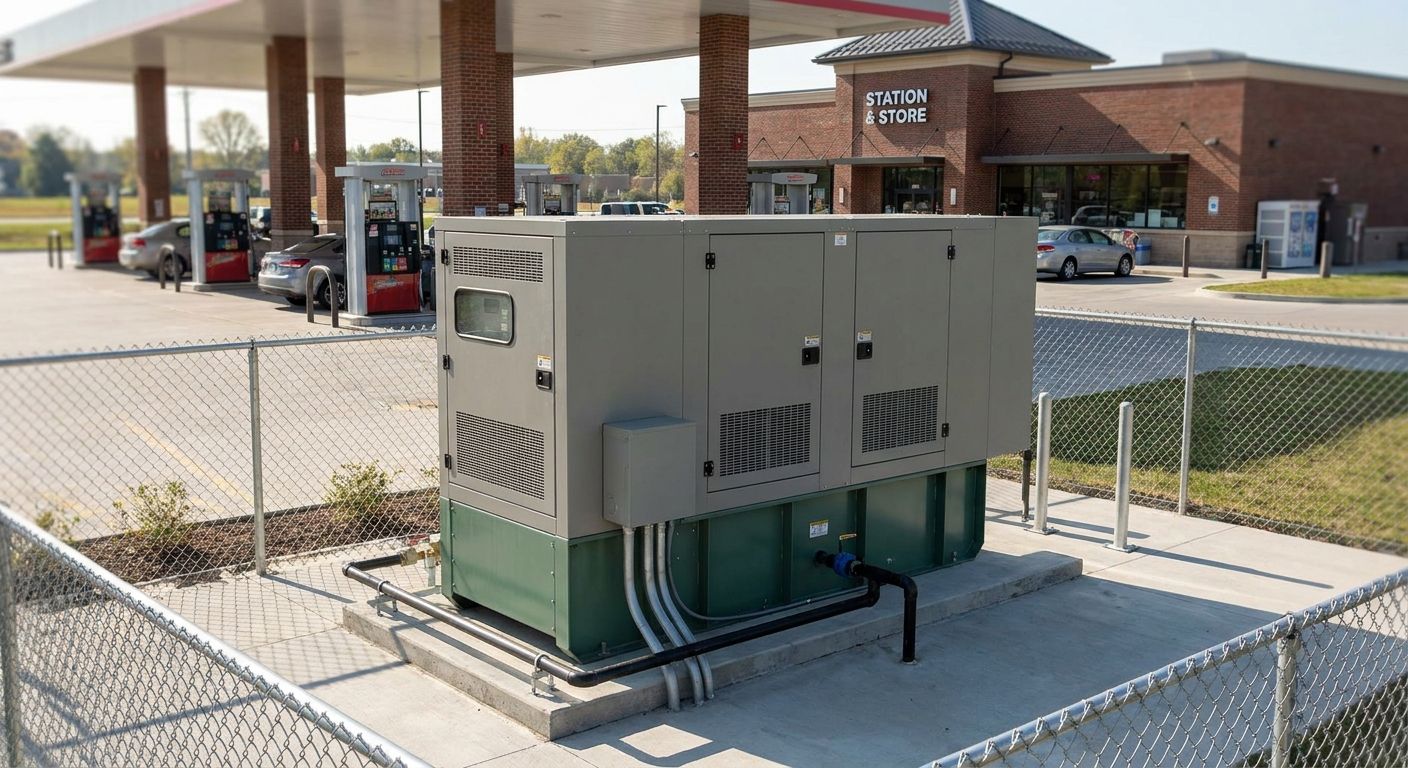
A gas station or convenience store loses money the second the pumps stop dispensing and the coolers start warming up, and along the Gulf Coast that outage clock starts running well before the storm makes landfall. Generator installation for gas stations and convenience stores has to account for fuel dispensers, POS terminals, security cameras, lighting, and refrigeration hitting the panel at the same moment power comes back on.
Undersize the unit and you get nuisance shutdowns during the exact week you need backup power most. Oversize it and you're paying for capacity the site never uses. The right pick depends on how the store operates, not just how big the building is.
What makes the best generator for gas stations
- Fuel flexibility - natural gas, propane, or diesel, matched to what's already run to the site
- Sizing that covers simultaneous loads - pumps, POS, coolers, and lighting starting together, not one at a time
- Automatic transfer switch response - backup power has to kick in within seconds, not minutes
- Runtime for multi-day outages - hurricane season outages routinely stretch past 24 hours
- Coastal corrosion resistance - salt air degrades unprotected enclosures faster than inland installs
- Compliance near fuel dispensing areas - equipment placement and wiring have to meet code for the environment it sits in
Best generators for gas stations at a glance
| Generator | Best For | Standout Feature | Key Limitation |
|---|---|---|---|
| Generac Commercial | High-volume travel centers running 24/7 | Wide kW range scales across multi-pump sites | Larger units need more install space and fuel supply capacity |
| Kohler Commercial | Stations needing clean power for pump electronics | Consistent voltage output protects sensitive controls | Fewer compact models for tight urban lots |
| Honeywell by Generac | Single-bay convenience stores on a budget | Simplified automatic start for smaller loads | Lower max output than heavy-duty commercial lines |
| Briggs & Stratton Commercial | Stations with heavy refrigeration loads | Built for continuous-duty cooling equipment | Narrower dealer and service network in some areas |
| Diesel Standby Units | Flood-prone, hurricane-exposed locations | Runs independent of utility gas lines | On-site fuel storage adds tank space and maintenance |
1. Generac Commercial Standby Generators: best for high-volume travel centers running 24/7
Generac's commercial line covers the kW range that fits a multi-pump travel center: enough capacity to run every dispenser, the POS network, exterior canopy lighting, and interior refrigeration without staggering startup. These units are built for continuous commercial duty, not intermittent home backup.
Generac Commercial pros:
- Scales from mid-size stores to full truck-stop-sized loads
- Wide dealer and parts network across the Gulf Coast
- Handles natural gas or propane depending on site fuel supply
Generac Commercial cons:
- Larger models need a bigger concrete pad and clearance
- Higher-capacity units draw more fuel supply than a small store's gas line may support without upgrades
Best for: stations and travel centers running fuel islands, coolers, and lighting around the clock. Verdict: Buy for any site where pump downtime directly costs sales every hour.
2. Kohler Commercial Generators: best for pump-control electronics that need clean power
Kohler's commercial units are built around stable voltage output, which matters at a fuel station where pump control boards and payment terminals are sensitive to power fluctuations. A generator that surges or sags on startup can trip the same electronics it's supposed to protect.
Kohler Commercial pros:
- Steady voltage regulation protects pump control boards and card readers
- Solid track record in commercial and light-industrial applications
- Available in configurations that pair cleanly with automatic transfer switches
Kohler Commercial cons:
- Fewer compact footprint options for stations on small urban lots
- Lead times can run longer than more common residential-adjacent models
Best for: stations where protecting pump electronics and payment systems matters as much as raw backup capacity. Verdict: Buy if a past outage has fried or glitched point-of-sale equipment.
3. Honeywell by Generac: best for single-bay convenience stores on a budget
Honeywell-branded standby units, built on Generac platforms, cover smaller loads without the price tag of a full commercial-class system. For a single-bay convenience store with one or two coolers and basic lighting, this is often enough capacity without paying for headroom the site will never use.
Honeywell pros:
- Lower entry point than heavy-duty commercial lines
- Automatic start and transfer function the same way larger units do
- Adequate capacity for lighting, small refrigeration, and POS in compact stores
Honeywell cons:
- Maxes out below what a multi-pump travel center needs
- Less headroom if the store adds equipment or expands refrigeration later
Best for: single-bay convenience stores with modest, predictable electrical loads. Verdict: Buy for smaller sites; Skip for anything with more than a couple of fuel dispensers.
4. Briggs & Stratton Commercial Series: best for heavy walk-in cooler loads
Convenience stores lose inventory fast when refrigeration goes down, and how to keep a walk-in cooler running during a power outage comes down to matching generator capacity to compressor startup demand, not just running wattage. Briggs & Stratton's commercial line is built around continuous-duty cooling equipment, which is exactly the load profile a station with multiple coolers and freezers presents.
Briggs & Stratton Commercial pros:
- Sized around continuous refrigeration and HVAC-style loads
- Straightforward integration with existing commercial electrical panels
- Competitive option among mid-size commercial standby units
Briggs & Stratton Commercial cons:
- Dealer and service network is narrower than Generac or Kohler in some parts of coastal Alabama
- Fewer ultra-large models for the biggest multi-pump sites
Best for: stations and convenience stores where refrigerated inventory is the biggest financial risk during an outage. Verdict: Buy for cooler-heavy layouts; confirm local service coverage before ordering.
5. Diesel-Fueled Standby Units: best for flood-prone, hurricane-exposed sites
A station that loses its natural gas supply during a storm still needs power, and diesel units solve that by running off on-site fuel storage instead of a utility line. That independence matters most on barrier-island and low-lying properties where gas service interruptions follow the same storms that cause the power outage in the first place.
Diesel Standby pros:
- Doesn't depend on natural gas line integrity during a storm
- Long track record in commercial and industrial backup applications
- Fuel can be stored on-site ahead of hurricane season
Diesel Standby cons:
- Requires tank space, permitting, and ongoing fuel maintenance
- Diesel fuel needs periodic testing and treatment to avoid degradation in storage
Best for: flood-prone or barrier-island stations that can't count on utility gas after a storm. Verdict: Buy for exposed coastal sites; Hold if the store already has reliable natural gas service and a stable supply history.
How we ranked these
Each generator was weighed against the criteria above: fuel flexibility, simultaneous-load sizing, transfer switch response, extended runtime, coastal corrosion resistance, and compliance near fuel dispensing equipment. No single brand wins on every criterion, which is why the list splits by use case instead of naming one universal winner.
Sizing discipline matters more than brand loyalty here. A property manager weighing a 60kW unit against a 100kW unit is making the same call an operator further north makes when sizing walk-behind snow plows for sidewalks instead of a full-size tractor: match the equipment to the actual job, not the biggest option on the shelf.
Get a site-specific generator quote
Sizing for your pumps, coolers, and POS load before hurricane season.
Which generator should a gas station or convenience store choose?
For a busy multi-pump travel center running around the clock, Generac Commercial is the default pick for 2026 - it scales to the load and has the widest service network across Baldwin County. If pump electronics or POS systems have failed during past outages, Kohler Commercial's steadier voltage output justifies the switch. Smaller single-bay stores do better on Honeywell by Generac, and any site carrying heavy refrigeration should weigh Briggs & Stratton Commercial against its cooler load specifically. Flood-prone barrier-island properties should default to a diesel-fueled unit regardless of what the rest of the list says.
Baldwin County Generators sizes each of these against the actual electrical load on-site rather than a generic square-footage estimate, which is where most undersized gas station generators go wrong.
FAQ
What size generator does a gas station need?
Most convenience stores and gas stations need 20kW to 150kW depending on pump count, refrigeration load, and lighting. A single-bay store with one or two coolers sits at the low end; a multi-pump travel center with heavy refrigeration sits near the top.
What is the best generator brand for gas stations?
Generac Commercial fits high-volume 24/7 travel centers, Kohler Commercial suits stations protecting sensitive pump electronics, and Briggs & Stratton Commercial fits stations with heavy walk-in cooler loads. The right brand depends on which load matters most at that site.
Should a gas station generator run on diesel, propane, or natural gas?
Diesel works best for flood-prone or barrier-island sites that can lose utility gas service during a storm. Natural gas or propane suits stations with reliable existing gas service and no on-site fuel storage requirement.
How fast does a standby generator restore power to a gas station?
An automatic transfer switch typically restores power within seconds of a utility outage, not minutes. That response time is what keeps pumps, POS systems, and coolers from ever fully shutting down.
Can a generator run a gas station's walk-in cooler and pumps at the same time?
Yes, but only if it's sized for simultaneous startup load, not just running wattage. Compressor motors draw significantly more current the instant they start than while running, and an undersized unit will trip trying to start everything at once.
How long should a gas station generator run during a hurricane outage?
Outages during Atlantic hurricane season, which runs June 1 through November 30, routinely stretch past 24 hours. A generator paired with adequate fuel supply or on-site diesel storage should be planned for multi-day runtime, not a single overnight outage.
Do coastal Alabama gas stations need corrosion-resistant generators?
Yes. Salt air degrades unprotected enclosures and electrical components faster near the Gulf Coast than inland, so coastal installations need generators and enclosures rated or treated for that exposure.
Is it cheaper to run a smaller generator and stagger loads at a gas station?
Staggering loads can lower upfront generator cost, but it risks nuisance shutdowns if pumps, coolers, and POS systems all demand power at once during an outage. Sizing for simultaneous load is more reliable for a business that can't afford downtime.
One last thing
Most undersized gas station generators fail for the same reason: the sizing only accounts for running wattage, not startup surge. Compressor motors in walk-in coolers typically pull three to six times their running amps the instant they kick on, and if two or three coolers restart together after an outage, that spike can trip a generator that looked plenty big on paper. Size for the worst-case simultaneous start, not the average running load.