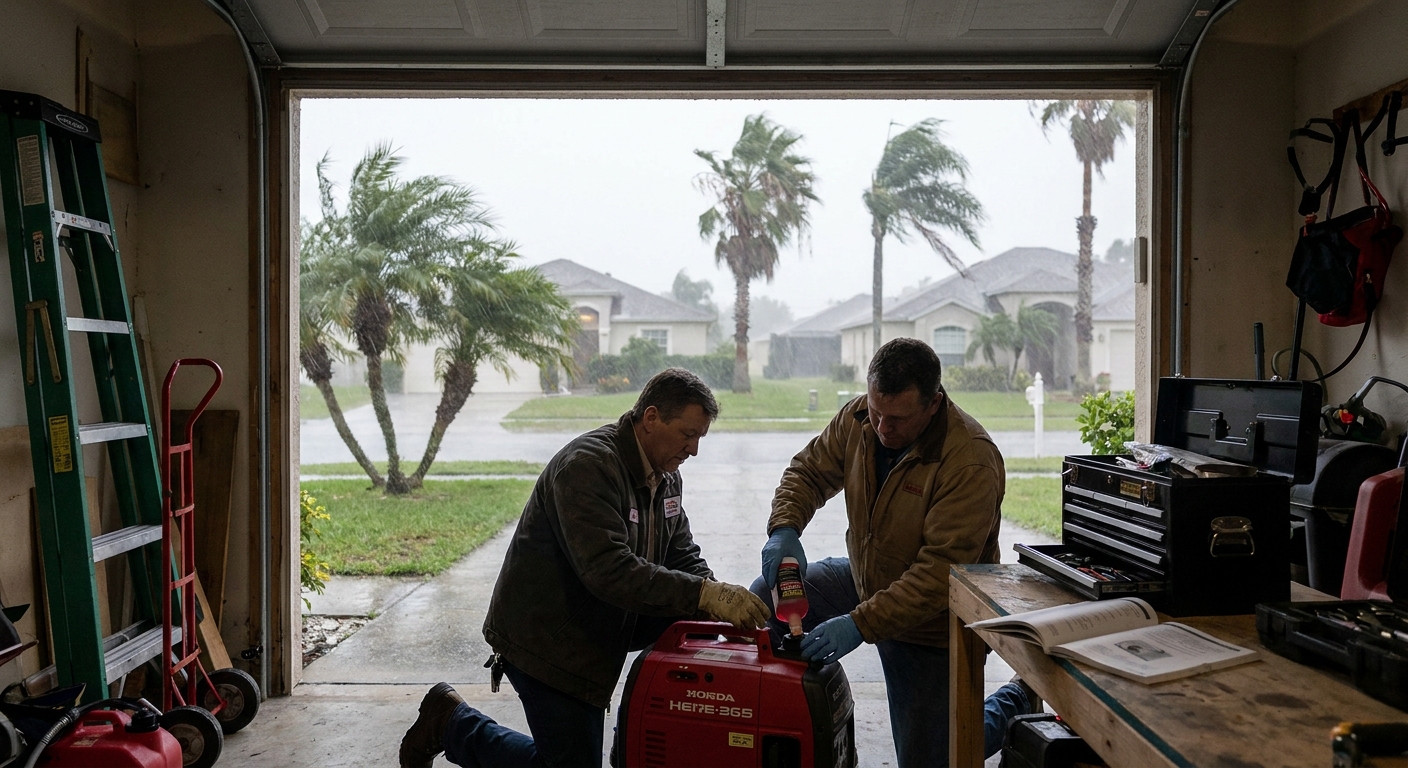
Hurricane season in coastal Alabama runs June through November, and a generator that sat untouched since last year's last storm is not ready to run when the power goes out. This guide walks through the exact pre-season checklist that keeps a standby unit starting on the first try in 2026.
TL;DR
Before hurricane season 2026 hits Baldwin County, run a load test, change the oil and filter, check the battery voltage, clear the exhaust and intake vents, and confirm the automatic transfer switch cycles correctly. A Generac or Kohler standby unit that skips annual maintenance is the most common reason homeowners in Daphne, Fairhope, Foley, and Gulf Shores lose power during a storm despite owning a generator. Verdict: do this checklist in May or early June, not the week a storm is forecast. If you don't have a standby unit yet, Baldwin County Generators installs and services Kohler, Generac, Honeywell, and Briggs & Stratton systems across the region.
Why this matters
A generator is a mechanical engine that sits idle 50 weeks a year, and idle engines develop problems: stale fuel, corroded battery terminals, wasp nests in the exhaust, dead cooling fans. None of that shows up until you need the unit at 2 a.m. during a tropical storm.
Coastal Alabama saw active storm seasons in recent years, and 2026 is shaping up no different based on NOAA's early-season outlooks. Homeowners who wait until a hurricane watch is issued to check their generator are often the ones calling for emergency service while the roads are already flooding. A 30-minute pre-season check in May costs nothing and prevents almost every no-start call Baldwin County Generators fields each June.
What you'll need
- Owner's manual for your specific unit (Kohler, Generac, Honeywell, or Briggs & Stratton model number)
- Fresh engine oil and an OEM oil filter matched to your generator's kW rating
- A digital multimeter to check battery voltage
- A shop vacuum or soft brush for vents and louvers
- A garden hose (low pressure) for exterior housing cleaning
- 30-45 minutes of time, done outside of storm-prep week
- A licensed technician on call if the unit fails any step below
The steps
1. Run a full load test, not just a start-up cycle
Most generators self-test for a few minutes weekly, but that's not the same as proving the unit can carry your home's actual load. Start the generator manually, transfer to generator power through the automatic transfer switch, and let it run your HVAC, refrigerator, and well pump (if applicable) for 15-20 minutes.
Watch for voltage sag, unusual vibration, or the engine struggling under load. Common mistake: owners test the generator running with zero load connected, which tells you almost nothing about how it performs during an actual outage.
2. Change the oil and filter on schedule, not by calendar guess
Standby generators typically need an oil change every 100-200 hours of run time or once a year, whichever comes first, per most Generac and Kohler service schedules. If your unit ran during last year's outages, check the hour meter before assuming it's due.
Use the oil weight specified in your manual - most air-cooled units call for synthetic 5W-30, but liquid-cooled models may differ. Old, dark oil is the single biggest predictor of engine wear on units over 5 years old.
3. Check battery voltage and terminal corrosion
The battery starts the engine - no charge, no start, no matter how good the generator itself is. Set a multimeter to DC voltage and check the battery reads at least 12.6 volts at rest.
Clean any white or greenish corrosion off the terminals with a wire brush and a baking soda solution. Replace batteries older than 3 years proactively; a battery that tests fine in May can fail by July in Gulf Coast heat and humidity.
4. Clear intake and exhaust vents completely
Wasps, mud daubers, and small rodents build nests in generator housings during the off-season, and a blocked exhaust can cause the unit to overheat or shut down mid-run. Open the enclosure and visually inspect the muffler, exhaust outlet, and cooling air intake louvers.
Use a shop vacuum or soft brush - never compressed air directed into sensitive components. Expected outcome: clear, unobstructed airflow with no visible debris or insect activity.
5. Inspect the fuel supply and connections
For natural gas units, check that the gas line valve is fully open and there's no smell of gas at any fitting - that indicates a leak requiring immediate professional attention. For propane or diesel units, confirm the tank level is adequate for extended run time; 2026 storm outages in Baldwin County have lasted anywhere from 2 to 10 days depending on damage severity.
Stale gasoline in portable backup units should be drained and replaced - gas older than 30 days degrades and causes hard starts or stalling.
6. Test the automatic transfer switch (ATS)
The ATS is what actually switches your home from utility power to generator power within seconds of an outage - a generator with a failed ATS is just an expensive lawn ornament. Simulate a power loss (many units have a test mode, or a technician can trip it safely) and time how long the switch takes to transfer.
Most residential ATS units switch within 10-20 seconds. Common mistake: assuming the ATS works because the generator itself starts fine - these are separate systems that fail independently.
7. Verify remote monitoring and alerts are active
Generac Mobile Link and Kohler's OnCue Plus notify you by app or text if the unit has a fault, low fuel, or maintenance need. Confirm your phone number and Wi-Fi connection are current before hurricane season 2026 arrives - a stale connection means you won't get the low-fuel alert until you're already in the dark.
Troubleshooting
- Generator won't start on battery power - Check voltage first; a reading under 12 volts means the battery needs charging or replacement before anything else.
- Unit starts but shuts down within a minute - Usually a low-oil safety shutoff or a fuel supply issue; check oil level and fuel valve position.
- Generator runs but house has no power - The transfer switch likely failed to engage; this needs a licensed electrician, not a DIY fix.
- Excessive vibration or noise under load - Often a sign of a failing capacitor or an engine mount issue; stop the unit and call for service rather than running it further.
- Low fuel alerts on natural gas units - This usually means a gas pressure problem, not an actual fuel shortage; have the gas line pressure checked.
- App shows unit offline - Check the generator's Wi-Fi module connection and router proximity before assuming a hardware fault.
Tools and resources
- Owner's manual and maintenance log for your specific Kohler, Generac, Honeywell, or Briggs & Stratton model
- Digital multimeter for battery checks
- A licensed electrical contractor for annual professional service and ATS testing
- Baldwin County Generators for installation, repair, and maintenance service across Daphne, Fairhope, Foley, and Gulf Shores
What to do next
If your generator fails any step above, or if you're running a portable unit and considering a whole-home standby system before the next storm, get it evaluated before hurricane season 2026 peaks in August and September - that's when service backlogs are longest and lead times for new installs stretch out.
FAQ
What's the best time of year to service a standby generator? May or early June, before hurricane season officially starts June 1 and before service companies get backed up with storm-prep calls.
How often should a standby generator get an oil change? Every 100-200 hours of run time or once a year, whichever comes first - check the hour meter rather than guessing by calendar date alone.
Is a natural gas generator better than propane for hurricane season? Natural gas never runs out as long as the utility line is intact, while propane requires an on-site tank with adequate fuel level - both work well in coastal Alabama, but natural gas removes the fuel-supply variable during extended outages.
How long can a standby generator run continuously during a storm? Most residential standby units are rated for continuous operation as long as fuel supply holds, and outages in Baldwin County have run anywhere from 2 to 10 days depending on storm severity.
Do I need a professional to prepare my generator for hurricane season, or can I do it myself? Homeowners can handle the visual inspection, battery check, and vent clearing themselves, but load testing the transfer switch and diagnosing engine faults should go to a licensed electrician.
What size generator do I need for a whole home in coastal Alabama? Sizing depends on square footage and whether you're running HVAC and well pumps simultaneously - a licensed installer measures actual load rather than guessing off home size alone.
How much does annual generator maintenance cost? Costs vary by unit size and service scope; get a quote specific to your Kohler, Generac, or Briggs & Stratton model rather than relying on a generic estimate.
Can I run my generator during the storm itself if I skipped pre-season maintenance? You can try, but an unmaintained unit is far more likely to fail mid-storm when you need it most - that's exactly the scenario this checklist prevents.
One last thing
The detail most homeowners skip: checking the transfer switch independently from the generator engine. A unit can pass every start-up and load test and still leave your house dark if the ATS doesn't engage - it's a separate mechanical system with its own failure points, and it's the one component most DIY checklists forget to test in 2026.