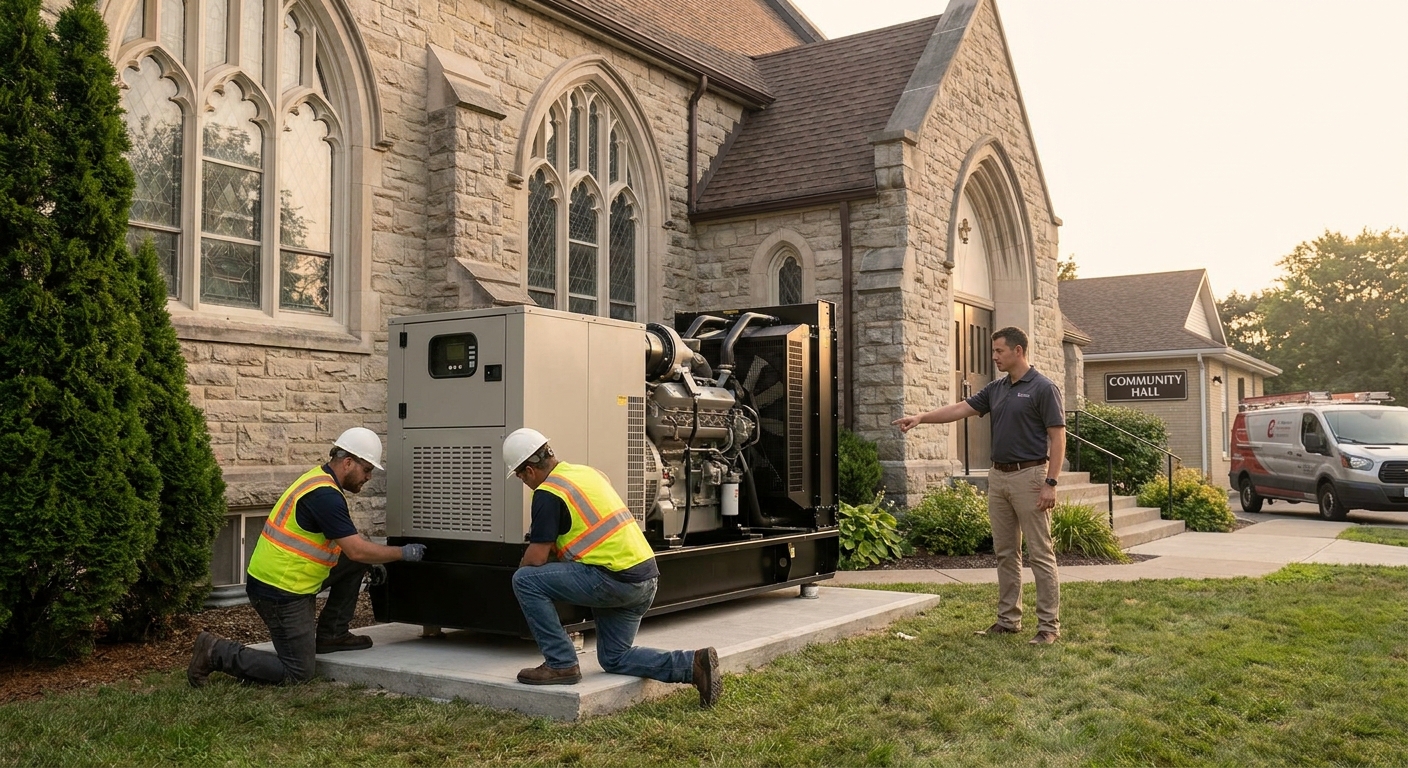
Churches and community centers run on their own clock - Sunday services, storm shelters, food pantries, funerals that can't wait for the power company. A standby generator installation for churches and community buildings has to cover more square footage and more critical circuits than a typical house call, and it has to work the first time it's asked to.
- A 48kW to 150kW standby unit covers most sanctuary-plus-fellowship-hall setups in coastal Alabama in 2026 - Buy for congregations over 200 members.
- Kohler and Generac commercial units both handle automatic transfer switching for HVAC, kitchens, and life-safety lighting without a hand-off delay.
- Propane wins over diesel for church sites without a fuel contract already in place - Consider it the default unless natural gas is already on-site.
- Skip undersized 20kW residential-class units for any building with a commercial kitchen or more than 3 HVAC zones.
- Baldwin County Generators installs and services standby systems for churches and community buildings across Daphne, Fairhope, Foley, and Gulf Shores.
Why this matters
Hurricane season doesn't check the church calendar. When a storm knocks out grid power for days, a church or community building often becomes the place people go - for shelter, for meals, for a working refrigerator. That means the load calculation, the fuel plan, and the transfer switch all matter more here than they would for a single-family home.
A generator installation for churches and community buildings that's sized for a house won't carry a commercial kitchen, a walk-in cooler, and three HVAC zones at once. Get the sizing wrong and the unit either trips under load or burns through fuel faster than budgeted. Get it right and the building keeps functioning as a shelter point, not just a dark structure with a generator parked outside.
Who this is for
This guide is for church administrators, facilities managers, and community center boards in coastal Alabama - Baldwin County Generators works with congregations in Daphne, Fairhope, Foley, and Gulf Shores that need backup power sized for a building larger and more complex than a typical residence, often with a kitchen, a fellowship hall, and a nursery or classroom wing all drawing at once.
What to look for in generator installation for churches and community buildings
Accurate load calculation for mixed-use space
A sanctuary, a commercial kitchen, and a nursery don't draw power the same way, and lumping them into one rough estimate is how buildings end up underpowered. A proper load calculation accounts for HVAC compressor start-up amps, kitchen equipment, and life-safety lighting circuits separately, then adds a margin instead of running at capacity.
Automatic transfer switch rated for the panel size
The transfer switch is what actually flips the building from grid to generator, usually in 10 to 20 seconds. A switch rated below the building's amperage becomes the bottleneck no matter how big the generator is, so this spec has to match the panel, not the generator nameplate.
Fuel type matched to what's already on-site
Propane and natural gas both run cleaner installs than diesel for community buildings, since neither requires a fuel delivery contract to keep the tank full during an extended outage. A church already on a natural gas line skips the tank altogether; one that isn't usually goes propane with a sized tank sitting on a concrete pad.
Noise and placement that satisfies local ordinance
A generator running for days during a storm needs to sit far enough from windows, property lines, and parking to clear local noise ordinances in towns like Fairhope and Foley. Placement gets decided before the concrete pad is poured, not after a neighbor complains.
Maintenance response time, not just install quality
A generator that starts on installation day and never gets serviced again is a liability by year three. Churches need a maintenance schedule with a documented response window, because a unit that fails silently for months only gets discovered during the outage it was supposed to prevent.
Code compliance and permitting handled by a licensed electrician
Commercial and institutional generator installs fall under different code sections than residential ones, and an unpermitted install can void insurance coverage on a building that doubles as a shelter point. A licensed electrical contractor pulls the permit and handles inspection sign-off as part of the job, not as an afterthought.
Top picks for church and community building standby power
Kohler commercial-class (48kW-150kW) - the safe pick for mid-to-large congregations. These units are built for continuous-duty commercial loads, not just intermittent residential ones, and the automatic transfer switch integrates directly with multi-panel commercial setups. A 100kW Kohler unit typically covers a sanctuary, fellowship hall, and full kitchen without load-shedding. Buy for any congregation running a commercial kitchen alongside the sanctuary.
Generac commercial-class (60kW-150kW) - the volume pick, widely stocked and serviced across the Gulf Coast. Generac's commercial line handles the same load profile as Kohler with comparable transfer switch speed, and parts availability tends to be faster during peak hurricane-season demand. Buy for buildings that need faster service turnaround during storm season.
Honeywell mid-tier standby units (20kW-48kW) - the right-sized pick for smaller community centers or churches without a commercial kitchen. These units cover HVAC, lighting, and office equipment without the footprint or fuel draw of a full commercial unit. Consider for community rooms and smaller congregations under 150 members.
Briggs & Stratton residential-class units (below 20kW) - the wildcard, and usually the wrong call for anything beyond a single-room chapel or small office annex. These units aren't built for continuous multi-zone HVAC cycling or commercial kitchen loads. Skip for any building with a fellowship hall, kitchen, or more than one HVAC zone.
What to avoid
- Undersized residential units on a commercial panel. A 20kW unit that looks fine on paper for a small building will trip the moment the kitchen equipment and HVAC compressor cycle at the same time.
- Skipping the transfer switch upgrade to save on the quote. A generator sized correctly but paired with an undersized transfer switch will never deliver its rated output to the panel.
- DIY or unlicensed installs on a shelter-point building. Churches that double as storm shelters often need inspection sign-off tied to insurance and local emergency management coordination - an unpermitted install can complicate both.
Verdict comparison
| Brand / Class | Typical Size Range | Fuel Type | Best For | Verdict |
|---|---|---|---|---|
| Kohler commercial | 48kW-150kW | Propane/natural gas | Full sanctuary + commercial kitchen | Buy |
| Generac commercial | 60kW-150kW | Propane/natural gas | Storm-season service speed | Buy |
| Honeywell mid-tier | 20kW-48kW | Propane | Smaller community centers | Consider |
| Briggs & Stratton residential | Under 20kW | Propane | Single-room chapels only | Skip for multi-zone buildings |
FAQ
What size generator does a church need in 2026?
Most mid-size churches with a sanctuary, fellowship hall, and kitchen need a 48kW to 100kW standby unit in 2026. Smaller chapels without a commercial kitchen can run on a 20kW to 48kW mid-tier unit instead.
Is Kohler or Generac better for a community building?
Kohler and Generac commercial-class units both handle continuous-duty church and community loads well, so the choice usually comes down to service turnaround in your area. In coastal Alabama, Generac's parts network tends to move faster during peak hurricane-season demand.
Does a church generator installation need a permit?
Yes, commercial and institutional generator installs in Alabama require a permit and inspection sign-off, especially for buildings that double as storm shelters. A licensed electrical contractor handles the permitting as part of the installation.
How long does a standby generator run during a power outage?
Propane and natural gas standby units can run for the duration of the outage as long as fuel supply holds, which is why a fuel plan matters more than the generator's spec sheet alone. Diesel units are limited by tank size and delivery access during extended storms.
Can a small community center use a residential generator?
A community room without a commercial kitchen or multiple HVAC zones can often run on a residential-class unit under 20kW. Once a kitchen or more than one HVAC zone is added, that size becomes undersized within the first year.
How fast does the power come back on with an automatic transfer switch?
An automatic transfer switch typically flips a building from grid to generator power within 10 to 20 seconds of an outage. The switch has to be rated for the building's full panel amperage, not just the generator's nameplate output.
Where should a church generator be placed?
Generators need placement that clears local noise ordinances and setback requirements from windows, property lines, and parking areas. Towns like Fairhope and Foley enforce specific distance rules, so placement gets planned before the concrete pad goes in.
How often does a church generator need maintenance?
Standby generators for institutional buildings typically need service checks on a scheduled basis, not just a one-time install. A documented maintenance contract with a defined response window catches failures before the next outage, instead of during it.
One last thing
The generator that fails a church isn't usually the wrong brand - it's the one nobody serviced after the ribbon-cutting. A unit installed correctly in 2023 and never checked again is running on borrowed time by 2026, and the failure almost always shows up during the storm it was supposed to get the building through.