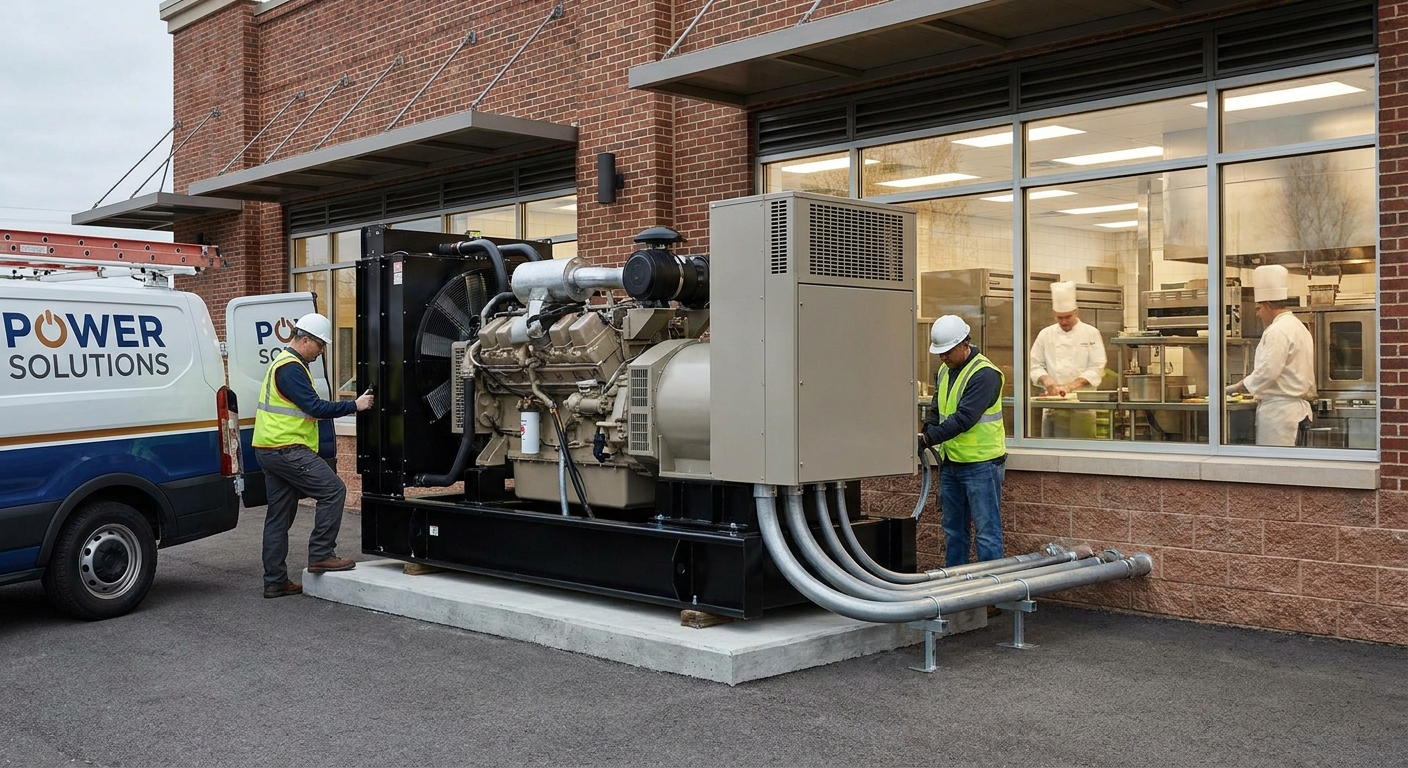
Restaurants and commercial kitchens in coastal Alabama lose more than comfort when the grid drops - they lose walk-in coolers, ice machines, exhaust hoods, and every ticket in the POS system the moment a storm knocks out power. This guide breaks down standby generator installation for restaurants and commercial kitchens across Daphne, Fairhope, Foley, and Gulf Shores, and what separates a code-compliant install from an expensive mistake.
- Standby generator installation for restaurants and commercial kitchens starts at roughly 48kW for quick-service and climbs past 150kW for full-service and multi-unit sites - size to your walk-in and hood load, not your square footage.
- Natural gas wins for restaurants tied into a municipal line since 2026 fuel deliveries during hurricane season are unreliable; propane is the fallback for rural Baldwin County sites.
- Health code requires refrigerated food back to 41°F within 4 hours of an outage - undersized units miss this window and cost you inventory.
- An automatic transfer switch that engages in 10 seconds beats a manual switch every time in a kitchen running walk-ins and freezers.
- Baldwin County Generators installs and services Kohler, Generac, Honeywell, and Briggs & Stratton commercial units for coastal Alabama food service operators - verdict: Buy the size that matches your actual load, not the cheapest tier.
Why this matters
A residential-grade generator installed on a commercial kitchen is the single most common mistake seen across Baldwin County job sites. Walk-in coolers, three-door freezers, exhaust hood fans, and hood suppression systems all draw starting loads that spike far above their running wattage, and an undersized unit trips or stalls the moment two of those loads hit at once.
Hurricane season in coastal Alabama runs June through November, and 2026 storm forecasts put pressure on restaurant owners to have power secured before the first named storm, not after. A generator that can't carry your kitchen's full load isn't a backup plan - it's a liability that fails during the exact week you need it most.
Baldwin County Generators works directly with restaurant owners on load calculations before any equipment gets quoted, because guessing at kW size is how kitchens end up with a generator that runs the lights but drops the walk-in.
Who this is for
This guide is built for restaurant owners, commercial kitchen operators, and multi-unit franchise managers in Daphne, Fairhope, Foley, and Gulf Shores who need power that keeps food safe, equipment running, and doors open through a grid outage - not a homeowner looking at a whole-house unit for a kitchen remodel.
What to look for in a commercial kitchen generator
Load capacity matched to your actual equipment
A quick-service kitchen with one walk-in and a flat-top runs a different load profile than a full-service restaurant with two walk-ins, a hood suppression system, and a bar. Sizing on square footage alone under- or over-sizes the unit - a proper install starts with a load calculation of every piece of equipment that has to stay on during an outage.
Fuel type reliability during storm season
Natural gas ties into the municipal line and doesn't run out mid-storm, which matters when diesel and propane delivery trucks can't reach coastal roads during a hurricane. Propane is the right call for rural Baldwin County sites without gas service, but it requires an on-site tank sized for at least 48-72 hours of run time.
Automatic transfer switch speed
A manual transfer switch means someone has to physically flip power over - not practical at 2 a.m. when a walk-in starts warming. An automatic transfer switch senses the outage and engages the generator in about 10 seconds, which keeps refrigeration compressors from cycling off long enough to matter.
Code compliance and health department requirements
Commercial kitchen installs fall under NFPA 37 for stationary engines and local health department rules requiring refrigerated food to stay at or below 41°F. An installation that isn't permitted and inspected correctly can trigger a health department citation even if the generator itself works fine.
Noise ordinances and placement
Fairhope and Gulf Shores both have commercial zoning rules on equipment noise and setback from property lines. A generator placed too close to a neighboring business or without sound attenuation can draw complaints even when it's running exactly as designed.
Maintenance and service contracts
A generator that sits unused for months until the first named storm of 2026 needs scheduled maintenance to start reliably - oil changes, battery checks, and load-bank testing catch problems before an actual outage does.
Top picks by kitchen size
The quick-service tier - 48kW A single-walk-in, limited-menu operation (think a sandwich shop or coffee counter) typically runs on a 48kW unit, which covers one walk-in cooler, a few pieces of cooking equipment, POS systems, and lighting. This tier handles the core food-safety load without paying for capacity you won't use. Verdict: Buy if your kitchen has one walk-in and a compact line.
The full-service tier - 80kW A sit-down restaurant with two refrigeration units, a hood suppression system, and a full kitchen line needs closer to 80kW to carry starting loads without nuisance trips. This size handles the walk-in, prep coolers, exhaust fans, and dining room HVAC simultaneously. Verdict: Buy for most full-service coastal Alabama restaurants.
The multi-location or high-volume tier - 150kW+ Multi-unit franchise kitchens or high-volume seafood and steakhouse operations running multiple walk-ins, ice machines, and commercial dishwashers need 150kW or more to keep every system online. Undersizing here means picking which equipment stays powered during an outage - never a good position to be in mid-service. Verdict: Buy if you're running more than two refrigeration units plus a full hood system.
The propane-only tier for rural sites Restaurants outside municipal gas service in parts of Foley and rural Baldwin County need a propane-fueled unit paired with an on-site tank. This works, but it demands more planning around tank refills during extended outages. Verdict: Consider - solid option, but confirm tank capacity covers at least 48-72 hours before committing.
What to avoid
- Portable generators for kitchen equipment. A portable unit can't carry the starting load of a walk-in compressor and exhaust fan running together, and it requires someone on-site to manually manage extension cords - not a fix for a commercial kitchen.
- Sizing off square footage instead of equipment load. Two restaurants of the same size can have completely different power needs depending on refrigeration count and hood systems; skipping the load calculation is the most common oversizing or undersizing mistake.
- Skipping the automatic transfer switch to save cost. A manual switch might shave a few hundred dollars off the install, but it turns a 3 a.m. outage into a race against your walk-in's compressor cycle.
If the generator can't carry your walk-in and your hood system at the same time, it's not sized for your kitchen - it's sized for your budget.
Verdict comparison table
| Tier | Best for | Fuel | Transfer switch | Verdict |
|---|---|---|---|---|
| 48kW | Quick-service, one walk-in | Natural gas | Automatic | Buy |
| 80kW | Full-service dining | Natural gas | Automatic | Buy |
| 150kW+ | Multi-unit, high-volume | Natural gas | Automatic | Buy |
| Propane tier | Rural sites off gas line | Propane | Automatic | Consider |
| Portable unit | None - not recommended | Gasoline | Manual | Skip |
FAQ
What size generator does a restaurant need?
Most quick-service restaurants need around 48kW, while full-service restaurants with two refrigeration units and a hood system need closer to 80kW. High-volume or multi-location kitchens often require 150kW or more, and the right size always comes from a load calculation of actual equipment, not square footage.
How much does standby generator installation cost for a commercial kitchen?
Commercial kitchen installations vary widely based on kW size, fuel type, and site conditions, so an accurate number requires a site-specific quote. Load size, fuel line access, and transfer switch type are the main cost drivers.
Is natural gas or propane better for a restaurant generator?
Natural gas is better when your building already has a municipal gas line, since it never runs out during an extended outage. Propane is the right fallback for rural sites without gas service, but it requires a properly sized on-site tank.
How fast does an automatic transfer switch kick in?
An automatic transfer switch typically engages within about 10 seconds of an outage. That speed matters in a commercial kitchen because refrigeration compressors and hood systems can't tolerate long gaps without damaging food safety windows or equipment.
Do restaurants need a permit for standby generator installation?
Yes, commercial kitchen generator installs fall under NFPA 37 and local building and health department codes. A licensed electrical contractor handles permitting and inspection as part of the installation, and skipping this step can trigger citations even if the unit runs correctly.
How long can food stay safe during a power outage?
Health code requires refrigerated food to stay at or below 41°F within 4 hours of losing power. A properly sized standby generator with an automatic transfer switch keeps compressors running before that window closes, protecting inventory.
Which generator brands are best for commercial kitchens?
Kohler, Generac, Honeywell, and Briggs & Stratton all make commercial-grade standby units suited to restaurant loads. The right brand matters less than correct sizing and installation quality for your specific kitchen.
Can one generator power multiple restaurant locations?
No, each location needs its own standby generator sized to that site's equipment load. Multi-unit franchise operators typically install a separate unit at each restaurant rather than sharing capacity across locations.
One last thing
The detail most restaurant owners miss until it's too late: a generator sized correctly for today's menu can fall short after a kitchen expansion adds a second walk-in or a new hood line. Any time equipment changes, the load calculation needs a second look - a unit that carried the kitchen fine in 2024 might not cover what's running in it by 2026.
Standby generator installation for restaurants and commercial kitchens isn't a one-time purchase decision - it's an ongoing match between equipment load and generator capacity, checked every time the kitchen changes. Baldwin County Generators handles that load calculation, the fuel and transfer switch decisions, and the permitting that keeps a coastal Alabama kitchen running through hurricane season.