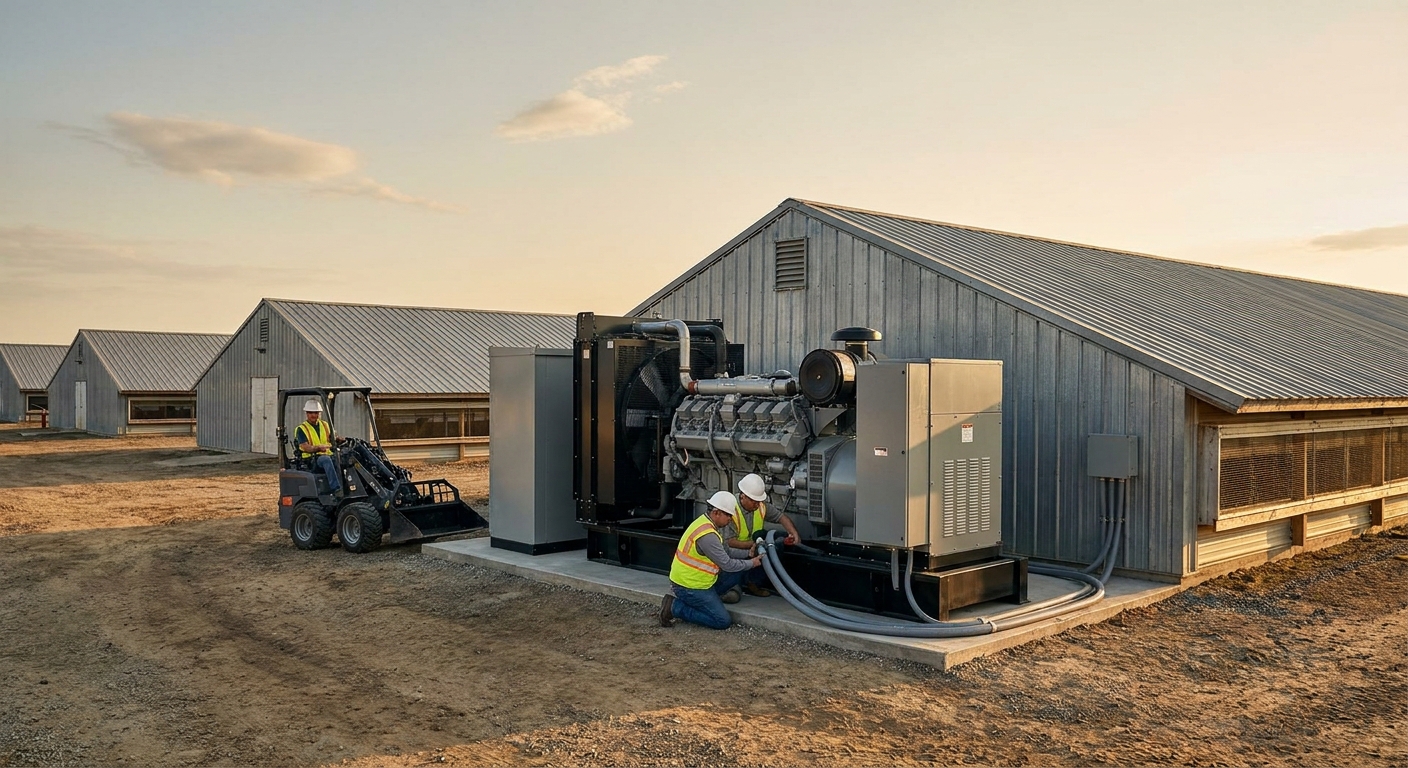
Chicken houses can lose an entire flock in under an hour without power for ventilation fans, and Baldwin County's grid takes a beating every hurricane season from June through November. Standby generator installation for poultry farms in coastal Alabama isn't optional equipment - it's the line between a normal Tuesday and a total loss.
- Poultry houses need 48kW-150kW standby generators sized to ventilation, feed, and well pump loads combined.
- Automatic transfer switches must engage in under 10 seconds - birds stress and die fast once airflow stops.
- Kohler and Generac industrial units with 72-hour propane reserves are the safe pick for multi-house operations in 2026.
- Skip residential-grade generators and big-box units without a poultry-rated transfer switch.
Why this matters
A single 40-foot broiler house holds thousands of birds packed tight, and their body heat alone can push interior temperatures past 100 degrees within 15-20 minutes once fans stop. Add a July afternoon in Foley or Robertsdale and the math gets worse fast. Growers under contract with integrators face financial penalties for flock losses on top of the loss itself, so power reliability isn't a comfort issue - it's a contract issue.
Baldwin County sits in a hurricane corridor, and outages here aren't rare 15-minute blips. Utility crews in Baldwin County have taken anywhere from hours to several days to restore power after major storms in recent years, and a poultry operation can't wait that long. Generator installation for poultry farms has to account for extended runtime, not just a quick bridge until the lights come back on.
Who this is for
This guide is for growers and integrator-contracted operators running one or more chicken houses - broiler, breeder, or pullet - across Baldwin County communities like Daphne, Fairhope, Foley, Robertsdale, and Gulf Shores. If you're managing ventilation-dependent livestock and your current backup plan is a portable generator and an extension cord, you're one bad storm away from a total flock loss.
What to look for in generator installation for poultry farms
Total house load, not just fan count
A single chicken house running tunnel ventilation fans, feed augers, water line pumps, lighting, and a well pump can pull well past what a homeowner-grade unit handles. Sizing has to account for every motor's starting load, not just running wattage, because fan and pump motors draw a surge on startup that can trip an undersized unit. Most single-house operations land in the 48kW to 80kW range; multi-house farms often need 100kW to 150kW or paralleled units.
Transfer switch speed
Birds don't tolerate a slow handoff. An automatic transfer switch needs to sense outage and switch to generator power in 10 seconds or less - anything slower and fans sit idle long enough for heat stress to set in during summer months. This is the single most overlooked spec on cut-rate installs.
Fuel type and reserve capacity
Propane is the standard choice for poultry standby power because it stores on-site and doesn't depend on a natural gas line surviving storm damage. A tank sized for 72 hours of continuous run time covers most restoration windows after a major hurricane hits coastal Alabama. Diesel works too, but tank maintenance and fuel gelling in humid storage conditions need more attention.
Multi-house configuration
Operations running two or more houses need to decide between one large paralleled system or separate units per house. Paralleling lets you run partial capacity if one generator needs service, which matters more than it sounds like during a stretch where a technician can't reach every farm in a single day after a storm.
Enclosure and corrosion resistance
Coastal Alabama's salt air and humidity chew through standard steel enclosures faster than inland installs. Look for aluminum or coated steel housing rated for high-humidity, high-salinity environments - this isn't optional on any install within 20 miles of the Gulf.
Service response time
A generator that won't start during a storm is worse than no generator, because you've budgeted around it. Confirm the installer offers maintenance contracts and priority service response during hurricane season, not just a warranty card.
Baldwin County Generators handles sizing, propane tank coordination, and transfer switch installation for poultry operations across the coastal counties, and stays local for service calls rather than dispatching from out of state.
Top picks for poultry house standby power
Kohler industrial standby units - the safe pick. Kohler's commercial-grade generators are built for continuous-duty applications like poultry houses, with transfer switch response typically under 10 seconds. A 100kW Kohler unit covers a two-house operation with headroom for a well pump and lighting circuits. Buy if you're running a multi-house farm and want a single trusted platform for both units.
Generac industrial series - the value pick. Generac's commercial line covers the 48kW to 150kW range poultry houses need, with propane and diesel configurations available. Parts and service techs for Generac are widely available across Alabama, which shortens repair windows. Buy for single-house or two-house operations on a tighter installation budget.
Honeywell standby generators - the mid-tier option. Honeywell's residential-to-light-commercial units fit smaller pullet houses or backup for non-ventilation circuits like office and feed storage. They're not built for the continuous-duty demands of full house ventilation loads at scale. Consider only as a secondary unit alongside a properly sized industrial generator, not as your primary house power.
Briggs & Stratton commercial units - the budget wildcard. Briggs & Stratton makes solid mid-range commercial gensets, but their largest standard commercial offerings top out lower than what a full-scale broiler house needs. Consider for a single small house under 48kW load; skip for anything larger without confirming exact kW output against your actual load calculation.
Portable towable generators - the temporary fix. These show up at farm supply stores and cost a fraction of a permanent install. They require manual hookup, can't run unattended overnight, and have no automatic transfer switch. Skip as a primary solution - fine as a spare for non-critical circuits only.
If the transfer switch takes longer than 10 seconds to engage, the fans have already stopped long enough to matter.
Get a Poultry Farm Power Quote
Sizing, propane coordination, and installation across coastal Alabama.
What to avoid
- Undersized units bought on price alone. A generator sized for a house's running load without accounting for motor startup surge will trip breakers the first time fans and augers kick on together.
- Standard residential transfer switches. These are built for home circuits, not the load-shedding logic a multi-motor poultry house needs during partial outages.
- Natural gas-only setups with no propane backup. Gas lines can lose pressure or take damage in a major storm; a propane reserve keeps you running when the utility gas system doesn't.
Verdict comparison
| Brand | Typical kW range | Transfer switch speed | Best for | Verdict |
|---|---|---|---|---|
| Kohler | 80kW-150kW | Under 10 sec | Multi-house farms | Buy |
| Generac | 48kW-150kW | Under 10 sec | Single or two-house | Buy |
| Honeywell | 20kW-48kW | 10-15 sec | Secondary circuits | Consider |
| Briggs & Stratton | 20kW-48kW | 10-15 sec | Small single house | Consider |
| Portable towable | Under 20kW | Manual only | Non-critical backup | Skip |
FAQ
What size generator does a chicken house need?
Most single broiler houses need a 48kW to 80kW standby generator to cover ventilation fans, feed augers, water pumps, and lighting together. Multi-house operations often require 100kW to 150kW or paralleled units, and exact sizing depends on a full load calculation of every motor's starting draw.
How fast does the transfer switch need to work for poultry houses?
An automatic transfer switch should engage within 10 seconds of an outage. Birds pack tight enough to generate their own heat, so any longer delay lets interior temperatures climb before fans restart.
Is propane or diesel better for poultry farm generators?
Propane is the more common choice for poultry standby power because it stores on-site without depending on a gas utility line surviving storm damage. Diesel works too, but needs more attention to fuel storage in humid coastal conditions.
How much does generator installation for poultry farms cost?
Cost depends on kW size, fuel setup, and number of houses covered, and varies by site. A quote from a licensed installer that includes load calculation, propane tank sizing, and transfer switch work gives the real number for your operation.
Can one generator run multiple chicken houses?
Yes, paralleled generator systems can cover two or more houses from a shared installation. This setup also lets partial capacity keep running if one unit needs service, which matters during storm season when repair techs are stretched thin.
Do I need a maintenance contract for a poultry farm generator?
A maintenance contract matters more for poultry operations than for a home backup unit, because a generator that fails to start during a hurricane can cost an entire flock. Priority service response during hurricane season is worth confirming before you sign an install contract.
What happens if a chicken house loses ventilation power?
Interior temperatures can climb into dangerous territory within 15-20 minutes once fans stop, especially in summer heat. That's why poultry standby generators require faster transfer switch response than typical residential backup systems.
Are portable generators enough for a chicken house?
No, portable generators lack automatic transfer switches and require manual hookup, which is too slow for continuous ventilation loads. They work as a spare for non-critical circuits but shouldn't be the primary power source for an active poultry house.
One last thing
Most growers size a generator for the house they have today and forget the next expansion. If a second house is even a possibility in 2026 or 2027, size the propane tank and transfer switch capacity for it now - retrofitting a paralleled system later costs more than building headroom into the first install.
Baldwin County Generators works directly with growers across Daphne, Fairhope, Foley, and Gulf Shores on load calculations, propane coordination, and transfer switch installation built for continuous-duty poultry operations, not residential backup jobs stretched past their rating.