Laundromats run their heaviest loads exactly when storms knock the grid out - think Gulf Shores in late August, forty coin-op washers spinning, water heaters recovering, and the marquee sign dark because the power company hasn't restored a line in six hours. This guide breaks down what standby generator installation for laundromats actually requires in coastal Alabama, what size unit covers a real machine count, and which brands hold up under commercial duty cycles.
- Most 24-30 machine laundromats need 48-80 kW of standby power, not a residential 22 kW unit.
- Generac Industrial and Kohler commercial lines both handle three-phase laundromat loads; Buy either for daily-run duty.
- Skip air-cooled residential generators under 48 kW for coin-op laundries running 20+ machines simultaneously.
- Automatic transfer switches sized for motor inrush prevent breaker trips when 10 dryers restart at once.
- A licensed electrical contractor should size the load before quoting generator installation for laundromats.
Why this matters
A laundromat without power for even four hours during hurricane season loses more than a day of quarter drops - it loses the customers who find another location open and don't come back. Coastal Alabama utilities report extended outages after every major named storm since 2020, and laundromats in Foley, Daphne, and Fairhope sit on the same feeder lines as everyone else waiting for a bucket truck.
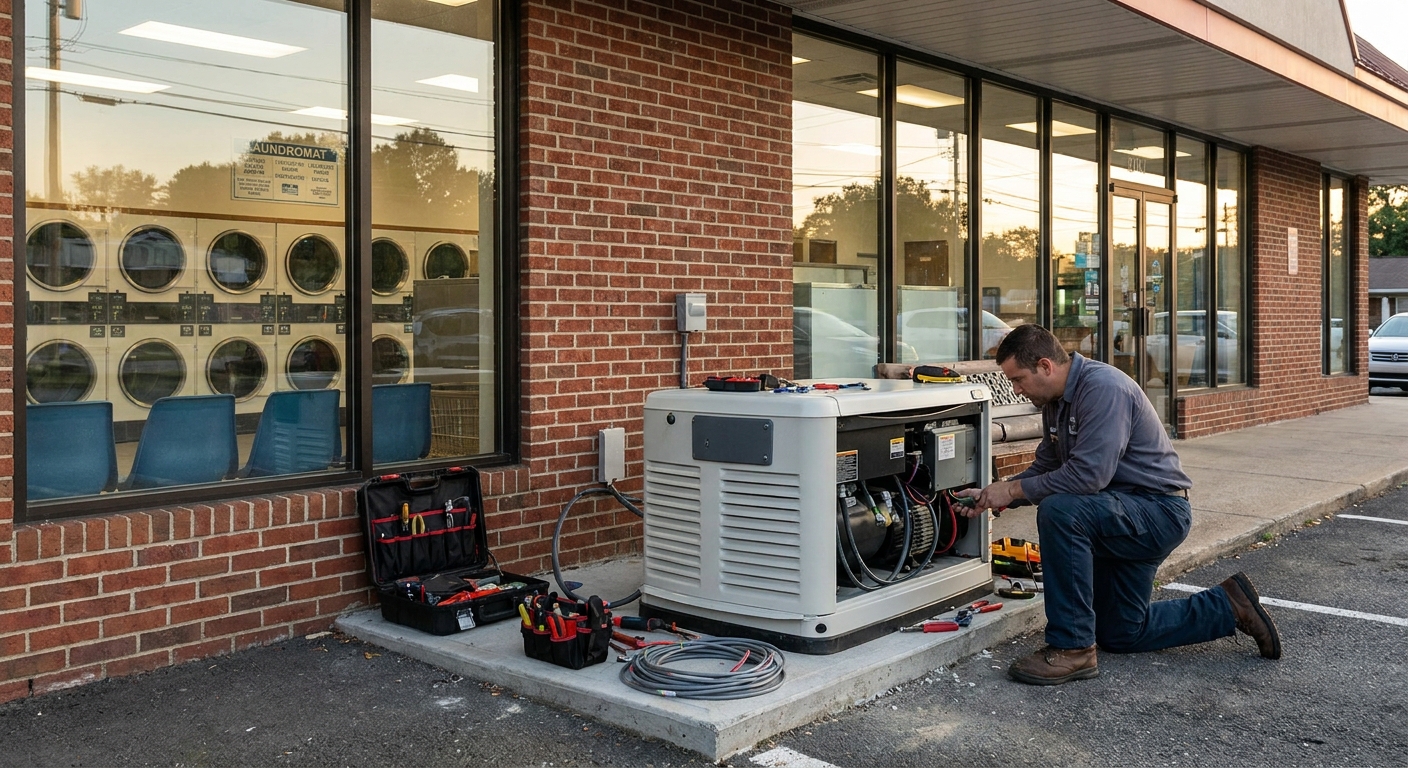
Unlike a house, a laundromat runs commercial-grade motor loads: top-load and front-load washer motors, gas or electric dryer blowers, and often a commercial water heater recovering 40+ gallons continuously. Sizing a generator here isn't a rule-of-thumb square-footage calculation - it's a load study on the panel. Baldwin County Generators runs that load study before quoting standby generator installation for any commercial account, because an undersized unit trips under startup surge the first time half the machines cycle at once.
Who this is for
This guide is for laundromat owners and operators across Daphne, Fairhope, Foley, and Gulf Shores running 15 or more washer/dryer pairs, especially self-service or hybrid drop-off locations that stay open unattended. If your location depends on continuous card-payment systems, a commercial water heater, and HVAC to keep the space usable in July, an outage isn't a minor inconvenience - it's a full day of lost revenue and a refund line at reopening.
What to look for in a generator for laundromat power
Load capacity matched to machine count
A generator sized for a house won't carry a laundromat's simultaneous motor start load. Count your washers, dryers, water heater draw, and lighting circuits, then size for worst-case simultaneous startup - not average running load. Most 20-30 machine locations land in the 48-80 kW range, and larger 40+ machine laundromats often need 100-150 kW commercial units.
Three-phase compatibility
Many commercial laundry buildings run three-phase service to handle larger dryer motors and water heater elements efficiently. Not every standby generator supports three-phase output, and mismatching single-phase generator power to a three-phase panel means an expensive re-quote after installation day. Confirm your building's service type with your electrical contractor before anyone talks kW.
Automatic transfer switch rated for motor inrush
The transfer switch is what actually saves the business, not just the generator. An ATS undersized for motor inrush current can trip nuisance breakers the moment several dryers restart together after a switchover. Commercial installs need an ATS rated above the combined locked-rotor amperage of your largest simultaneous motor group, confirmed on paper, not estimated.
Fuel type and run-time during extended outages
Natural gas units run indefinitely if the gas utility stays up, which coastal Alabama gas lines generally do even when electric grids go down. Propane units need a tank sized for the outage length you're planning for - a 3-5 day tank is standard for hurricane season prep in 2026. Diesel commercial units offer the highest continuous-duty rating but need scheduled refueling for outages past a week.
Noise and placement near customer-facing space
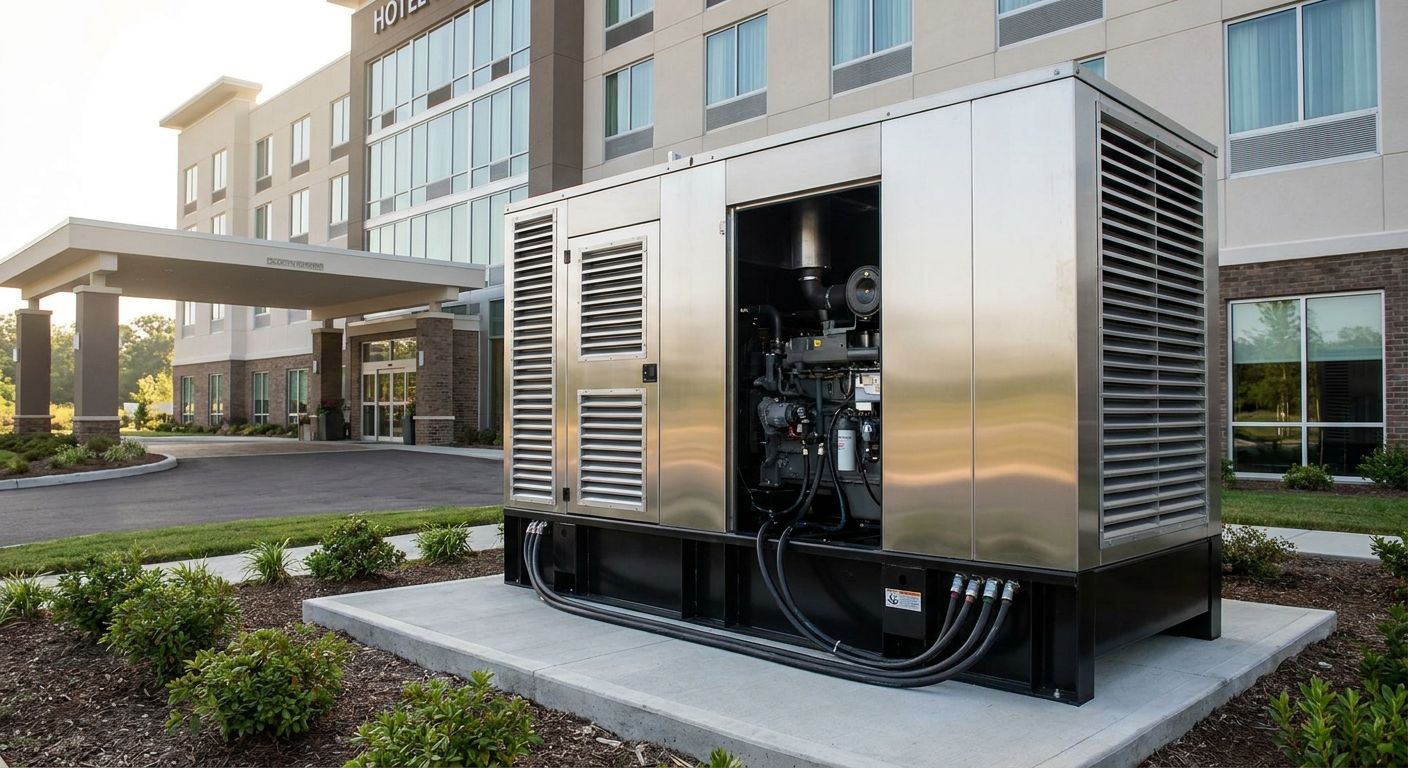
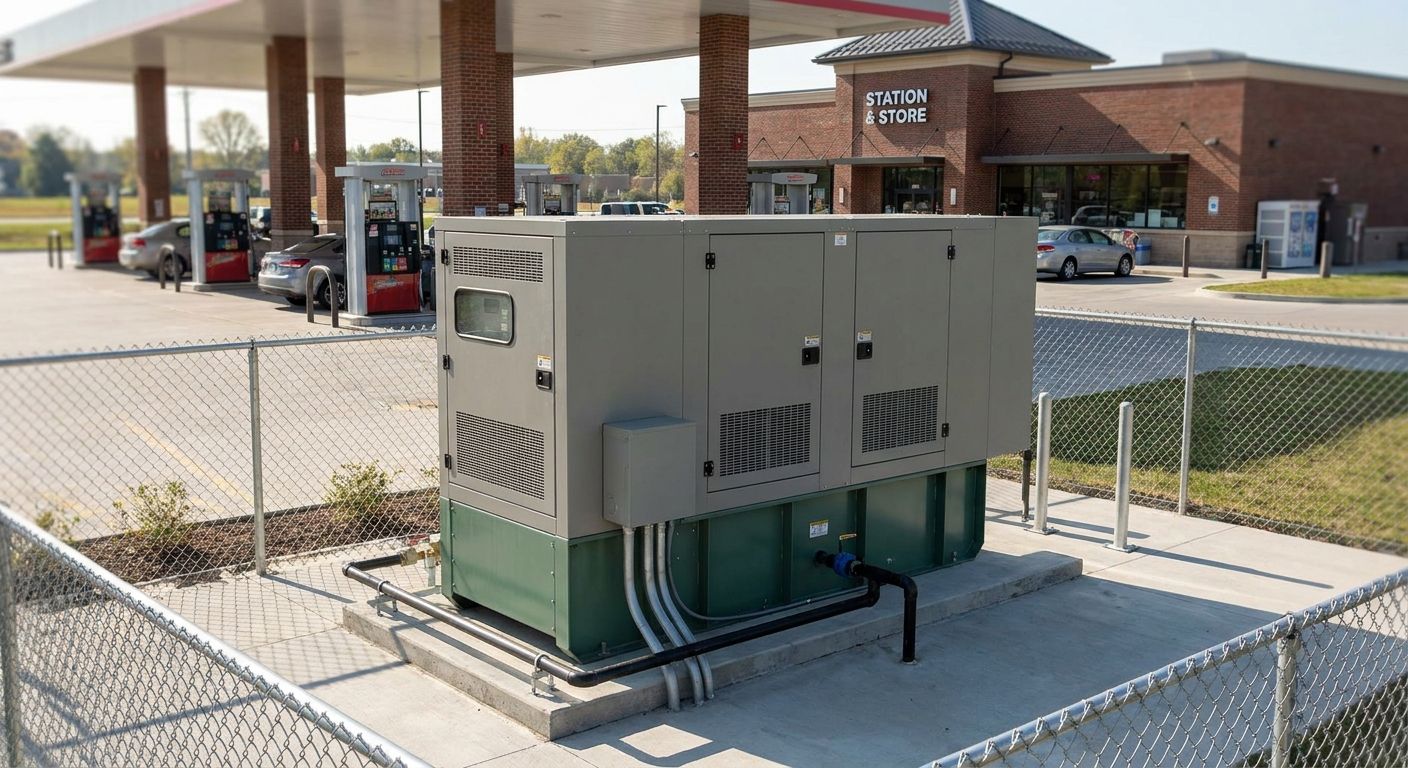
A laundromat generator often sits close to a parking lot or a shared strip-mall wall, and commercial units in the 48-150 kW range run louder than the whisper-quiet residential 22 kW models homeowners expect. Sound-attenuated enclosures cut decibel output substantially, and placement studies matter more here than they do on a residential lot - a licensed installer checks setback codes for Daphne and Fairhope before pouring a pad.
Maintenance contract built for daily-run reliability
A laundromat generator isn't a once-a-year hurricane backup sitting idle - in a bad storm season it might run 30-40 hours straight, then sit for months. Commercial maintenance plans that include quarterly load-bank testing catch a weak battery or a clogged fuel filter before the unit fails during an actual outage, not after.
Get your laundromat load sized right
A licensed contractor sizes the panel before you buy a kW number.
Top picks for laundromat standby power
Generac Industrial series - the safe pick. Generac's commercial line covers 48 kW to over 150 kW with load management software that sheds non-critical circuits automatically during startup surge. A 48 kW unit handles roughly 20-24 machines plus lighting and a standard water heater. Buy for mid-size self-service laundromats running natural gas.
Kohler commercial standby - the reliability pick. Kohler's industrial units are built around continuous-duty engines rated for daily-run cycles rather than occasional standby use, which matters for a business that might actually run the generator 40+ hours in a single storm week. A 100 kW Kohler unit covers larger 40-machine laundry buildings with three-phase service. Buy for high-volume locations that can't risk engine fatigue.
Honeywell commercial line - the mid-tier option. Honeywell generators (built on Generac platforms) offer similar kW ranges at a comparable install cost but with a narrower dealer network for parts in coastal Alabama. Consider if your installer stocks Honeywell parts locally; otherwise the wait on a warranty part during hurricane season is a real risk.
Briggs & Stratton commercial standby - the budget-conscious pick. Briggs & Stratton's commercial units run smaller kW ranges, typically capping out lower than Generac or Kohler's top commercial tiers. This works for smaller 10-15 machine laundromats but starts to strain past 20 machines with a water heater on the same panel. Consider for small self-service locations only; Skip for anything approaching 30+ machines.
Residential air-cooled 22 kW units - the wildcard that isn't. These are built for a house, not a laundry floor. A 22 kW residential unit can't carry the simultaneous motor start of even eight commercial washers plus a water heater. Skip entirely for laundromat use regardless of price.
What to avoid
- Undersized residential generators marketed as "whole building" backup. A 22 kW unit sounds like enough kW for a small commercial space on paper, but motor inrush from multiple simultaneous washer starts overwhelms it in seconds, not minutes.
- Generic transfer switches not rated for the panel's amperage. A transfer switch sized for a house panel trips under commercial motor load even when the generator itself is correctly sized.
- Skipping the load study to save on the quote. A contractor who quotes a kW number without counting machines, water heater draw, and lighting circuits is guessing, and a wrong guess costs a re-installation after the first failed startup during an actual outage.
Verdict comparison table
| Brand | kW range | Best for machine count | Three-phase | 2026 verdict |
|---|---|---|---|---|
| Generac Industrial | 48-150+ kW | 20-40+ machines | Yes | Buy |
| Kohler commercial | 48-150+ kW | 20-40+ machines | Yes | Buy |
| Honeywell commercial | 48-130 kW | 20-35 machines | Yes | Consider |
| Briggs & Stratton commercial | 20-60 kW | 10-20 machines | Limited | Consider small only |
| Residential 22 kW air-cooled | 22 kW | Under 8 machines | No | Skip for laundromats |
FAQ
What size generator does a laundromat need?
Most 20-30 machine laundromats need 48-80 kW of standby power, and locations with 40 or more machines often need 100-150 kW commercial units. The exact number depends on simultaneous motor startup load, not just machine count, so a load study on the panel is required before buying.
How much does generator installation for laundromats cost?
Commercial standby installation for a laundromat typically runs well above residential pricing because of the larger kW unit, three-phase transfer switch, and concrete pad requirements. Costs vary by machine count and whether the site already has adequate gas or propane service, so a site-specific quote from a licensed electrician is the only reliable number.
Can a residential generator power a laundromat?
No, a standard 22 kW residential air-cooled generator cannot carry the simultaneous motor startup load of a working laundromat with 15 or more machines. Commercial units in the 48 kW-plus range are built specifically for continuous-duty motor loads and three-phase service.
Does a laundromat generator need a three-phase transfer switch?
If the building's electrical service is three-phase, which is common in larger commercial laundry buildings, the generator and transfer switch both need to match that service type. Installing a single-phase system on a three-phase panel means a costly correction after the fact.
How long can a standby generator run a laundromat during an outage?
A natural gas unit can run indefinitely as long as the gas utility stays online, which coastal Alabama gas service generally does through most electric outages. Propane units need a tank sized for the expected outage length, with 3-5 days being standard hurricane season planning for 2026.
Is Generac or Kohler better for laundromat backup power?
Both Generac Industrial and Kohler commercial lines cover the 48-150 kW range laundromats typically need, with Kohler's engines built more specifically for continuous-duty daily-run cycles. The better choice depends on local dealer support and parts availability in your area more than a spec-sheet difference.
Do laundromats need a maintenance contract for their generator?
Yes, a commercial maintenance plan with quarterly load-bank testing catches battery and fuel filter issues before an actual outage exposes them. A generator that sits idle for months between hurricane seasons needs that testing more than a residential unit running occasional short cycles.
What happens if a laundromat generator is undersized?
An undersized generator trips or shuts down when several washer or dryer motors restart simultaneously after a power transfer, which is the exact moment the business needs it working. This is why a load study, not a square-footage guess, has to happen before the unit is purchased.
One last thing
The machine that actually breaks an undersized generator isn't the washer - it's the water heater recovery cycle hitting at the same second eight dryers kick back on after a transfer switch flips, and that overlap is the single most common reason a "good enough" generator fails on its first real test during hurricane season instead of during a scheduled maintenance run.