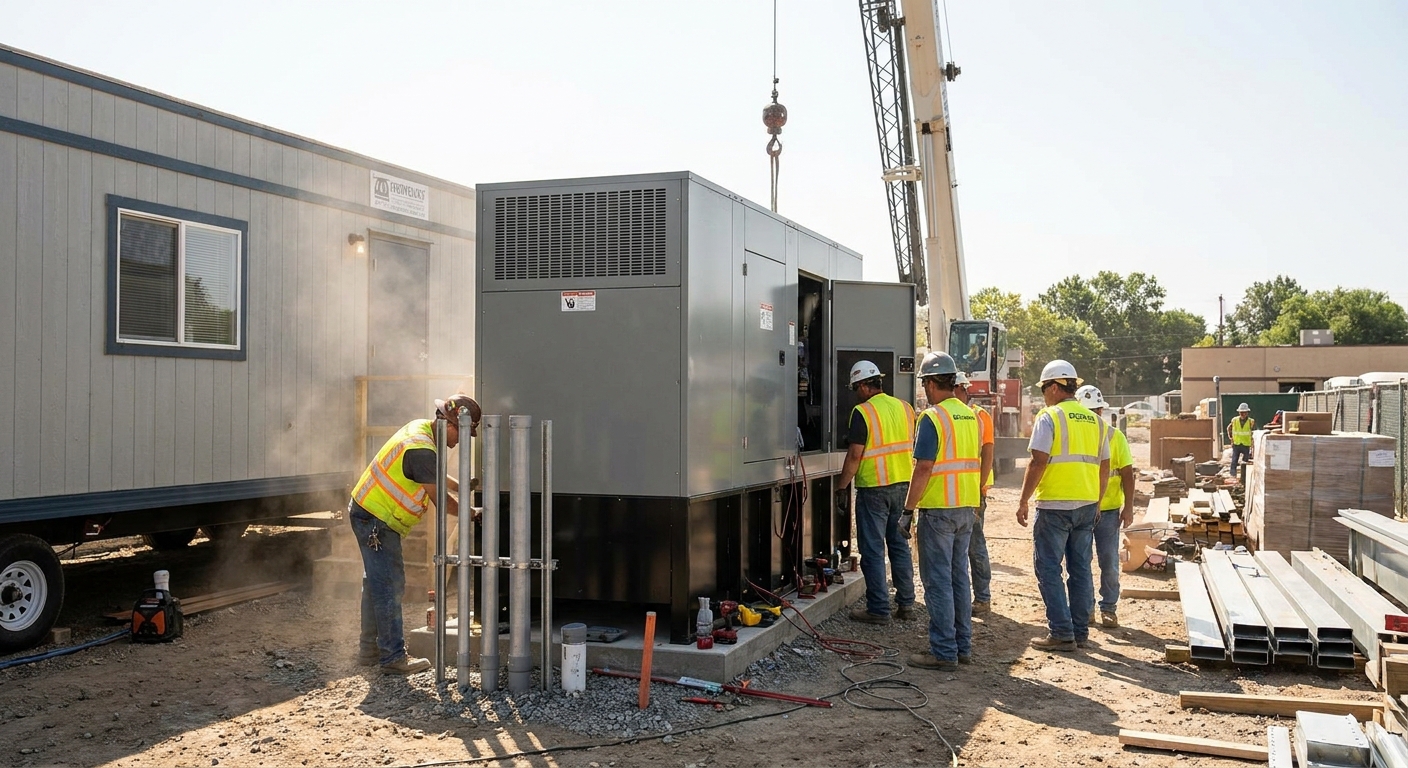
Job trailers on Baldwin County construction sites lose power the moment a storm rolls off the Gulf, and that means stalled schedules, spoiled materials, and OSHA-flagged working conditions until a generator installation for construction site trailers gets specified and wired in correctly.
- Size standby units at 20-48kW for double-wide job trailers running HVAC, lighting, and power tools simultaneously.
- Diesel trailer-mount generators win for jobsites running past 72 hours without utility power in 2026.
- Portable towable units under 15kW are a Skip for anything beyond a single-wide office trailer.
- Automatic transfer switches rated for temporary service keep crews compliant with NEC Article 590.
- Baldwin County Generators handles licensed installation across Daphne, Fairhope, Foley, and Gulf Shores job sites.
Why this matters
Hurricane season runs June 1 through November 30, and coastal Alabama job sites sit in the path every year. A construction trailer without backup power means no climate control for blueprints and electronics, no charging station for tools, and no lighting for early-morning or after-dark shifts when contractors push to make up storm delays. Inspectors also expect temporary electrical service on active sites to meet code, and a generator that's undersized or improperly transferred can trip a stop-work order faster than a missed permit.
The difference between a generator that keeps a jobsite running through 2026's storm season and one that fails on day two usually comes down to sizing, fuel logistics, and whether the transfer switch was installed by a licensed electrician instead of bolted on by a subcontractor in a hurry.
Who this is for
This guide is built for general contractors, site superintendents, and project managers responsible for keeping a construction site trailer powered in Daphne, Fairhope, Foley, Gulf Shores, and the surrounding coastal Alabama building corridor. If you're managing a single-wide sales office trailer or a multi-unit jobsite command post running HVAC, security systems, and power tool charging stations, the sizing and fuel decisions below apply directly to your setup.
What to look for in generator installation for construction site trailers
Fuel type and site logistics
Diesel trailer-mount units run longer between refuels and match the fuel already on-site for heavy equipment, which matters on jobs where refueling trips eat into labor hours. Propane and natural gas units burn cleaner but need a supply line or tank swap schedule that most active construction sites can't manage reliably.
Correct kW sizing for the trailer load
A single-wide office trailer with lighting, a window unit, and a coffee maker runs comfortably on 10-14kW. A double-wide command trailer running central HVAC, multiple workstations, and power tool charging needs 20-48kW, and undersizing here causes breaker trips exactly when the site needs power most.
Transfer switch compliance
Temporary electrical installations on active construction sites fall under NEC Article 590, and an automatic transfer switch rated for that use keeps the site inspection-ready. A generator wired without a proper transfer switch is the single most common code violation site inspectors flag in 2026.
Mobility and theft deterrence
Jobsite generators get stolen. A trailer-mounted unit with a locking hitch and tamper-resistant fuel cap costs less in the long run than replacing a stolen portable unit mid-project, and it also means one less delay in your 2026 project timeline.
Weatherproofing for coastal humidity and salt air
Generators installed within a few miles of the Gulf face accelerated corrosion on unprotected components. Units with marine-grade coatings or enclosed weatherproof housings hold up through a full Baldwin County storm season instead of needing replacement parts by year two.
Noise and permit restrictions
Some municipalities in Baldwin County cap generator decibel levels near residential zones, especially for overnight security lighting runs. Check local ordinance before locking in a unit - a generator that's technically powerful enough but too loud for the zoning can force a swap mid-project.
Getting the sizing and transfer switch installation handled by a licensed contractor up front avoids the rework that comes from a generator picked on gut instinct alone.
Top picks for construction site trailers
The workhorse: diesel trailer-mount, 20-30kW
Diesel trailer-mount generators in the 20-30kW range run the longest between refuels and pair naturally with the diesel already on-site for excavators and loaders. Verdict: Buy for any active jobsite trailer expected to run past a single storm outage.
The command post: 48kW standby unit
For multi-trailer command setups running HVAC across several units plus security systems, a 48kW standby generator handles the combined load without cycling. Runtime on a full diesel tank typically covers 48-72 hours before refuel, which matters when a hurricane closes roads for days. Verdict: Buy for large multi-trailer job sites.
The budget trap: single-wide portable under 15kW
A 15kW portable unit looks like a reasonable middle-ground price point, but it stalls the moment a site runs HVAC and power tools at the same time. Verdict: Consider only for a single-wide office trailer with no more than one climate control unit running.
The wildcard: propane trailer generator
Propane units start cleaner in cold snaps and produce fewer emissions on sites near residential zoning, but they require a dedicated tank swap schedule that most active construction crews forget to manage. Verdict: Consider only if the site already has propane delivery set up for other equipment.
The one to skip: uninstalled portable generator with extension cords
Running extension cords from a portable unit into a job trailer instead of a proper transfer switch installation is the fastest way to fail an electrical inspection in 2026. It also voids most equipment warranties and creates a fire hazard on an active jobsite. Verdict: Skip.
What to avoid
- Sizing by guesswork instead of load calculation. A generator that should be enough on paper often trips under real jobsite load once HVAC, tools, and lighting run together.
- Skipping the transfer switch to save on install cost. Inspectors flag this immediately, and the rework costs more than doing it right the first time.
- Ignoring salt air corrosion on units installed near the coast. A generator without weatherproof housing near Gulf Shores or Fairhope degrades faster than the same unit inland.
Get your jobsite generator sized right
Licensed installation across Daphne, Fairhope, Foley, and Gulf Shores.
Verdict comparison
| Option | Best For | kW Range | Verdict |
|---|---|---|---|
| Diesel trailer-mount | Active jobsite, long outages | 20-30kW | Buy |
| 48kW standby unit | Multi-trailer command post | 40-48kW | Buy |
| Portable under 15kW | Single-wide office trailer only | 10-14kW | Consider |
| Propane trailer unit | Sites with existing propane supply | 15-25kW | Consider |
| Uninstalled portable + extension cords | Nothing on an active jobsite | Any | Skip |
FAQ
What size generator does a construction site trailer need?
A single-wide office trailer needs 10-14kW, while a double-wide command trailer running HVAC and tool charging needs 20-48kW. Sizing depends on how many loads run simultaneously during a power outage.
Is a portable generator enough for a construction trailer?
A portable unit under 15kW works for a single-wide trailer with minimal HVAC, but it stalls on larger command trailers running multiple systems. Running one through extension cords instead of a proper transfer switch also fails most jobsite electrical inspections.
Do construction site generators need a transfer switch?
Yes, an automatic transfer switch rated for temporary service keeps the installation compliant with NEC Article 590. Sites without one are the most common electrical code violation flagged on active construction inspections in 2026.
How long can a diesel trailer generator run without refueling?
A 20-30kW diesel trailer-mount unit typically runs 48-72 hours on a full tank depending on load. Larger 48kW units draw fuel faster but cover the same runtime window under heavier combined loads.
Are propane generators good for construction jobsites?
Propane generators start cleaner in cold weather and produce fewer emissions near residential zoning, but they need a scheduled tank swap that many active jobsites struggle to maintain. They work best on sites that already have propane delivery set up for other equipment.
Does salt air affect generators installed near the Gulf Coast?
Yes, generators installed within a few miles of the coast corrode faster without marine-grade coatings or enclosed weatherproof housing. A unit without that protection often needs part replacement within two storm seasons.
When should a jobsite generator be installed before hurricane season?
Installation should be scheduled before June 1, when Gulf Coast hurricane season begins, to avoid delays from contractor backlog. Sites that wait until a storm warning often can't get licensed installation completed in time.
One last thing
Most jobsite generator failures in Baldwin County aren't about the equipment - they're about the transfer switch being skipped to save a day of install time. That shortcut is exactly what fails inspection and stalls a project when the next named storm hits in 2026.
A properly sized diesel trailer-mount unit with a code-compliant transfer switch, installed by a licensed contractor before storm season starts, is the difference between a jobsite that keeps working through an outage and one that shuts down waiting on utility crews.