Coastal Alabama doesn't get brutal winters, but a standby generator left unchecked from November through February will fail the one week you actually need it - usually during a February cold snap or the first spring storm of 2026. This guide walks through the exact steps to winterize a home generator so it starts on the first crank when the power drops.
TL;DR
Winterizing a home generator in 2026 means stabilizing the fuel, checking the battery and block heater, protecting the enclosure from moisture, and running a load test before cold weather sets in - skip any one of these and you risk a no-start during an outage. A Kohler or Generac standby unit maintained on this schedule should start within 10 seconds of a utility failure. Verdict: do it yourself in under two hours, or book a fall maintenance visit through Baldwin County Generators before December. The primary_keyword here - how to winterize a home generator - comes down to five checks: fuel, battery, filters, exhaust, and a test run.
Why this matters
Generators don't fail in the summer when you're running them for a hurricane. They fail in January and February, sitting idle, when moisture, stale fuel, and a weak battery all creep in at once. Baldwin County's humidity swings hard between a warm December and a 28-degree overnight in January, and that swing is exactly what corrodes battery terminals and condenses water inside a fuel tank.
A standby generator that hasn't been exercised in 60 days has a measurably higher chance of a no-start event. Manufacturers like Kohler and Generac build in automatic weekly exercise cycles for this reason - but only if the unit is wired correctly and the battery holds a charge. Winterizing isn't optional maintenance. It's the difference between power in 10 seconds and a cold, dark house during the next outage.
What you'll need
- Fresh engine oil rated for your generator's model (check the owner's manual for viscosity)
- A new oil filter and air filter if it's been more than 100 hours since the last change
- Fuel stabilizer, if your unit runs on gasoline or diesel rather than natural gas or propane
- A digital multimeter to check battery voltage
- A soft brush or shop vac for the intake and exhaust vents
- Silicone spray or dielectric grease for battery terminals
- 30 minutes for the maintenance steps, plus a 20-minute load test
If your unit is a whole-home standby model from a licensed installer like Baldwin County Generators, most of this was covered at install - but annual upkeep still falls on the homeowner unless you're on a service plan.
The steps
1. Change the oil and filter
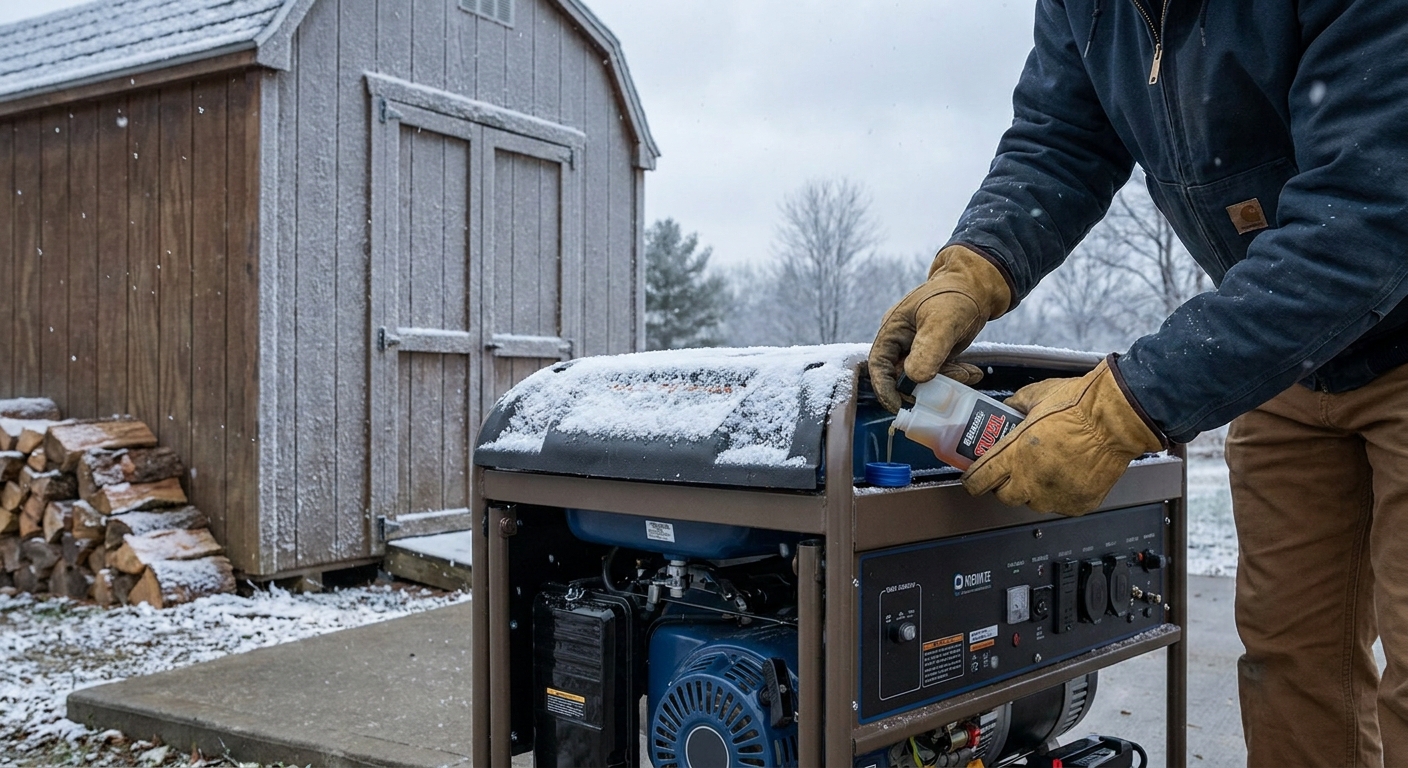
Old oil breaks down over a season of idle sitting and standby exercise cycles, leaving carbon deposits that make cold starts harder. Drain the oil while the engine is still warm from its last exercise cycle, replace the filter, and refill to the level marked on the dipstick - overfilling is as bad as underfilling. Expect this to take 15 minutes on most air-cooled standby units. Common mistake: using summer-weight oil in a generator that will sit through a 30-degree night - check the manual for a cold-weather viscosity rating.
2. Stabilize or purge the fuel
If your generator runs on propane or natural gas, skip this step entirely - fuel doesn't degrade. If it's gasoline or diesel, add a fuel stabilizer rated for 12 months of storage and run the engine for 10 minutes so the treated fuel circulates through the carburetor or injectors. Untreated gasoline starts breaking down in as little as 30 days and can gum up a carburetor by spring. Common mistake: adding stabilizer to a full tank without running the engine afterward - the additive never reaches the fuel line.
3. Test the battery
A weak battery is the single most common reason a standby generator fails to start during an outage. Use a multimeter to check voltage - a healthy 12-volt battery should read at or above 12.4 volts at rest. If it's below 12.2 volts, charge it fully before winter; if it won't hold a charge after charging, replace it now rather than in February. Clean the terminals with a wire brush and coat them with dielectric grease to block corrosion from humidity swings.
4. Clear the intake, exhaust, and enclosure
Leaves, pine straw, and mulch collect around outdoor enclosures fast in coastal Alabama yards, and blocked vents cause overheating or shutdown codes the moment the unit tries to run. Clear a two-foot radius around the enclosure and use a soft brush or shop vac on the intake and exhaust louvers. Check that the enclosure's weep holes - the small drainage ports at the base - aren't clogged with debris, since trapped water is what causes rust and electrical shorts over a damp winter.
5. Inspect the block heater and cold-weather kit
If your unit has a factory-installed cold-weather kit (common on Kohler and Generac models rated for regions with occasional freezes), confirm the block heater is drawing power and the thermostat is functioning. This keeps the engine oil warm enough for a fast cold start on the rare 25-degree Baldwin County morning. Common mistake: assuming the kit works because it's installed - test it with a temperature gauge or infrared thermometer against the block.
6. Run a full load test
Exercise cycles built into the automatic transfer switch run the engine for a few minutes weekly, but that's not the same as a load test. Manually transfer the home's electrical load to the generator for 20 to 30 minutes and watch for voltage drops, stalling, or unusual noise under real load. This is the single best predictor of how the unit will perform during an actual outage, and it's worth doing once before December each year.
7. Check the transfer switch and wiring
Inspect the automatic transfer switch enclosure for moisture intrusion, corroded contacts, or loose connections - a transfer switch failure means the generator can run perfectly and still never power the house. This step takes five minutes with a flashlight but catches problems that are expensive to diagnose once the power's already out.
Troubleshooting
- Generator won't start on the first try - check battery voltage first; anything under 12 volts is the likely culprit.
- Engine cranks but won't fire - stale or untreated fuel is the most common cause on gasoline and diesel units; drain and replace it.
- Unit shuts down mid-cycle with an error code - this usually points to a blocked exhaust or intake vent; clear debris and reset the controller.
- Battery won't hold a charge overnight - the battery is likely past its 2 to 3 year service life and needs replacement, not just a recharge.
- Transfer switch hums but doesn't engage - corroded contacts or a tripped breaker inside the switch enclosure; this is a job for a licensed electrician, not a DIY fix.
- Weekly exercise cycle stopped running - check the controller's clock and settings; a power blip can reset the schedule without warning.
Tools and resources
- Owner's manual for your specific model (Kohler, Generac, Honeywell, or Briggs & Stratton all specify different oil weights and service intervals)
- A basic digital multimeter, available at any hardware store for under $20
- Fuel stabilizer rated for 12-month storage if your unit runs on liquid fuel
- A licensed electrical contractor for transfer switch or wiring issues - this isn't a step to improvise
- Baldwin County Generators for annual maintenance plans that cover the oil change, battery test, and load test in one visit
If your standby generator is due for its annual service or you're not confident running these checks yourself, Baldwin County Generators handles installation, repair, and maintenance across Daphne, Fairhope, Foley, and Gulf Shores.
What to do next
Once winterizing is done, mark your calendar for a spring check before hurricane season ramps up again in 2026 - that's when the generator actually earns its keep. The same battery, fuel, and vent checks apply, just swap the fuel stabilizer step for a fuel-freshness check if the tank sat all winter.
FAQ
Do I need to winterize a natural gas or propane generator? Yes, but the fuel step is unnecessary since gas fuels don't degrade in storage. Focus on the battery, oil, filters, vents, and a load test instead.
How often should I change the oil on a standby generator? Most manufacturers recommend an oil change every 100 hours of run time or once a year, whichever comes first - annual is the right call for most Baldwin County homeowners who rarely hit 100 hours.
What voltage should a healthy generator battery read? A 12-volt battery at rest should read 12.4 volts or higher. Anything below 12.2 volts needs a full charge, and a battery that won't hold that charge needs replacement before winter.
Can I winterize my generator myself, or do I need a professional? Most of the steps - oil change, battery check, vent clearing - are DIY-friendly with basic tools. Transfer switch and wiring issues should go to a licensed electrical contractor.
How much does it cost to winterize a home generator? DIY costs are minimal - oil, a filter, and fuel stabilizer typically run under $50 total. A professional maintenance visit costs more but covers diagnostics a homeowner can't run alone.
Is it bad to let a standby generator sit unused all winter? Yes - an idle generator with no exercise cycle and stale fuel has a significantly higher failure rate come spring. The built-in weekly exercise cycle exists specifically to prevent this.
What's the biggest cause of generator failure in winter? A weak or dead battery, followed closely by stale fuel in gasoline and diesel units. Both are preventable with the steps above.
Should I cover my outdoor generator enclosure in winter? No - covering it can trap moisture and block the intake and exhaust vents the unit needs to run. The factory enclosure is built to handle coastal Alabama weather without an added cover.
One last thing
The part homeowners skip most often isn't the oil or the fuel - it's the load test. A generator can pass every visual check, start on command, and still stall the moment it's asked to carry a real electrical load, which is exactly the scenario it exists for. Running that 20-minute test before December, not after the first cold snap, is what separates a generator that works from one that just looks like it will.