Running a five-minute self-test on your standby generator every month is the single habit that separates homeowners who stay powered through a Gulf Coast blackout from the ones who discover a dead battery mid-storm. This guide walks through the exact monthly test sequence for a Kohler, Generac, Honeywell, or Briggs & Stratton standby unit, plus what to do when something doesn't fire up right.
TL;DR
Testing a standby generator monthly means running it under no-load or transfer-switch exercise for 12-20 minutes, checking oil level, battery voltage, and coolant, and listening for irregular RPM or smoke. Most automatic standby units (Generac, Kohler) already run a self-exercise cycle weekly or biweekly from the factory - your job is to confirm it actually happened and inspect the unit visually once a month. Verdict: if your generator hasn"'t run in the last 30 days, or the exercise cycle throws a code, that"'s a service call, not a wait-and-see. Baldwin County Generators technicians see more no-start failures from skipped monthly checks than from actual equipment defects - a $400 battery replacement in April beats a dark house in September.
Why this matters
Coastal Alabama loses grid power more often than most of the country - Baldwin County has logged multiple named-storm outages every hurricane season since 2020, and 2026 isn"'t shaping up any different. A standby generator that hasn"'t been exercised in 60-90 days has a dramatically higher no-start rate, mostly from stale fuel varnish in carbureted units and sulfated batteries that lose cranking amps sitting idle.
The irony is that most standby generator failures aren"'t catastrophic - they"'re a $150 battery or a clogged air filter that a five-minute check would have caught weeks earlier. Baldwin County Generators technicians in Daphne, Fairhope, Foley, and Gulf Shores run into the same three failure points on nearly every emergency call: dead battery, low oil shutdown, and a transfer switch that never got exercised. All three show up in a monthly test.
What you'll need
- Owner"'s manual for your specific unit (Kohler, Generac, Honeywell, or Briggs & Stratton - test sequences differ slightly)
- Flashlight or phone light for the enclosure interior
- Clean rag for checking oil dipstick and wiping terminals
- 10-15 minutes of uninterrupted time
- A notepad or phone note to log the date, run time, and any codes displayed
- Multimeter (optional, for battery voltage checks past year one)
The steps
1. Confirm the automatic exercise cycle actually ran
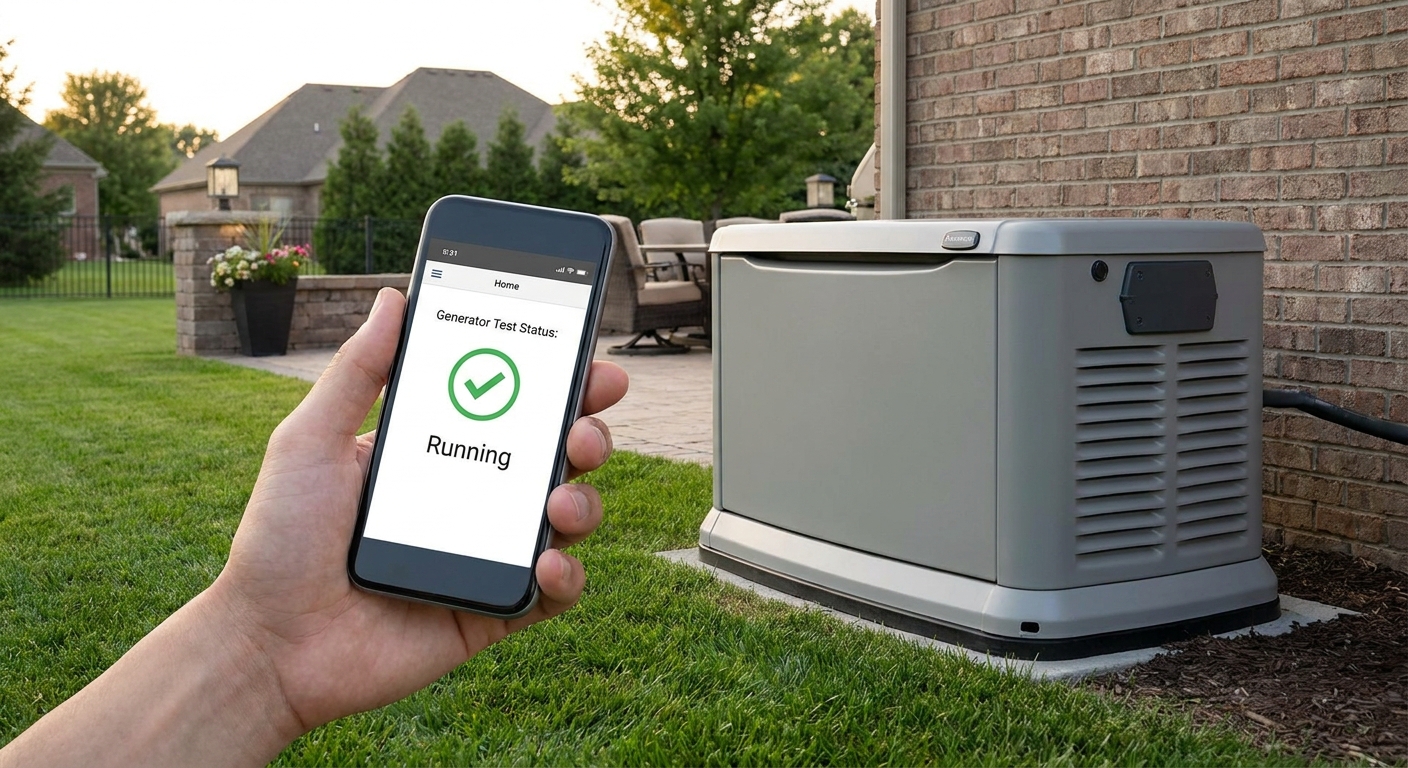
Most 2026-model standby generators are programmed to self-exercise on a set schedule - weekly for Generac Guardian series, biweekly for many Kohler units. Check the controller display or app log for the last run date and duration.
If the log shows no run in the past 30 days, don"'t assume the schedule is just off - that"'s the first sign of a dead battery or a controller fault. Common mistake: homeowners see the generator sitting quiet and assume "it"'s fine, it just hasn"'t needed to run." A standby unit that skips its programmed exercise is telling you something is already wrong.
2. Walk the enclosure and check fluid levels
Open the side panel and pull the oil dipstick. Oil should sit between the fill lines, look amber to light brown, and not smell burnt. Check coolant level on liquid-cooled commercial units - most residential air-cooled Generac and Kohler units skip this step entirely.
Look for oil residue under the unit, a sign of a slow leak that won"'t show up until the generator is under real load during an outage. Common mistake: topping off oil without checking why the level dropped in the first place.
3. Inspect the battery terminals and connections
The battery is the single most common point of failure on a standby unit that"'s otherwise mechanically sound. Look for corrosion - a white or greenish crust on the terminals - and wipe it off with a dry rag before it spreads.
If you have a multimeter, a healthy 12V starting battery should read 12.4V or higher at rest. Anything under 12V means the battery is on its way out, typically within 60-90 days. Battery replacement runs a fraction of a full service call, so catching this in a monthly check saves both money and downtime.
4. Run the manual test cycle
Most controllers have a dedicated "Manual/Test" button or switch. Press it and let the unit run for 12-20 minutes minimum - long enough to reach full operating temperature, not just crank and idle.
Watch the RPM stabilize within the first 30 seconds. A unit that surges, hunts, or takes more than 10 seconds to reach steady speed usually points to a fuel delivery issue - stale gas in a liquid-propane conversion or a dirty carburetor. Expected outcome: smooth, consistent engine note with no visible smoke after the first 20 seconds of startup burn-off.
5. Exercise the transfer switch under a light load
If your setup allows a manual transfer test - check the owner"'s manual, since this varies by installer configuration - flip a couple of circuits over to generator power for a few minutes. This confirms the transfer switch mechanism itself isn"'t stuck, which the no-load exercise cycle alone won"'t catch.
Listen for a clean, single-click transition rather than chattering or multiple attempts. A hesitant transfer switch is a repair item, not a wait-until-next-outage item.
6. Check the exhaust and listen for abnormal sounds
Stand a safe distance from the exhaust outlet and confirm exhaust flow is steady, not sputtering. A weak or intermittent exhaust pulse, paired with any rattling or knocking from the engine block, means stop the test and call for service rather than run it longer.
7. Log the results and reset the counter
Write down the date, run duration, oil condition, and battery reading. This log becomes valuable when you eventually call a technician - a documented history of "ran clean every month since March 2026" versus "hasn"'t run since January" changes how fast a repair gets diagnosed.
Troubleshooting
Generator won"'t crank at all. Almost always a dead or disconnected battery. Check terminal connections first, then test voltage - under 11.5V means replace it.
Cranks but won"'t start. Points to fuel supply on propane/natural gas units - check that the gas valve is fully open - or a fouled spark plug on older Briggs & Stratton models.
Starts, then shuts down after a few seconds. Typically a low-oil-pressure sensor tripping, either from genuinely low oil or a failing sensor. Check the dipstick before assuming the sensor is at fault.
Runs rough or surges. Usually stale fuel in gasoline-fueled units sitting more than 90 days, or a dirty air filter restricting airflow. Clean or replace the filter as a first step.
Transfer switch doesn"'t engage. Often a tripped breaker on the switch itself or a loose control wire connection - this is a job for a licensed electrician, not a DIY fix, since it involves live transfer circuitry.
Exercise cycle shows a fault code. Cross-reference the code against your owner"'s manual immediately. Ignoring a fault code and hoping next month"'s cycle clears it is how a $200 fix turns into a $1,200 one.
Tools and resources
- Owner"'s manual (Kohler, Generac, Honeywell, or Briggs & Stratton specific)
- Basic multimeter for battery voltage checks
- A running maintenance log - paper or phone note, either works
- Manufacturer app if your unit has Wi-Fi connectivity (Generac Mobile Link and similar platforms show exercise history remotely)
- Baldwin County Generators for annual service, battery replacement, or any fault code you can"'t clear yourself
What to do next
A monthly self-test catches the small stuff. It won"'t catch everything - oil breakdown at the molecular level, worn spark plugs, or transfer switch contacts wearing thin all need a full annual service inspection with load-bank testing that goes beyond what a homeowner can do with a flashlight and a rag. If your unit is coming up on its annual service window in 2026, or it failed any step in this test, schedule a technician visit before hurricane season peaks rather than after the first storm watch gets issued.
FAQ
How often should you test a standby generator? Run a full manual test monthly, even if the unit has an automatic exercise cycle, because self-exercise catches engine issues but not visual problems like corrosion, oil residue, or a hesitant transfer switch.
How long should a generator test run last? Run the test for at least 12-20 minutes so the engine reaches full operating temperature - a 30-second crank-and-stop tells you almost nothing about long-term reliability.
What does it mean if my generator won"'t start during testing? In most cases it"'s a dead battery or empty/low fuel supply - both account for the majority of no-start service calls Baldwin County Generators sees on standby units.
Is it safe to test a standby generator myself? Yes, for the basic manual exercise cycle and visual checks - but any work involving the transfer switch wiring or gas line connections should go to a licensed electrician.
How much does a standby generator battery replacement cost? Costs vary by brand and battery type, so get a current quote from a licensed installer rather than relying on a number that could be outdated by 2026 pricing.
Do Generac and Kohler generators test themselves automatically? Most current models run a programmed self-exercise cycle weekly or biweekly, but that only confirms the engine starts - it doesn"'t replace a monthly visual and transfer-switch check.
What's the biggest cause of standby generator failure during an outage? A weak or dead battery is the single most common failure point, followed by stale fuel in units that sit unused for more than 90 days.
Should I test my generator before hurricane season? Yes - run a full manual test and schedule any needed repairs at least 30 days before peak season, since parts availability and technician scheduling both get tighter once storm watches start.
One last thing
The generator that fails during an actual outage almost never fails because of the storm - it fails because of something that was quietly wrong for 60 days beforehand. The five-minute monthly test is cheap insurance against a $2,000+ emergency repair bill during peak hurricane season, and it's the difference between a generator that's genuinely storm-ready in 2026 and one that just looks like it is sitting in the yard.