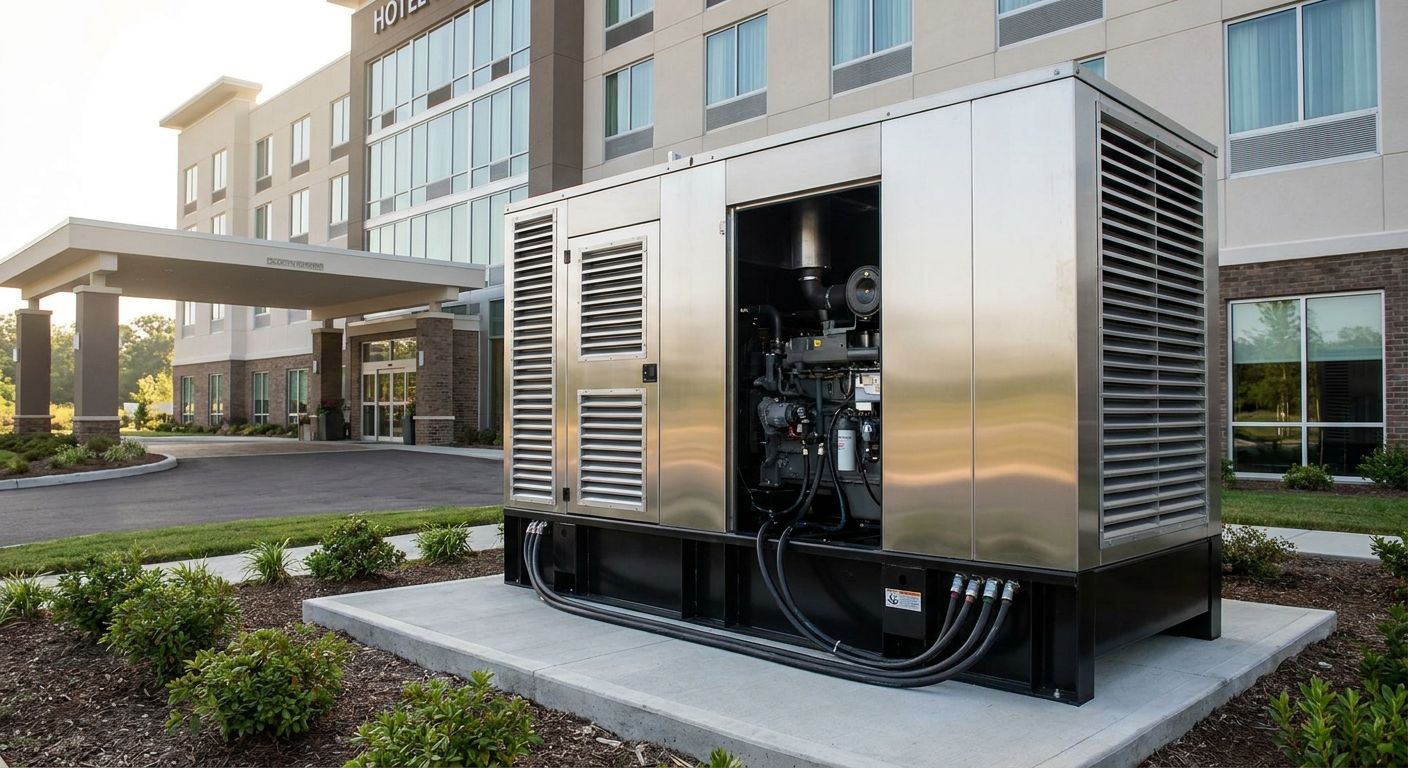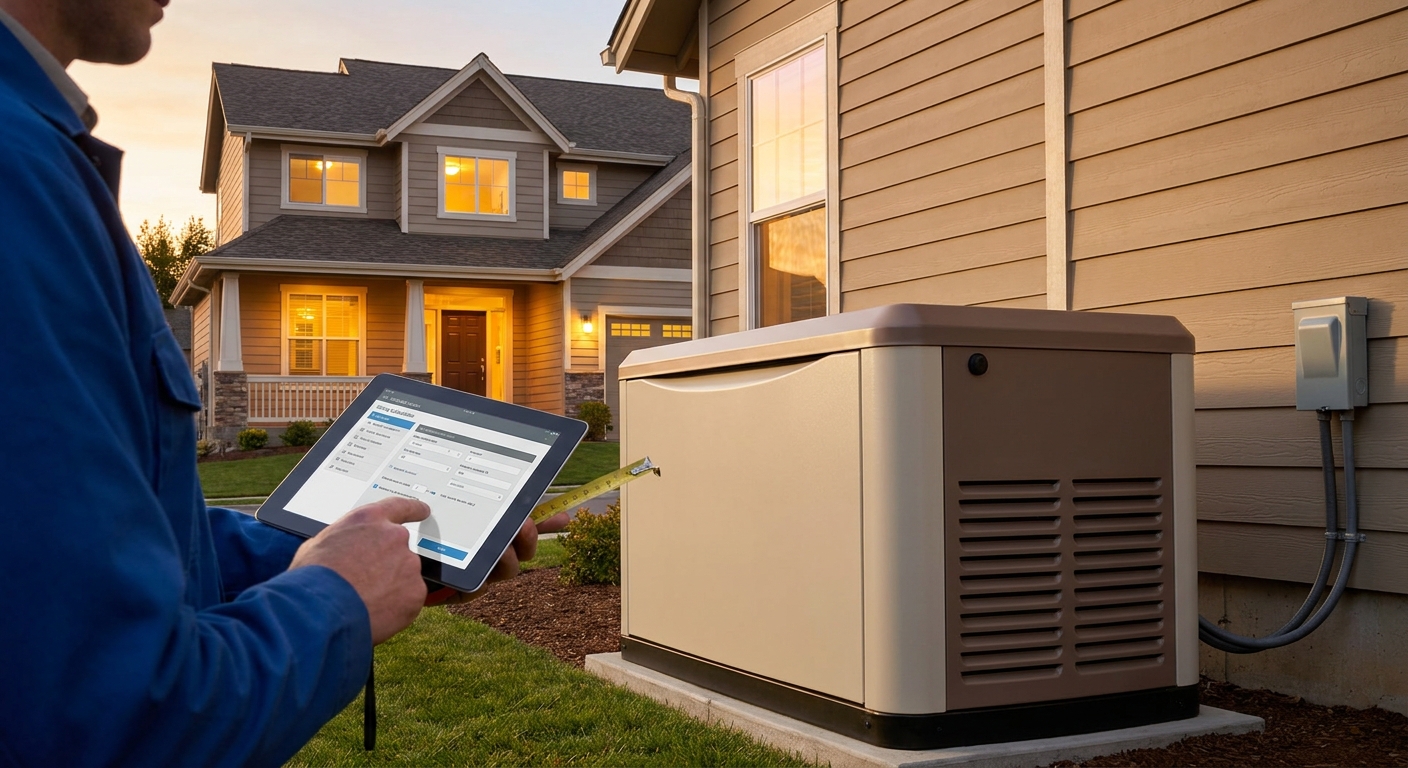
Sizing a whole house generator wrong means one of two expensive mistakes: paying for kilowatts you never use, or watching your AC shut off mid-August because the unit can't carry the load. This guide walks through the exact math contractors use in 2026 to match a generator to a home's real power draw.
TL;DR: Sizing a whole house generator starts with adding up your running watts, not guessing by square footage. A 3,000 sq ft coastal Alabama home with central AC, a well pump, and an electric water heater typically needs 20-24kW. Homes under 2,500 sq ft with gas heat and gas water heating often run fine on 14-17kW. Verdict: get a load calculation before you buy - don't size off house size alone. Baldwin County Generators runs full load assessments for Daphne, Fairhope, Foley, and Gulf Shores homeowners before quoting a unit.
Why this matters
An undersized generator trips its breaker the first time your AC compressor kicks on alongside the refrigerator and a few lights. That's not a defect - it's a math problem. Startup surge (the jolt an AC compressor or well pump draws for one to three seconds) can be 2-3 times higher than its running watts, and generators sized without accounting for that surge fail in real storms, not on paper.
Oversizing costs money every month you're not in an outage. A 24kW unit installed where a 16kW would carry the house means paying for fuel capacity and install labor you'll never use. During hurricane season in coastal Alabama, correct sizing is the difference between a generator that runs your whole house for the duration of an outage and one that trips every time the AC and dryer overlap.
What you'll need
- A list of every major appliance and its running/starting wattage (found on the nameplate or owner's manual)
- Your home's electrical panel amperage (100A, 150A, or 200A - check the main breaker)
- Square footage and HVAC tonnage (a 3-ton unit draws differently than a 5-ton)
- 15-20 minutes to walk your breaker panel with a flashlight and notepad
- A licensed electrician or generator dealer for the final verification - DIY math gets you close, a professional load calculation gets you exact
The steps
1. List every essential circuit
Walk your panel and write down what each breaker feeds: AC/heat pump, water heater, well pump, refrigerator, sump pump, garage door, range, dryer. This is the difference between sizing for "the whole house" versus sizing for "everything that matters when the power's out."
Expected outcome: a list of 8-15 circuits with labels. Common mistake: skipping small loads like garage door openers and sump pumps - these add up fast and matter most during storms when sump pumps run nonstop.
2. Pull running wattage for each item
Check nameplates or manuals for running watts. As a rough guide for 2026-era residential equipment: a 3-ton central AC runs around 3,500-4,000 watts, a well pump runs 1,000-2,000 watts, an electric water heater runs 3,000-4,500 watts, and a refrigerator runs 600-800 watts.
Why it matters: running watts is your baseline load - this is what the generator has to sustain continuously, not just start.
3. Add starting (surge) watts for motor-driven loads
AC compressors, well pumps, and sump pumps need a surge on startup - often 2-3x their running wattage for one to three seconds. A 4,000-watt AC unit might need a 9,000-10,000 watt surge just to start.
Common mistake: adding up only running watts and ignoring surge - this is the number one reason a "correctly sized" generator trips on day one. Expected outcome: you now have two totals - sum of running watts, and your single highest surge load added on top.
4. Calculate total demand
Add your total running watts to your single largest surge demand (not every surge - appliances rarely all start at once). For a typical 2,800-3,200 sq ft coastal Alabama home with central AC, electric water heater, well pump, and standard kitchen loads, total demand lands around 18,000-22,000 watts.
Why it matters: this number, not square footage, is what determines whether you need a 14kW, 20kW, or 24-26kW unit.
5. Match total demand to a generator kW rating
Generators are rated in kW at continuous output. Round your total demand up to the nearest standard size - 14kW, 17kW, 20kW, 22kW, or 26kW are common whole-home ratings from manufacturers like Kohler, Generac, and Briggs & Stratton. Round up, never down.
Expected outcome: a target kW size with 10-15% headroom above your calculated demand. Common mistake: rounding down to save money - a generator running at 100% capacity constantly shortens its lifespan and leaves zero room for adding a pool pump or EV charger later.
6. Decide between whole-house and managed/partial coverage
A true whole-house unit powers every circuit simultaneously. A managed system uses load-shedding modules to prioritize AC, well pump, and refrigeration while cycling lower-priority loads. Managed systems let you size down - sometimes a 14kW unit with load management covers what would otherwise need 22kW unmanaged.
Why it matters for coastal Alabama homes: during a multi-day outage after a hurricane, load management keeps your AC and refrigeration running continuously while shedding the dryer and oven, extending fuel efficiency.
7. Confirm against panel amperage
Cross-check your target kW against your panel's amperage. A 200A panel can typically support a 20-26kW generator with the right transfer switch; a 100A panel often caps out closer to 14-17kW without a panel upgrade.
Expected outcome: confirmation your electrical panel can physically accept the transfer switch amperage the generator requires. Common mistake: buying a 24kW unit for a 100A panel - the panel becomes the bottleneck, not the generator.
Troubleshooting
- Generator trips on AC startup: your surge calculation was too low, or the unit is undersized by one full size class - recalculate with actual nameplate surge data.
- Lights dim when well pump kicks on: normal for correctly sized units under 20kW, but if it happens with the AC off too, the generator is running near its ceiling - a sign it's undersized.
- Fuel runs out faster than expected: oversized generators running well below capacity actually burn less efficiently per kW delivered - check your actual load percentage against rated capacity.
- Transfer switch won't engage full panel: panel amperage mismatch - this is a wiring issue, not a generator sizing issue, and needs an electrician.
- Unit runs fine in mild weather, struggles in summer heat: AC compressors draw more surge in extreme heat - size with a summer-load buffer, not spring numbers.
- Generator cycles on/off repeatedly: usually oversized for current load with poor load management settings, not an undersized problem.
Tools and resources
- A clamp meter to verify actual amp draw on individual circuits
- Manufacturer nameplate data (Kohler, Generac, Honeywell, Briggs & Stratton all publish running/starting watt specs)
- Your home's electrical panel schedule (usually taped inside the panel door)
- A licensed electrical contractor for panel amperage verification
- Baldwin County Generators for a full in-home load assessment before you commit to a size
What to do next
DIY math gets you within one size class of correct. A professional load calculation, done on-site with a clamp meter and panel inspection, gets you exact - and catches panel amperage issues before installation day. Before hurricane season 2026 arrives, get that assessment done rather than guessing off square footage alone.
FAQ
What size whole house generator do I need for a 2,500 sq ft home? Most 2,500 sq ft homes with central AC and electric water heating need 16-20kW, but the real answer depends on your appliance list, not just square footage - a home with gas heat and gas water heater can often run on 12-14kW.
Is a 22kW generator enough for a whole house? Yes, for most homes up to about 3,500 sq ft with standard AC, well pump, and electric appliances, 22kW covers the whole house with headroom. Larger homes or those with dual AC units may need 26kW or higher.
How much does it cost to size and install a whole house generator in 2026? Costs vary by kW size, panel work needed, and site conditions - get a specific quote after a load assessment rather than relying on a general estimate.
Do I need an electrician to size a generator or can I do it myself? You can build an estimate yourself by adding running and surge watts from nameplates, but panel amperage verification and final sizing should come from a licensed electrician or generator dealer.
What happens if I buy a generator that's too small? It trips breakers when high-surge appliances like AC compressors or well pumps start, and it shortens the generator's lifespan from running at or above rated capacity constantly.
Can a 14kW generator run a whole house? 14kW covers many homes under 2,500 sq ft with gas heat and gas water heating, but it's tight or insufficient for larger homes with electric water heaters and central AC - confirm with a load calculation first.
Does square footage determine generator size? No - square footage is a rough starting point, but actual appliance load (AC tonnage, water heater type, well pump, electric vs. gas) determines the real number.
How do coastal Alabama homes differ in sizing needs? Homes in Daphne, Fairhope, Foley, and Gulf Shores often run larger AC systems for humidity control and well pumps in less urban areas, pushing typical sizing toward the 20-24kW range compared to homes in drier, cooler climates.
One last thing
The single most-skipped step in DIY sizing is the well pump surge calculation - homeowners on municipal water skip it entirely, but anyone on a private well needs to add that 2-3x surge multiplier or the generator trips the first time the pump cycles during an outage. Get that number right in 2026 before storm season, not after the power goes out.