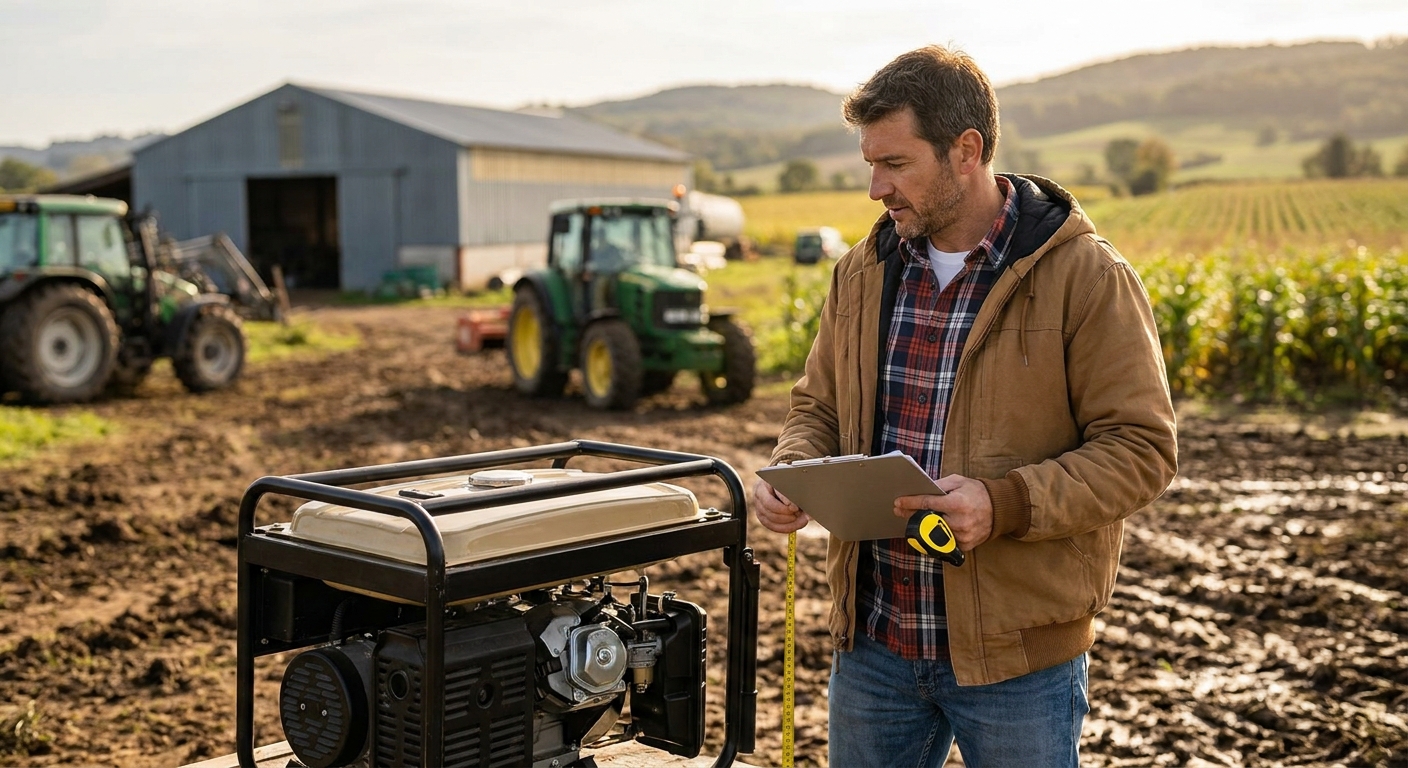
Sizing a generator for a farm in coastal Alabama means adding up well pumps, irrigation motors, walk-in coolers, and barn equipment before you ever glance at a spec sheet - get the math wrong and a storm outage in 2026 costs you livestock, spoiled feed, or a ruined harvest.
- Most Baldwin County farms need 22kW to 48kW standby units to run pumps, coolers, and barn equipment reliably in 2026.
- Size for your single largest motor's starting watts first, not just total running watts, or the unit stalls.
- A 20kW Kohler or Generac handles a homestead with one well pump; row-crop or livestock operations often need 36kW or more.
- Skip any sizing method that ignores surge load from motors starting simultaneously - undersized units trip breakers.
Why this matters
A farm's electrical load doesn't look like a house's load. A homeowner in Fairhope worries about the refrigerator and the AC. A farmer in Foley or on the outskirts of Daphne is running a submersible well pump, a walk-in cooler compressor, grain augers, barn fans, and maybe a milking parlor - often on the same circuit panel, often starting at the same time.
Most sizing mistakes on rural properties come from adding up running watts only. Running watts tell you what a motor draws once it's spinning. They don't tell you what it draws for the half-second it takes to start - and that starting surge, called locked-rotor amperage, can be two to three times the running load. Undersize for that surge and the generator's voltage sags, the motor can't start, and you're standing in a dark barn during hurricane season wondering why the pump won't come on.
What you'll need
- A complete list of every motor and appliance the generator needs to carry, with nameplate data (volts, amps, HP, or watts)
- A clamp meter or the nameplate tags themselves, since guessing wattage from memory produces bad math
- Knowledge of which single load has the highest starting surge - usually the well pump or a large compressor
- 20-25% headroom built into your final kW number, not squeezed against the ceiling
- A licensed electrician or master electrician to verify the panel and transfer switch setup before you buy
- Fuel access - propane or natural gas line capacity, since most whole-property standby units in coastal Alabama run on one of the two
The steps
1. Inventory every circuit that has to stay on
Walk the property and list every load: well pump, irrigation pump, walk-in cooler or freezer, barn ventilation fans, grain dryer, livestock waterers, lighting circuits, and any office or shop equipment. Farms almost always run more simultaneous equipment than a typical house, so this list is usually longer than owners expect.
Mistake to avoid: skipping seasonal equipment. If the grain dryer only runs in fall, it still has to be on the list - the generator has to cover peak season, not average load.
2. Separate running watts from starting watts
Running watts is what a motor pulls once it's up to speed. Starting watts is the surge at the moment of ignition, and for pumps and compressors that surge runs two to three times higher than the running number. A 1.5 HP well pump that runs at roughly 1,500 watts can surge to 4,000-4,500 watts on startup.
Add up total running watts for everything that runs at once. Then separately note the starting-watt figure for your single largest motor - you'll need both numbers in step 4.
3. Identify your single largest motor load
This is the load most farm owners get wrong. You don't add every motor's starting watts together - motors rarely all start in the same instant. You only need to cover the highest single surge on top of everything else already running.
On most Baldwin County farms, that's the well pump or the walk-in cooler compressor. Grain dryers and large irrigation pumps can also take the top spot depending on horsepower.
4. Add starting surge to running total, then apply a safety margin
Take your total running watts (step 2), add the starting-watt figure for the single largest motor (step 3), then add 20-25% headroom. That final number is your target generator output in watts - divide by 1,000 to get kW.
A property running 15,000 running watts with a 4,500-watt pump surge lands near 19,500 watts before margin. Add 20% and you're at roughly 23,400 watts - a 24kW or 25kW unit, not a 20kW.
5. Match the total to a continuous-duty generator rating
Generator spec sheets list a continuous (running) kW rating and a higher peak/surge rating. Match your calculated number to the continuous rating, not the peak number printed in bold on the box - that peak figure is only sustainable for seconds.
Homesteads with one well pump and a cooler often land at 20kW. Row-crop operations with irrigation pumps and grain handling frequently need 36kW to 48kW. Larger livestock operations with milking equipment and climate-controlled barns can push past 48kW.
6. Plan load management before you finalize the unit size
A load management module or smart transfer switch can stagger high-draw equipment so the generator never sees two big surges at once. This lets some farms run a smaller kW unit than the raw math suggests, because the transfer switch sequences the well pump and the grain dryer instead of firing them together.
This is a design decision, not a guess - it has to be engineered into the transfer switch, not assumed after installation.
7. Confirm fuel type and runtime capacity
Propane and natural gas are the two standard fuel sources for whole-property standby units in coastal Alabama. Propane tanks need enough capacity to run the unit continuously through a multi-day outage - which matters more on a farm than a house, since spoiled feed and dead livestock don't wait for the power company.
Check your propane tank size against the generator's fuel consumption rate at the load level you calculated, not at idle.
8. Get a licensed load calculation before you buy
Even a careful DIY calculation should get checked by a licensed electrician before the unit is ordered. Panel capacity, transfer switch placement, and code requirements vary property to property, and a miscalculated install voids warranties and wastes money on an undersized or oversized unit.
Get your farm's load calculated right
A licensed electrician sizes your generator before you buy - not after.
Troubleshooting
- Breaker trips every time the well pump kicks on - the generator is undersized for the pump's starting surge. Recheck the locked-rotor amperage on the pump's nameplate against the generator's surge rating.
- Lights dim or flicker when the cooler compressor starts - voltage sag from insufficient headroom. Add the 20-25% margin from step 4 if it's missing.
- Generator runs but the grain dryer fan won't spin up - the fan motor's starting watts exceed what's left after other loads are already running. Sequence it through a load management module instead of running it simultaneously with the pump.
- Automatic transfer switch cycles on and off during storms - often a fuel delivery problem, not a sizing problem. Check propane pressure and tank level before assuming the unit is too small.
- Two big motors start together and the unit stalls - this is the exact failure mode load staggering prevents. Revisit step 6 with your electrician.
- Unit runs fine at first but bogs down after 20-30 minutes - possible fuel supply restriction under sustained farm-scale load, not an electrical sizing issue.
Tools and resources
- Clamp meter for verifying actual amp draw against nameplate ratings
- Nameplate data from every pump, compressor, and motor on the property
- A written load calculation worksheet you can hand to an electrician
- A licensed, insured electrical contractor experienced with farm and commercial standby installs - not just residential jobs
- Baldwin County Generators for a property-specific load calculation and installed quote across coastal Alabama farm properties
What to do next
Run your inventory list against the steps above, then get a licensed load calculation before ordering equipment - a spreadsheet estimate is a starting point, not a final answer for a property carrying livestock, crops, or perishable inventory through hurricane season.
FAQ
What size generator does a farm need?
Most farms need 20kW to 48kW depending on well pumps, irrigation, refrigeration, and grain or livestock equipment. A homestead with one well pump often runs on 20kW, while row-crop or livestock operations typically need 36kW or higher in 2026.
How do I calculate generator size for a well pump?
Take the pump's running watts from its nameplate, then add its starting watts, which run two to three times higher due to locked-rotor surge. A 1.5 HP pump running at 1,500 watts can surge to 4,000-4,500 watts on startup, and the generator has to cover that surge on top of everything else running.
Is a portable generator enough for a farm?
Portable generators rarely cover whole-farm loads reliably because they lack the continuous kW output and automatic transfer switching that pumps, coolers, and barn equipment need during multi-day outages. Whole-property standby units sized to the property's actual load are the standard choice for agricultural operations.
How much starting surge does a grain dryer fan need?
Grain dryer fan motors can surge two to three times their running wattage at startup, similar to well pumps and compressors. That surge has to be accounted for separately from total running watts when sizing the generator.
Should I size for propane or natural gas on a farm?
Both work for whole-property standby units, but propane tank capacity needs to match the generator's fuel consumption rate at full farm load, not at idle. Natural gas requires adequate line pressure and supply capacity, which a licensed electrician or gas contractor should verify before installation.
Can load management let me buy a smaller generator?
Yes. A load management module or smart transfer switch sequences high-draw equipment like well pumps and grain dryers so they never surge simultaneously, which can let some properties run a smaller kW unit than the raw addition of all loads would suggest.
What happens if a farm generator is undersized?
An undersized generator trips breakers when motors try to start, causes voltage sag that damages sensitive equipment, and can fail entirely during multi-day outages when livestock, refrigeration, and crops depend on continuous power. Resizing after installation costs more than getting the calculation right up front.
Do I need a licensed electrician to size a farm generator?
A DIY load calculation is a useful starting point, but a licensed electrician should verify panel capacity, transfer switch placement, and code compliance before the unit is purchased. Farm properties carry higher stakes than houses, since spoiled inventory and livestock losses happen fast during an outage.
One last thing
The single most common sizing error on farm properties isn't the total load - it's forgetting that a well pump and a grain dryer or cooler compressor rarely need to run at the exact same instant, and a smart transfer switch can be engineered around that timing instead of forcing a bigger, more expensive unit. Get the load calculation done before hurricane season 2026 starts, not after the first outage.