Rental properties lose money every hour the power stays off, whether it's a beach condo in Gulf Shores or a duplex in Daphne with tenants calling about a warm refrigerator. A generator maintenance schedule that lives on a calendar instead of in someone's memory keeps that standby unit ready when hurricane season hits coastal Alabama in 2026.
- Schedule generator maintenance rental property units twice a year: pre-hurricane season (April-May) and post-season (October-November).
- Kohler and Generac both recommend oil changes every 100-200 hours or annually, whichever comes first, in 2026.
- Log every service visit with date, hours run, and technician name so a new property manager can pick up the schedule cold.
- Skip DIY oil changes on units under warranty; an authorized dealer visit protects the coverage and takes under 90 minutes.
Why this matters
A standby generator that fails during a named storm doesn't just cost you a repair bill. It costs a tenant their food, their AC, their patience, and possibly their lease renewal. Coastal Alabama rental owners in Foley, Fairhope, and Gulf Shores who skip a maintenance cycle are the ones calling for emergency service during a tropical storm watch, when technicians are already booked solid.
Insurance and warranty paperwork also depend on documented maintenance. Generac and Kohler warranties can require proof of scheduled service, and if a unit fails without that paper trail, a claim gets denied. A rental property with multiple units or multiple owners needs this in writing, not in someone's head.
What you'll need
- The generator's model and serial number (Kohler, Generac, Honeywell, or Briggs & Stratton all print this on the unit's data plate)
- A maintenance log, digital or paper, tracking hours run and last service date
- Access to the property on a set day each quarter, even if the tenant is present
- A relationship with a licensed electrical contractor for oil, filter, and battery service
- Manufacturer-specific service intervals (usually 100 hours or 1 year for oil changes)
- A calendar reminder system tied to hurricane season dates, not just the calendar year
If the property doesn't have a standby unit installed yet, get a quote through Baldwin County Generators before the next named storm forms in the Gulf.
The steps
1. Pull the generator's service history first
Before setting any new schedule, find out what's already been done. Check the unit's built-in hour meter and compare it against the last documented oil change or filter swap.
A generator with 180 hours logged and no service record since installation is overdue right now, not next quarter. Skipping this step means guessing at a schedule instead of building one off real data.
Common mistake: assuming a newer unit (installed in 2023 or 2024) doesn't need attention yet. Age doesn't matter as much as run hours and battery condition.
2. Set two fixed service windows per year
Coastal Alabama's hurricane season runs June through November, so the smartest maintenance calendar has one visit in April or May and a second in October or November. This puts eyes on the unit right before peak risk and again right after, catching any wear from storm-related runtime.
Mark both dates on a shared calendar the property manager, owner, and maintenance vendor can all see. A single missed window is how units end up running on six-month-old oil during a named storm.
Common mistake: scheduling both visits back-to-back in spring because it's convenient, then having nothing checked from June through the following spring.
3. Confirm the manufacturer's service interval
Generac units typically call for an oil change every 100-200 hours or once a year, whichever hits first. Kohler follows a similar interval, while Briggs & Stratton and Honeywell units sometimes differ by a few hundred hours depending on load size.
Pull the owner's manual or the sticker on the unit itself rather than assuming every brand follows the same clock. Mixing up intervals across a portfolio with different brands is one of the most common scheduling errors property managers make.
4. Book the technician visit two weeks ahead of the target window
April and October are the busiest months for licensed electrical contractors doing generator service across Baldwin County, since every rental owner is thinking about the same storm dates. Booking two weeks out instead of two days out gets you a slot before the calendar fills.
A rushed, last-minute booking in late May often means waiting until June, right as tropical activity picks up.
5. Have the tenant on notice, not surprised
Send a written notice at least 48 hours before the scheduled visit if the property is occupied. Most leases require advance notice for non-emergency maintenance access, and a surprised tenant creates friction that outlasts the visit itself.
Include the expected visit length (most standard service calls run 45-90 minutes) so the tenant can plan around it.
6. Document every visit immediately
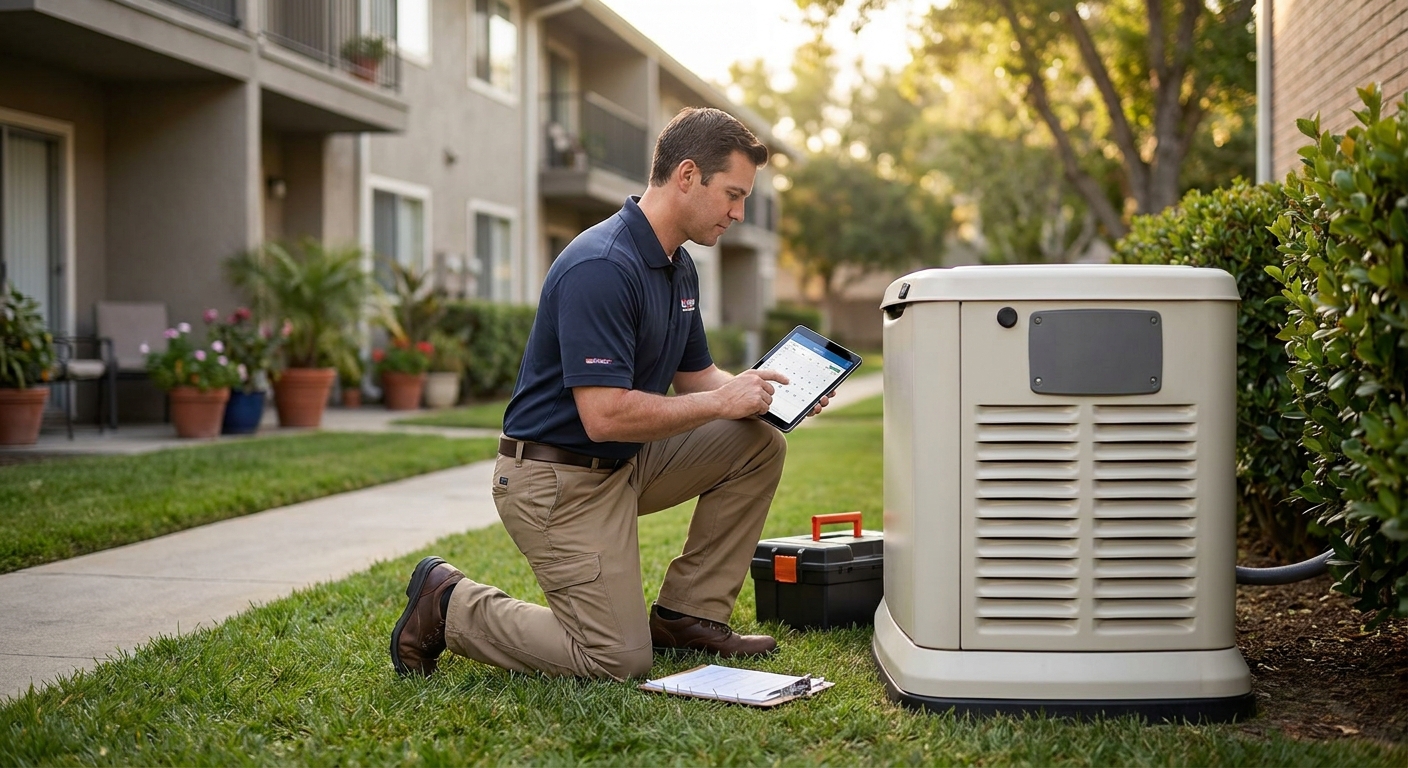
The technician should leave a service report listing oil changed, filter status, battery voltage, and any parts flagged for future replacement. Log that report the same day, tied to the unit's serial number and the date.
A maintenance log with gaps is functionally the same as no log at all when a warranty claim or insurance question comes up later.
7. Review the battery and transfer switch separately
Batteries are the most common point of failure on standby units that otherwise pass every other check. A battery test should happen at every scheduled visit, not just when the unit fails to start.
The automatic transfer switch also needs a functional test, since a generator that runs fine on its own but won't transfer power to the panel is just as useless during an outage.
Common mistake: treating the transfer switch as maintenance-free because it has no moving parts visible from the outside.
Get your rental property storm-ready
Schedule standby generator maintenance before the next named storm hits coastal Alabama.
Troubleshooting
- Unit won't start during a self-test. Check the battery voltage first; a weak battery is the cause more often than a fuel or ignition problem.
- Service history is incomplete or missing. Start a new log today with a baseline hour-meter reading rather than trying to reconstruct years of gaps.
- Tenant refuses access on the scheduled date. Reference the lease's maintenance access clause and offer a 48-hour alternate window in writing.
- Multiple properties, multiple generator brands. Build one master calendar with separate columns per brand and interval rather than a single generic schedule.
- Fuel smells off or gauge reads low after months of no runtime. Have a technician check fuel stability during the next scheduled visit instead of waiting for a failed start.
- Warranty claim denied for lack of service records. This is preventable going forward; keep every service report from 2026 onward filed with the unit's serial number.
Tools and resources
- A shared digital calendar (Google Calendar or a property management platform) for the two annual service windows
- The manufacturer's owner manual for exact interval specs (Kohler, Generac, Honeywell, or Briggs & Stratton)
- A licensed electrical contractor relationship for scheduled visits, not just emergency calls
- A written maintenance log template covering date, hours run, technician, and parts serviced
- Baldwin County Generators for sales, installation, and ongoing service across Daphne, Fairhope, Foley, and Gulf Shores
What to do next
Once the twice-yearly schedule is running, the next step is confirming the unit itself is sized correctly for the property's actual load, especially if a rental has added a second AC unit or upgraded appliances since the generator went in. An undersized generator that's perfectly maintained will still fail under real storm conditions.
FAQ
How often should a rental property generator be serviced?
A rental property standby generator should be serviced twice a year: once in April or May before hurricane season and again in October or November after it ends. This catches wear before peak risk and after heavy runtime, matching Kohler and Generac's recommended 100-200 hour or annual interval.
Who is responsible for generator maintenance on a rental property?
The property owner is typically responsible for standby generator maintenance, not the tenant, since the unit is a fixed system tied to the building. Lease agreements should state this explicitly to avoid disputes when a service visit requires tenant access.
How much does generator maintenance cost for a rental property in 2026?
Routine generator maintenance visits generally run a few hundred dollars per visit depending on brand and unit size, though exact pricing varies by service scope. A written quote from a licensed contractor is the fastest way to get an accurate number for a specific property.
Can a tenant refuse generator maintenance access?
A tenant can request a different date but generally cannot refuse access outright if the lease includes a standard maintenance access clause with proper notice. Most leases require 24-48 hours written notice before a non-emergency service visit.
Does skipping maintenance void a generator warranty?
Skipping scheduled maintenance can void a Kohler or Generac warranty since most manufacturers require documented service at set intervals. Keeping a dated service log with the unit's serial number is the simplest way to protect warranty coverage.
What's the best time of year to schedule generator maintenance in coastal Alabama?
April and October are the best months to schedule generator maintenance in coastal Alabama, timed just before and just after hurricane season. Booking two weeks ahead of these windows avoids the scheduling backlog that hits in late May and early June.
How long does a standard generator maintenance visit take?
A standard maintenance visit runs 45 to 90 minutes for oil change, filter check, battery test, and transfer switch inspection. Larger commercial units or units with deferred maintenance can take longer.
What brands does a licensed contractor typically service?
Licensed electrical contractors in coastal Alabama typically service Kohler, Generac, Honeywell, and Briggs & Stratton standby units. Confirm brand-specific experience before booking, since service intervals and parts differ across manufacturers.
One last thing
The generator that fails during a storm almost never fails because of a major mechanical problem. It's a battery nobody tested, a transfer switch nobody exercised, or an oil change that slipped from April to July while everyone assumed someone else handled it. The rental owners who never lose a tenant over a power outage are the ones with a calendar reminder, not the ones with the newest unit.