Your standby generator is flashing a light and you have no idea if that means "call a technician tomorrow" or "we're about to lose power in the middle of a storm." This guide breaks down what those lights and codes actually mean, and what to do about each one.
TL;DR
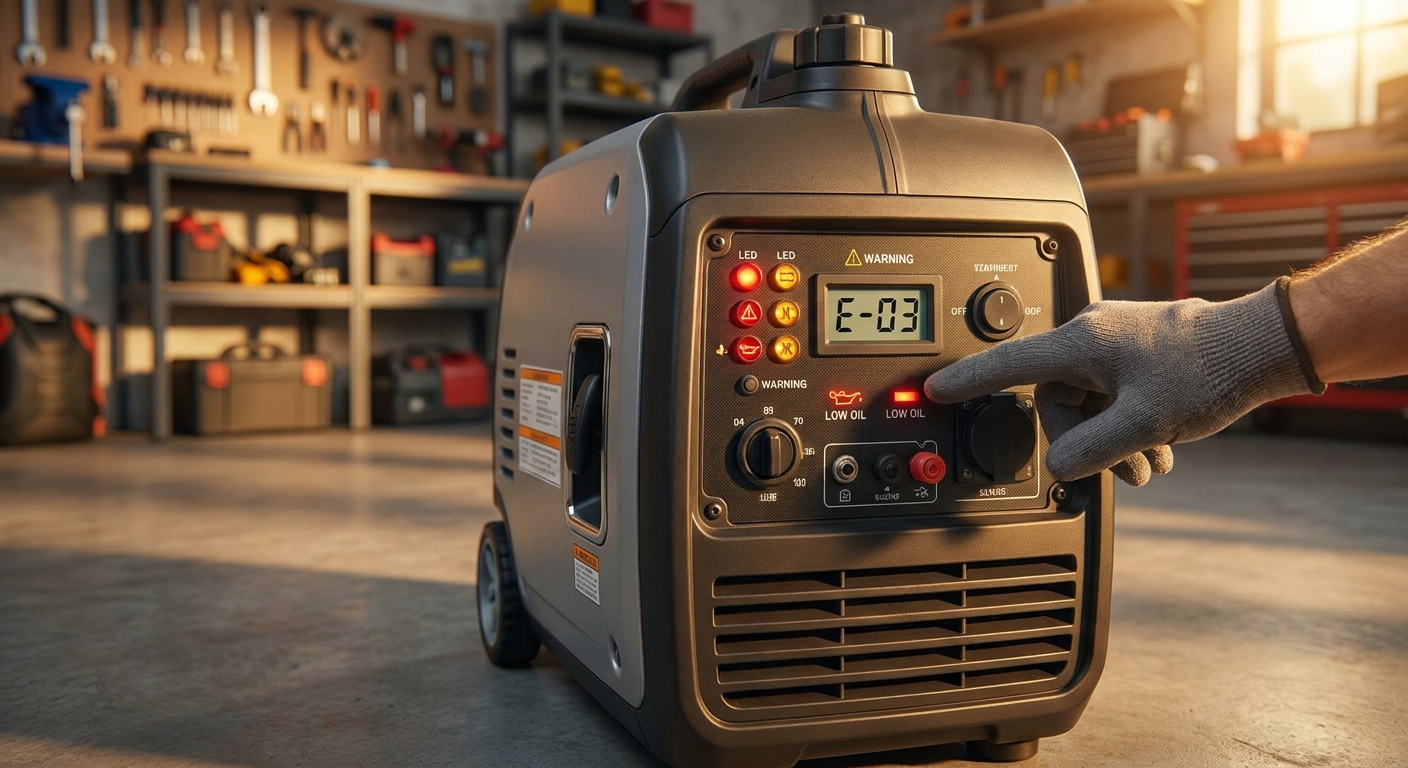
Most standby generators use a red, amber, or green LED pattern, sometimes paired with an LCD code like "Overcrank" or "Battery Problem," to tell you what's wrong. A steady green light means standby-ready. Amber usually means a warning you can address yourself, like a maintenance reminder or low battery. A steady or flashing red light means the unit shut down and won't run until the fault clears. Generac, Kohler, Honeywell, and Briggs & Stratton units all use variations of this same three-color logic. If you're in coastal Alabama and see a red fault light before hurricane season 2026, treat it as a same-week service call, not a someday task, and reach out to Baldwin County Generators if the fix isn't obvious from the code.
Why this matters
A generator that looks fine sitting in your yard can still fail to start when a storm knocks out grid power. The warning light is the only early signal you get, days or weeks before the outage, that something's off. Ignore an amber "maintenance due" light in June and you may be staring at a red "overcrank" fault in August with no power and a full house.
Coastal Alabama homeowners run these units through salt air, high humidity, and long idle stretches between storms. That combination corrodes battery terminals, drains starting batteries faster than inland units, and clogs air filters quicker. Reading the code correctly the first time saves a wasted truck roll and, more importantly, saves you from finding out your generator is dead during an actual outage.
What you'll need
- Your generator's owner's manual or the model/serial number plate (usually on the side panel)
- A flashlight or phone light - the LCD screen on some units is hard to read in daylight
- A notepad or your phone's camera to record the exact code before you touch anything
- Basic hand tools if the fix is filter or battery related (screwdriver, 10mm socket)
- Five minutes of patience before you reset anything
The steps
1. Identify the light color first
Before you touch a single button, note whether the light is green, amber/yellow, or red, and whether it's solid or flashing. This single detail narrows the problem down before you even read the text code.
- Green, solid = standby ready, no action needed
- Amber/yellow = a warning condition, unit may still run
- Red, solid or flashing = a fault that stopped or blocked the engine
2. Read the LCD or code display
Most 2020s-and-newer standby units (Generac Guardian series, Kohler RESL, Briggs & Stratton) pair the light with a short text string on a small screen: "Stopped-Overcrank," "Warning-Battery Problem," "Stopped-Low Oil Pressure," or similar. Write the exact wording down. Technicians diagnose faster when you can quote the exact code instead of "it just said 'stopped' something."
Common outcome: you'll have a two- to four-word phrase that maps directly to one of the categories below.
3. Match the code to a category
Run the code against these general categories, which apply across Generac, Kohler, Honeywell, and Briggs & Stratton units with only minor wording differences:
- Overcrank / Failed to Start - engine tried to start (usually 3-5 attempts) and didn't catch. Often fuel supply or spark related.
- Overspeed - engine ran faster than its governed RPM, usually a governor or sensor fault.
- Low Oil Pressure / Level - safety shutdown to protect the engine. Do not restart until oil is checked.
- Battery Problem / Charger Warning - starting battery voltage is low or the charger isn't maintaining it.
- RPM Sense Loss - the control board lost its speed signal mid-run.
- Maintenance Due - scheduled service reminder, not an active fault.
4. Handle battery and maintenance warnings yourself
Amber "Battery Problem" or "Maintenance Due" lights are the two most common codes a homeowner can safely act on. Check the battery terminals for corrosion (a common issue in Gulf Shores and Foley's salt air), and confirm the battery charger light on the unit is lit. A "Maintenance Due" light just means the built-in service hour counter hit its threshold, typically every 100-200 hours or annually, whichever comes first.
Expected outcome: clearing corrosion and confirming charger function resolves most battery warnings within minutes.
5. Treat red fault lights as a stop-run signal
A solid or flashing red light means the control board shut the engine down to prevent damage. Do not attempt to force a restart more than once. Repeated forced restarts on an "Overcrank" or "Low Oil Pressure" fault can damage the engine or starter motor.
Common mistake: homeowners hold the start button repeatedly, draining the battery further and masking the real fault code with a new "Battery Problem" warning.
6. Clear the code only after noting it
Most control panels have an "OFF/Reset" or "Enter" sequence that clears the fault so the unit can attempt to run again. Clear it only after you've written down the original code. Clearing before recording it erases the fault history your technician needs to diagnose the real cause.
7. Attempt one supervised restart
After clearing a minor warning (not a red safety shutdown), switch the unit to manual or test mode and watch a full start cycle. If it starts, runs smoothly for 60 seconds, and shows no new codes, the fix held. If the same code returns, stop and call for service instead of cycling it again.
Troubleshooting
- Generator won't start and shows no light at all - check the transfer switch position and confirm the battery isn't fully dead; a completely dark panel usually means zero battery voltage.
- Amber light stays on after clearing - the underlying condition (low battery, dirty filter) hasn't actually been resolved, only the display was reset.
- Red "Overcrank" appears repeatedly - almost always fuel supply: check the propane tank level or natural gas shutoff valve before assuming it's mechanical.
- "Low Oil Pressure" fault with oil that looks fine on the dipstick - this can be a sensor fault rather than an actual oil problem, but don't ignore it either way.
- Code flashes too fast to read - most panels repeat the pattern in a loop; wait through two full cycles and use your phone's slow-motion video if needed.
- Unit runs fine on manual test but faults during an actual outage - points to a transfer switch or load-sensing issue, not the generator itself.
Tools and resources
- Owner's manual specific to your model (Kohler, Generac, Honeywell, or Briggs & Stratton control panels each label codes slightly differently)
- A basic digital multimeter if you're comfortable checking battery voltage yourself
- Your unit's serial number, ready to reference on any service call
- Baldwin County Generators for licensed diagnostic and repair service across Daphne, Fairhope, Foley, and Gulf Shores
What to do next
If the code points to anything beyond a battery terminal clean or a maintenance reset, don't keep cycling the unit hoping it clears itself. A licensed electrical contractor can pull the full fault history off the control board, not just the current code, and catch a developing problem before hurricane season 2026 turns it into a no-start emergency.
FAQ
What does a flashing red light on a standby generator mean? A flashing or solid red light means the control board shut the engine down for safety, usually from overcrank, overspeed, or low oil pressure. Don't force repeated restarts; read the LCD code first and address the underlying cause.
Is an amber warning light serious? Amber usually signals a condition the unit can still run through, like a maintenance reminder or a battery charging issue, but it should be resolved within days, not months. Left unresolved, amber warnings often become red faults.
How much does it cost to fix a generator fault code? Costs vary by the underlying issue - a battery terminal cleaning or filter swap runs far less than a sensor or control board replacement. Get a diagnostic visit before assuming the worst; many codes trace back to simple fixes.
Can I reset a generator fault code myself? Yes, most panels let you clear a fault through an OFF/Reset sequence, but write down the original code first. Resetting before recording it erases data a technician needs if the fault returns.
Why does my generator show "Overcrank" every time it tries to start? Overcrank almost always points to a fuel supply problem - check your propane level or natural gas shutoff before assuming a mechanical failure. It can also indicate a spark or fuel solenoid issue on older units.
How often should I check my generator's warning lights? Check the panel monthly and immediately before any forecasted storm. Standby units run a self-test weekly, so a fault that appears right after a self-test cycle is worth investigating the same day.
Do Generac, Kohler, and Honeywell use the same warning codes? The underlying categories (overcrank, overspeed, low oil, battery, maintenance) are the same across brands, but the exact wording and LED patterns differ slightly. Always cross-reference your specific model's manual.
Should I run my generator during a warning light before a storm? Only for amber warnings that don't stop the engine, and only as a short supervised test. Never rely on a unit showing a red fault code to carry your home through an outage in 2026 - get it serviced first.
One last thing
The single most common mistake homeowners make with generator codes isn't misreading them, it's clearing them too fast. Write the exact code down before you touch reset. A technician diagnosing a unit in 2026 with the original fault history can often fix it in one visit; a technician working from "it said something and I cleared it" usually needs a second trip.