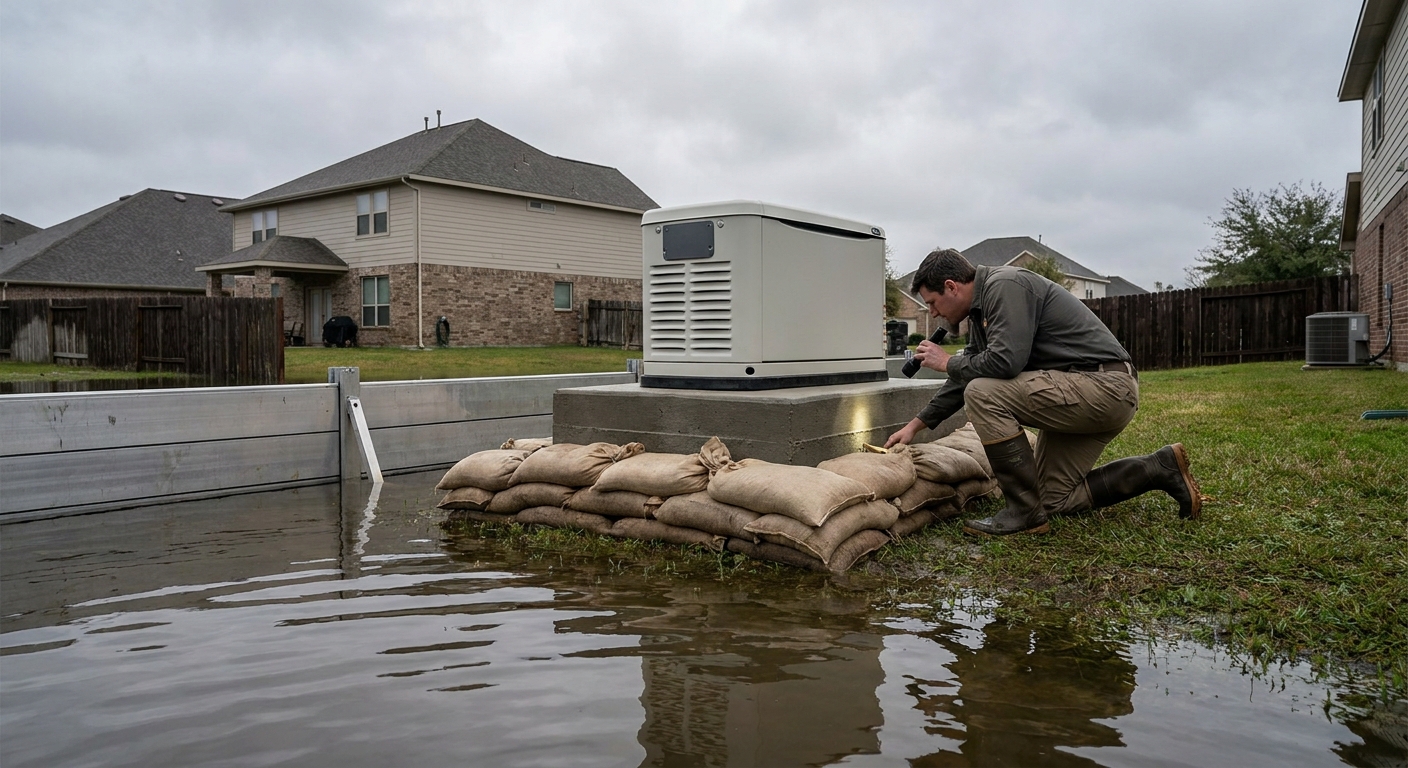
Flood damage - not high winds - is what actually kills standby generators along the Alabama Gulf Coast, and the fix comes down to elevation, sealing, and code compliance handled before storm season, not after.
- Set the generator pad at least 18 inches above Base Flood Elevation before hurricane season 2026 - anything lower risks a total loss.
- Concrete pads anchored per NEC 700 beat gravel or paver bases in every flood-prone install in Baldwin County.
- Transfer switches and conduit must sit above the surge line - a flooded switch means no backup power when you need it most.
- Saltwater intrusion corrodes control boards fast; annual pre-season inspection catches it before it strips the unit.
- Skip DIY siting in a flood zone - a licensed electrician verifying NEC 700/701/702 compliance is non-negotiable in 2026.
Why this matters
Daphne, Fairhope, Foley, and Gulf Shores all sit inside or near FEMA-mapped flood zones off Mobile Bay and the Gulf, and storm surge from even a moderate named storm can put standing water on a property that never floods in a normal year. A standby generator sited at ground level in one of these zones isn't a backup power source during a hurricane - it's a piece of equipment waiting to short out at the exact moment you need it running.
Baldwin County Generators installs Kohler, Generac, Honeywell, and Briggs & Stratton units across coastal Alabama, and the single biggest failure point on flood-zone jobs isn't the generator itself - it's where and how it's set. Get the siting, pad height, and electrical routing right in 2026, and the unit survives a surge event that would otherwise cost thousands in replacement parts and weeks of lost power.
What you'll need
- Your property's FEMA flood zone designation and Base Flood Elevation (BFE) number, pulled from the current flood insurance rate map
- A reinforced concrete pad rated for the generator's weight, not a gravel bed or paver set
- A generator model built for coastal exposure - Kohler and Generac both offer aluminum enclosures that resist salt-air corrosion better than steel
- A transfer switch and conduit run positioned above the expected surge line for your zone
- A licensed electrician familiar with NEC 700, 701, and 702 emergency power provisions
- A sump pump or French drain if the equipment sits in a low-lying yard corner
- A pre-season inspection scheduled before June 1, the start of Atlantic hurricane season
The steps
1. Pull your FEMA flood zone before you site anything
This determines every decision after it. A property in Zone AE near Mobile Bay has a documented Base Flood Elevation; a property in Zone X does not carry the same requirement, but coastal Alabama's storm history means "not required" and "not at risk" are two different things. Get the zone letter and BFE number from your county's flood map before ordering equipment.
Common mistake: relying on where the old generator sat, or where a neighbor placed theirs. Flood maps get revised, and a pad that was compliant a decade ago may not meet current standards in 2026.
2. Set the pad height at BFE plus 18 inches
The generator's control board, engine electronics, and battery all sit low to the ground on most residential units. An 18-inch buffer above the mapped flood elevation gives surge water somewhere to go besides the inside of your generator.
Expect the outcome to be a pad that looks noticeably taller than a standard installation - that's correct, not oversized.
Common mistake: matching pad height to the AC unit or pool equipment next to it instead of calculating from BFE independently.
3. Anchor to reinforced concrete, not gravel
Gravel pads shift and settle after repeated saturation, tilting the unit and stressing fuel and electrical connections over time. A poured concrete pad, properly reinforced and anchored per the manufacturer's bolt pattern, holds level through multiple flood cycles.
Budget for a pad thickness and rebar spec that matches the generator's operating weight - a 20kW unit needs more structure underneath it than a 10kW unit.
Common mistake: pouring the pad flush with existing grade instead of building up to the calculated flood buffer.
4. Route the transfer switch above the surge line
The automatic transfer switch and its conduit run are more vulnerable than the generator enclosure itself, because they're often mounted lower, closer to the house, and closer to grade. If the switch floods, the generator can be sitting dry and still fail to power the home.
Run conduit up and over rather than through low points, and mount the switch enclosure at or above the same elevation buffer used for the pad.
Common mistake: leaving the transfer switch at its original height when upgrading to a taller pad, creating a mismatch between the two.
5. Seal penetrations and elevate fuel connections
Every wire and pipe entry into the generator enclosure is a potential water path. Weatherproof, gasketed seals at each penetration keep wind-driven rain and splash-up from getting inside during a storm, not just standing floodwater.
Propane and natural gas connections should route above the pad's flood buffer wherever the utility allows it, reducing the risk of contaminated fuel lines after a surge event.
Common mistake: assuming a weatherproof enclosure rating alone handles this - enclosure ratings cover rain exposure, not submersion or prolonged standing water.
6. Add drainage around the pad
A sump pump or French drain redirects water away from the base of the pad instead of letting it pool and rise against the concrete. This matters most on lots with poor natural drainage or a low-lying equipment corner.
A drain that empties 10-15 feet away from the pad, angled downhill, does more for long-term protection than any amount of sealant on the enclosure itself.
Common mistake: skipping drainage because the pad itself is elevated - elevation slows water intrusion, drainage prevents it from ever reaching the pad edge.
7. Verify code compliance with a licensed electrician
NEC Article 700 covers emergency systems, 701 covers legally required standby systems, and 702 covers optional standby - the article that applies depends on what the generator powers in your home. A licensed electrician confirms siting, bonding, and switch placement meet the applicable article before the county inspector signs off.
This step also protects insurance claims: a generator installed outside code in a mapped flood zone can complicate a damage claim after a storm.
Common mistake: treating the inspection as a formality instead of a real check against current 2026 code cycles, which get updated on a regular schedule.
8. Schedule a pre-season inspection every year
Salt air corrodes connections and fasteners faster on the coast than inland, even on units that never flooded. An annual check before June 1 catches corrosion, battery drain, and seal degradation while there's still time to fix it before a named storm forms.
Expected outcome: a unit that starts reliably on the first test run of the season, not the third attempt during an actual outage.
Common mistake: running the annual maintenance check but skipping a visual inspection of the pad and drainage - corrosion and settling both happen slowly enough to miss without a dedicated look.
Get your flood-zone install checked
Request a site evaluation before hurricane season 2026 hits Baldwin County.
Troubleshooting
- Generator won't start after minor flooding. Check the control panel for moisture first - water intrusion trips the low-oil or fault sensors even when the engine itself is fine. Dry the compartment fully before attempting a restart.
- Pad has cracked or tilted. This usually means the original pour lacked adequate reinforcement or the sub-base wasn't compacted before pouring. A tilted pad needs releveling, not just a patch.
- Corrosion on battery terminals or wiring after storm season. Salt-laden humidity accelerates this even without direct flooding. Clean and inspect terminals every spring, and replace corroded connectors rather than just tightening them.
- Transfer switch tripped and won't reset after a storm. Confirm no water reached the enclosure before resetting - a switch that reset into a wet environment risks arcing.
- Fuel smells off or engine runs rough after a flood event. Contaminated fuel lines need draining and flushing before the generator runs again; don't just top off the tank.
- Enclosure shows rust spots within a year or two of install. This points to a steel enclosure in a high-salt-exposure location - an aluminum enclosure upgrade solves it going forward.
Tools and resources
- Current FEMA flood insurance rate map for your Baldwin County address
- NEC 700/701/702 reference sections for emergency and standby power
- A licensed, insured electrician for permitting and final inspection
- Manufacturer specs for Kohler, Generac, Honeywell, or Briggs & Stratton units rated for coastal exposure
- A scheduled annual pre-season maintenance visit ahead of June 1 each year
What to do next
If your generator was installed more than five years ago, or before your current flood zone map was issued, get the siting reassessed rather than assuming it still meets today's standards. Flood maps get revised, code cycles update, and a pad that was compliant in an earlier year isn't automatically compliant in 2026.
FAQ
How high above flood elevation should a generator be installed?
A generator pad should sit at least 18 inches above the property's Base Flood Elevation (BFE). Coastal Alabama properties near Mobile Bay or the Gulf often need this buffer even outside the highest-risk flood zones.
Can a standby generator survive storm surge if it floods?
Most residential standby generators do not survive direct submersion - the control board and engine electronics sit too low to withstand standing water. Elevation above BFE is the primary defense, not the enclosure rating.
What NEC code applies to generator flood siting?
NEC Article 700 covers emergency systems, 701 covers legally required standby, and 702 covers optional standby installations. A licensed electrician determines which article applies based on what circuits the generator powers.
Is a concrete pad required for generator installation in a flood zone?
Yes, a reinforced concrete pad is strongly recommended over gravel or pavers in flood-prone areas. Concrete holds level through repeated saturation cycles, while gravel bases shift and settle.
How often should a coastal generator be inspected for flood readiness?
Annually, before June 1 each year when hurricane season begins. Salt air corrosion and pad settling both progress slowly enough that a yearly check catches problems before storm season, not during it.
Does homeowners insurance cover generator flood damage?
Coverage varies by policy and whether the installation met local code at the time of the loss. A generator installed below BFE without proper permitting can complicate or void a claim after storm damage.
What generator brands hold up best in coastal flood zones?
Kohler and Generac both offer aluminum enclosures that resist salt-air corrosion better than standard steel housings. Brand matters less than siting, but enclosure material affects long-term durability on the coast.
Should the transfer switch be elevated along with the generator?
Yes, the transfer switch and its conduit run should sit at or above the same flood buffer as the generator pad. A flooded switch can disable backup power even when the generator itself stayed dry.
One last thing
Most flood-damage claims on standby generators in Baldwin County trace back to the transfer switch, not the generator enclosure - homeowners elevate the unit and forget the switch sits at the original, lower height. Check that measurement specifically before the next named storm forms in 2026.