Getting HOA approval for a standby generator in coastal Alabama takes paperwork, patience, and the right numbers on paper before you ever call an installer - most boards in Daphne, Fairhope, Foley, and Gulf Shores approve requests in 30 to 45 days when the application is complete the first time.
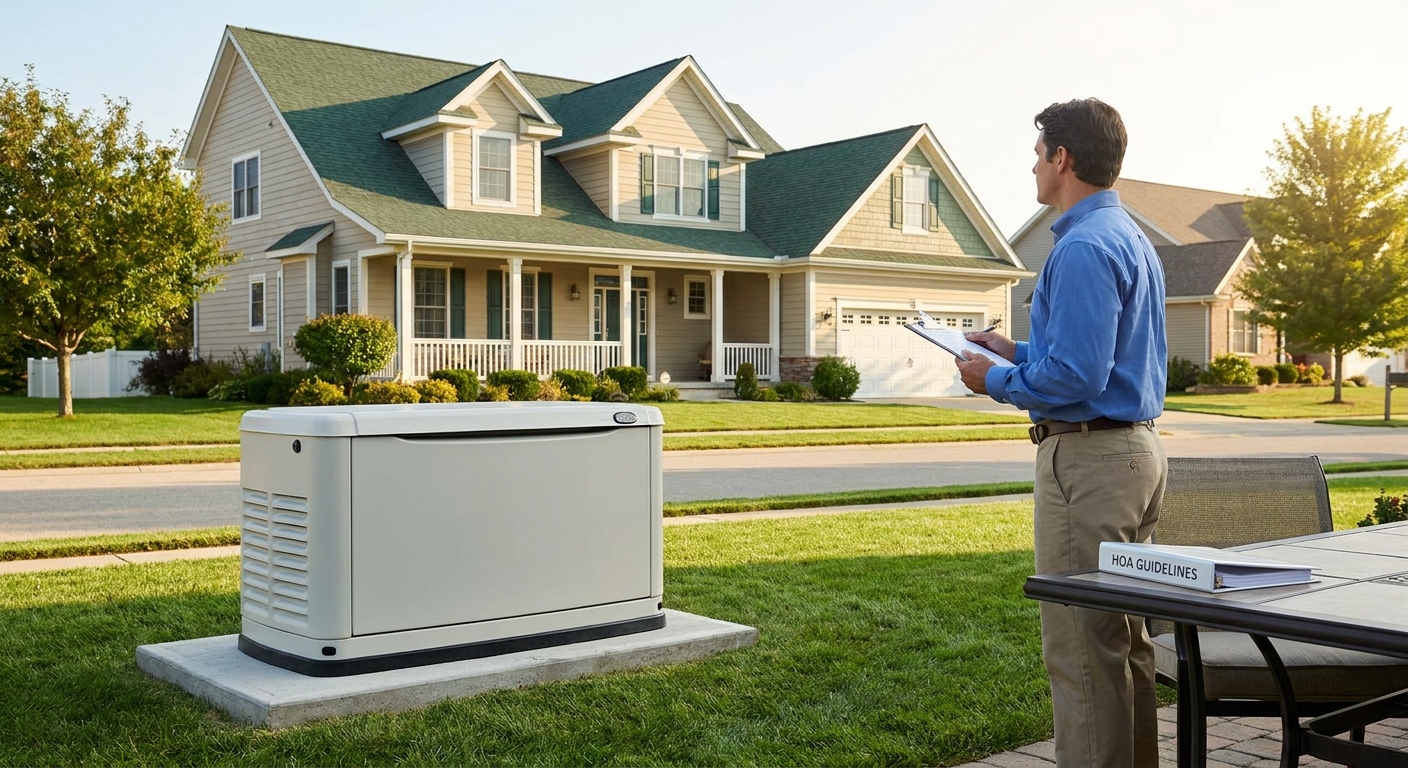
- Pull your HOA's architectural guidelines before you get a quote - setback and noise rules vary by neighborhood.
- Submit sound rating (dBA at 23 feet) and a site plan with your first request; incomplete applications cause most 2026 denials.
- Baldwin County permits and HOA approval are separate processes - you need both before installation, not one or the other.
- Whole-home standby generators from Kohler and Generac run 58-68 dBA at 23 feet, quiet enough for most HOA noise caps.
- Verdict: get HOA approval before you sign an install contract, not after - reversing an approved install costs more than waiting three weeks.
Why this matters
Hurricane season runs June through November on the Gulf Coast, and HOA boards in gated and deed-restricted communities across Baldwin County get flooded with generator requests every spring. A denied or delayed application means another storm season with a portable generator and extension cords running through a window.
Boards don't reject standby generators outright in 2026 - most coastal Alabama HOAs have added generator provisions to their covenants since 2020 because demand outpaced their original rules. What gets applications denied is missing information: no sound spec, no site plan, no setback measurement from the property line.
A licensed electrical contractor who's installed generators across Fairhope and Gulf Shores HOAs knows exactly what boards ask for, because the same five questions come up every time.
What you'll need
- A copy of your HOA's CC&Rs (Covenants, Conditions & Restrictions) and architectural review guidelines
- A site plan showing the proposed generator location relative to property lines, setbacks, and neighboring structures
- The manufacturer's sound rating in dBA at 23 feet (Kohler, Generac, Honeywell, and Briggs & Stratton all publish this)
- A written scope from your installer covering unit size in kW, fuel type (propane or natural gas), and pad or mounting details
- Your county building permit application, filed separately from HOA approval
- 30-45 days of lead time before hurricane season if you want the unit installed and tested by June
The steps
1. Pull your HOA's governing documents first
Read the CC&Rs and any architectural review guidelines before you talk to an installer. Generator-specific language usually falls under "exterior improvements" or "mechanical equipment" sections, and it often specifies setback distance, screening requirements, and whether a variance is needed.
Some Baldwin County HOAs cap noise at 60-65 dBA measured at the property line; others require the unit to be screened from street view with landscaping or fencing. Skipping this step is the number one reason applications bounce back for revision in 2026.
Common mistake: assuming HOA rules mirror county code. They don't - a generator can meet every Baldwin County electrical and fuel-line requirement and still violate a stricter HOA setback rule.
2. Check municipal permit requirements alongside HOA rules
HOA approval and a county or city building permit are two separate processes that run in parallel, not sequentially. Foley, Fairhope, and Daphne each have their own permit requirements for generator pads, fuel lines, and electrical transfer switches.
Get the permit checklist from your local building department the same week you request HOA documents. This lets your installer size the unit and plan the fuel line once, instead of redesigning it after a board rejects the first layout.
Common mistake: installing before the permit is finalized because the HOA approved the plan first. HOA sign-off never substitutes for a county permit.
3. Get a site plan and sound rating from your installer
Ask your installer for a scaled site plan showing the generator's exact placement, distance to the property line, distance to neighboring windows, and orientation of the exhaust. Pair it with the manufacturer's published sound rating at 23 feet - most 22kW to 26kW Kohler and Generac whole-home units run 58-68 dBA, comparable to a running dishwasher.
This single document answers the two questions every HOA architectural review committee asks first: how far away is it, and how loud is it. Boards approve faster when both numbers are on the page instead of buried in a spec sheet.
Expected outcome: a one-page site plan you can attach directly to the HOA application, no follow-up requests needed.
4. Submit the architectural review request with specs attached
File the formal request through whatever process your HOA uses - an online portal, a paper form, or a submission to the property management company. Attach the site plan, the sound rating, the fuel type, and a photo or rendering of the unit if the board requires visual review.
Include the installer's license number and insurance certificate if your HOA guidelines mention contractor verification. A complete packet gets a decision in 2-4 weeks; an incomplete one gets tabled until the next board meeting, which can add another 30 days.
Common mistake: submitting a verbal description instead of a scaled drawing. Boards vote on paper, not conversations.
5. Address setback, noise, and screening proactively
If your HOA's guidelines require screening - a fence, shrubs, or a lattice enclosure - propose it in the initial submission rather than waiting for the board to ask. Boards approve faster when the applicant has already solved the aesthetic concern.
For lots with tight side yards common in Fairhope and Daphne subdivisions, confirm the generator's required clearance from the house (check the manufacturer's install manual) doesn't conflict with the HOA's minimum property-line setback. A 3-foot code clearance and a 10-foot HOA setback can both be true at once - plan the pad location around whichever is stricter.
Expected outcome: no follow-up questions from the architectural review committee.
6. Attend the board meeting if it's required
Many Baldwin County HOAs require architectural requests above a certain cost or size threshold to go before the full board rather than a review committee. Check your guidelines - if a board vote is required, attend in person or submit written comments addressing the specific criteria in the covenants.
Bring the same site plan and sound rating. Boards move faster when the applicant is present to answer a follow-up question on the spot instead of tabling the item for a written response.
Common mistake: skipping the meeting and hoping the paperwork speaks for itself. A five-minute in-person answer often clears a question that would otherwise cost three more weeks.
7. Get approval in writing before installation begins
Don't schedule installation off a verbal "yes" from a board member or property manager. Get the written approval letter or the signed architectural review form before your installer breaks ground on the pad.
Keep this letter with your homeowner's insurance file - some coastal Alabama insurers ask for proof of HOA-approved permanent equipment when adjusting a claim after a storm.
Expected outcome: a dated, signed approval you can reference if a neighbor complains after installation.
8. Schedule installation after final sign-off
Once both the HOA approval letter and the county permit are in hand, schedule the installation. Baldwin County Generators and other licensed contractors typically need 1-2 weeks lead time to schedule the crew, pour the pad, and run the fuel line and transfer switch.
Time this before hurricane season peaks - units installed and commissioned by late May are tested and ready before the first named storm threatens the coast.
Get your generator quote before storm season
Licensed installers who know Baldwin County HOA and permit requirements.
Troubleshooting
Board says the sound rating is too high. Ask your installer about a sound-reducing enclosure or relocating the unit farther from the property line - most manufacturers offer both options without changing the kW output.
Neighbor objects during the comment period. Offer to adjust screening or orientation of the exhaust away from their windows; boards often approve once a documented compromise is on file.
Application sits for more than 30 days with no response. Check your CC&Rs for a default-approval clause - many Alabama HOA governing documents state that a request is deemed approved if the board doesn't respond within a set window, often 30 or 45 days.
Permit and HOA approval conflict on setback distance. The stricter of the two rules governs. Adjust the site plan to the tighter number rather than assuming one approval overrides the other.
Board asks for a variance because the lot doesn't meet standard setback. Request the variance in the same submission as the generator approval - running them separately doubles your wait time.
HOA requires a professional engineer stamp on the site plan. Confirm this early; it's uncommon but some master-planned coastal communities require it for any permanent exterior equipment installed after 2022.
Tools and resources
- Your HOA's CC&Rs and architectural review guidelines (request from your property management company)
- County or city building permit portal for Daphne, Fairhope, Foley, or Gulf Shores
- Manufacturer spec sheets for sound rating and clearance requirements (Kohler, Generac, Honeywell, Briggs & Stratton)
- A licensed electrical contractor's site plan and scope of work
- Baldwin County Generators for sizing, permitting guidance, and installation across coastal Alabama
What to do next
Once HOA approval and the county permit are both signed, the next decision is sizing the unit correctly for your home's electrical load - a 22kW unit covers most 2,500-3,000 square foot homes, while larger homes with well pumps or multiple HVAC zones need 26kW or higher. Get that sizing conversation started with your installer before you finalize the site plan, since a larger unit sometimes changes the pad footprint and the setback math your HOA already approved.
FAQ
How long does HOA approval for a standby generator take in 2026?
Most Baldwin County HOAs decide within 2-4 weeks when the application includes a site plan and sound rating. Incomplete submissions can add another 30 days if the board tables the request for revision.
Do I need both HOA approval and a county permit?
Yes, HOA approval and a county or city building permit are separate requirements that run in parallel. Neither one substitutes for the other, and installation should wait until both are finalized.
How loud is a whole-home standby generator?
Most 22kW to 26kW Kohler and Generac units run 58-68 dBA at 23 feet, close to a running dishwasher. Sound-reducing enclosures are available if your HOA's noise cap is stricter.
What setback distance do HOAs require for generators?
Setback rules vary by community, but many Baldwin County HOAs require 5-10 feet from the property line in addition to the manufacturer's minimum clearance from the house. Check your specific CC&Rs since the stricter of the two rules always governs.
Can my HOA deny a standby generator request outright?
Most coastal Alabama HOAs allow standby generators with conditions rather than outright denial, since storm preparedness is a common priority in the region. Denials in 2026 usually trace back to missing paperwork rather than a blanket ban.
What happens if the HOA board never responds to my application?
Check your CC&Rs for a default-approval clause; many Alabama HOA governing documents deem a request approved if the board misses a 30- or 45-day response window. Get this in writing from your property management company if it applies.
Does screening or fencing help get generator approval faster?
Yes, proposing screening in your initial submission rather than waiting for the board to request it speeds up approval. Fencing, lattice, or landscaping around the unit addresses the aesthetic concern most architectural review committees raise first.
Should I install the generator before HOA approval is finalized?
No, wait for written HOA approval before installation begins. Installing first risks a forced relocation or removal order, which costs far more than the 30-45 days most applications take to clear.
One last thing
The HOA approval letter isn't just paperwork for the board - some coastal Alabama homeowner's insurers ask for it when adjusting a claim on permanent exterior equipment after a hurricane. Keep the signed letter and the county permit together in one file, because that pairing is what an adjuster or a future buyer will ask for, not the installer's invoice.