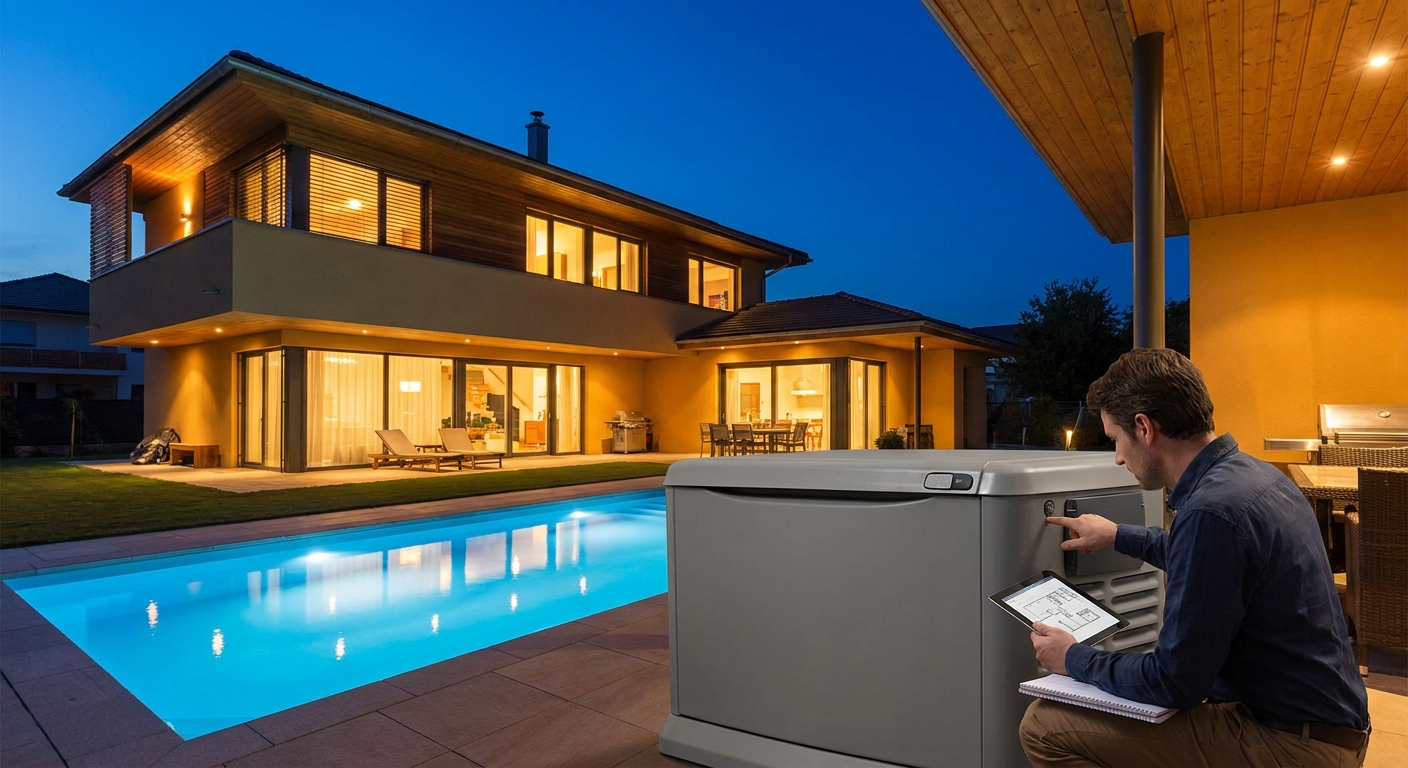
Sizing a standby generator for a home with a pool means adding pump, heater, and salt chlorinator loads on top of your normal house circuits - get the math wrong and the unit trips every time the pump kicks on. This guide walks through the actual amp-to-watt conversion so you land on a kW number a licensed electrician can confirm before installation.
- A single-speed pool pump adds 950-2,500 running watts and up to 7,500 starting watts to your load.
- Most coastal Alabama homes with a pool need a 22kW to 26kW standby generator, not the base 14kW unit.
- Variable-speed pumps cut starting wattage by roughly 60% versus single-speed models - factor this in before sizing down.
- Skip the guesswork: a licensed electrician's load calculation catches subpanel and heater loads a DIY tally misses.
Why this matters
A generator undersized by even 3kW will run your refrigerator and lights fine, then trip the moment the pool pump's start-up surge hits it. That's the most common service call Baldwin County Generators gets in the months after installation - homeowners who sized for the house and forgot the pool. Getting the load calculation right in 2026, before a storm forces the issue, means the whole system runs instead of shutting down every few hours.
Pool equipment behaves differently from a refrigerator or a light fixture. Motors draw far more amperage the instant they start than they do once running, and that starting surge is what actually determines generator size - not the running wattage most people calculate first.
What you'll need
- Nameplate data (volts, amps, or watts) from your pool pump, heater, and any salt chlorinator or automation panel
- Your home's electrical panel schedule or a walk-through of breaker labels
- A calculator or spreadsheet - even simple addition works if you keep units consistent
- A clamp meter, if you want to confirm actual running amps rather than nameplate estimates
- Contact information for Baldwin County Generators if you want a licensed electrician to verify the final number
The steps
1. List every circuit tied to the pool
Walk your panel and note every breaker feeding pool equipment: pump, heater, salt chlorinator, pool lights, and any automation controller. Homes in Fairhope and Gulf Shores with in-ground pools typically run 3 to 5 separate circuits just for pool gear, separate from the house panel.
Miss one circuit and your total load calculation comes in low, which is the single biggest reason a newly installed generator underperforms in its first storm.
2. Find running and starting watts for the pump
Check the pump's nameplate for amps and volts, then multiply (amps x volts = watts) to get running wattage. A single-speed pool pump typically runs at 950 to 2,500 watts, while a variable-speed pump often runs lower, around 400 to 1,100 watts at cruising speed.
Starting watts matter more for sizing. Single-speed pumps can spike to 2.5-3x running wattage on startup - meaning a 2,000-watt running pump can briefly demand 5,000 to 6,000 starting watts. Variable-speed models soften that spike significantly, often staying under 2,000 starting watts.
Common mistake: using only the running wattage from the nameplate and ignoring the starting surge - this is the number one cause of a generator that trips on pump startup.
3. Add whole-home loads you want backed up
List the rest of what you want the generator to carry: HVAC (3,500-5,000 running watts for a typical coastal Alabama central unit), refrigerator (600-800 watts), well pump if applicable, and general lighting/outlet circuits.
Add these running watts together first, separate from the pool numbers, so you can see the whole-home baseline before layering in pool equipment.
4. Add the pool heater if you're backing it up
A heat pump pool heater draws 4,700 to 6,000 running watts - enough on its own to push a marginal generator over capacity. A gas or propane pool heater only needs power for ignition and controls, usually under 300 watts, making it far easier to support during an outage.
Decide now whether the heater runs during an outage or stays off - that decision alone can shift your generator size by a full class.
5. Combine running loads, then check the starting surge
Add every running-watt figure together: house loads plus pool pump plus heater (if included). This total is your continuous running load, and it's what the generator must sustain hour after hour.
Then check your single largest starting-watt item - usually the pool pump or the HVAC compressor - and confirm the generator's surge rating covers it on top of everything else already running. Most 22kW-26kW standby units carry enough surge capacity for a single-speed pump plus a running AC unit, but it's worth confirming against the manufacturer's chart.
Common mistake: sizing only to the running total and never checking whether the generator's surge rating covers the pump's starting spike layered on top of an already-running house load.
6. Match your total to a standby generator size
Homes with a pool and central AC in Daphne, Foley, or Gulf Shores commonly land in the 22kW to 26kW range once pump, heater controls, and house loads are combined. Larger homes with heat pump pool heaters and dual HVAC systems often move up to 32kW-48kW units.
Kohler and Generac both publish load charts by model - cross-reference your total kW against the manufacturer's chart rather than rounding up on instinct.
7. Confirm with a licensed load calculation
A DIY tally gets you close, but a licensed electrician runs a formal load calculation (NEC Article 220) that accounts for demand factors, diversity, and code requirements your spreadsheet won't catch. Baldwin County Generators performs this calculation as part of every installation quote in 2026, and it's the step that prevents an undersized unit from reaching your driveway.
Troubleshooting
- Generator trips every time the pool pump starts - the surge rating is too low for the pump's starting watts; either upsize the generator or add a soft-start device to the pump.
- Pool heater won't run alongside AC - combined running load exceeds capacity; stagger the heater and AC on a load management module instead of running both simultaneously.
- Variable-speed pump still spikes on startup - some VS pumps briefly draw full-speed startup watts before settling; check the pump's actual startup curve, not just its cruising wattage.
- Voltage sags when the pump kicks on - this usually signals the generator is running near its ceiling; a load calculation review will show whether you need a larger unit or a transfer switch adjustment.
- Transfer switch doesn't include the pool subpanel - confirm during installation that the pool's dedicated subpanel is wired into the transfer switch, not just the main house panel.
- Salt chlorinator resets after every outage cycle - low-draw electronics can be sensitive to brief power fluctuations; a whole-home standby unit with a fast transfer time (typically under 10 seconds) usually resolves this.
Tools and resources
- Manufacturer load charts from Kohler and Generac, cross-referenced against your total kW
- A clamp meter to verify actual running amps instead of relying on nameplate estimates alone
- NEC Article 220 as the reference standard for a formal load calculation
- A licensed electrician's site visit - Baldwin County Generators includes this in every installation quote across Daphne, Fairhope, Foley, and Gulf Shores
What to do next
Once you have a rough kW total, don't install based on a spreadsheet alone. A licensed electrician verifying the number against your panel and pool equipment nameplate is the difference between a generator that carries the whole house through hurricane season and one that trips every afternoon the pump runs. Reach out for a formal load calculation and quote before storm season peaks in 2026.
FAQ
How many kW does a generator need for a house with a pool?
Most homes with a pool and central AC need a 22kW to 26kW standby generator in 2026, though larger homes with heat pump pool heaters often require 32kW or more. The exact number depends on pump type, heater choice, and total house load.
Does a pool pump need extra generator capacity?
Yes, a pool pump's starting watts can run 2.5 to 3 times its running watts, so a 2,000-watt pump can briefly demand 5,000-6,000 starting watts. This surge, not the running wattage, is what determines whether a generator can support it.
Is a variable-speed pool pump easier to run on a generator?
Yes, variable-speed pumps typically draw 400-1,100 running watts and produce a much smaller starting surge than single-speed pumps. This makes them easier to support on a smaller standby generator.
Can a generator run a pool heater and AC at the same time?
It depends on total capacity - a heat pump pool heater alone draws 4,700-6,000 running watts, which combined with a central AC unit can exceed a mid-size generator's rating. A load management module can stagger the two so they don't run simultaneously.
How do I calculate generator load for a home with a pool?
Add the running watts of your house circuits, pool pump, and heater together, then check the single largest starting-watt item against the generator's surge rating. A licensed electrician's formal load calculation confirms the number against NEC standards before installation.
What size generator do I need for a pool pump alone?
A single-speed pool pump alone typically needs a generator that can handle 5,000-7,500 starting watts, even though its running wattage is only 950-2,500 watts. Most whole-home standby units in the 20kW range or larger cover this without issue.
Does a gas pool heater need less generator power than an electric one?
Yes, a gas or propane pool heater only draws power for ignition and controls, usually under 300 watts, compared to 4,700-6,000 watts for a heat pump pool heater. This makes gas heaters far easier to keep running during an outage.
Should I get a professional load calculation before buying a generator?
Yes, a DIY wattage tally gets you close, but a licensed electrician's load calculation accounts for code demand factors and diversity that a spreadsheet misses. This step is what prevents an undersized generator from tripping once installed.
One last thing
The number that trips up most homeowners isn't the pump's running wattage - it's the starting surge, and it's rarely printed clearly on the equipment label. If your pool pump's nameplate only lists running amps, ask the manufacturer or your installer for the locked-rotor amperage figure before you finalize a generator size for 2026.