Medical equipment doesn't pause for a storm outage, and a standard generator sized for lights and a refrigerator won't necessarily keep an oxygen concentrator or a home dialysis machine running clean. This guide breaks down what to look for in home generator installation for medical equipment, who needs it, and which setups actually hold up during a coastal Alabama outage.
TL;DR
If someone in your home depends on an oxygen concentrator, CPAP, home dialysis, a feeding pump, or refrigerated medication, a whole-home standby unit in the 14kW to 22kW range with an automatic transfer switch is the baseline for home generator installation medical equipment needs - not a portable unit you have to fuel and start by hand. Baldwin County Generators installs Kohler, Generac, Honeywell, and Briggs & Stratton standby systems across Daphne, Fairhope, Foley, and Gulf Shores, and for medical-dependent households the Buy pick is a 22kW automatic-start unit with at least a 200-amp transfer switch - a portable inverter generator is a Skip for anyone on life-sustaining equipment. Sizing, transfer speed, and fuel supply matter more than brand name here, and 2026 hurricane season planning should start before storm watches go up, not during them.
Why this matters
A power outage that's an inconvenience for most households is a medical emergency for a household running an oxygen concentrator, a home ventilator, or refrigerated insulin. Oxygen concentrators and CPAP machines need continuous, clean power - not the surging output of an undersized or aging portable unit. Dialysis at home and enteral feeding pumps run on tight schedules that don't wait for someone to physically start a generator at 2 a.m.
Coastal Alabama sees extended outages during and after tropical storms, and outages that stretch past 24 to 48 hours are common in the wake of a direct hit. A whole-home standby system with automatic transfer switches over in about 10 seconds, before backup batteries on most medical devices even deplete. That gap between manual portable units and automatic standby systems is the entire decision for a household with medical equipment on-site.
Who this is for
This guide is for homeowners in Baldwin County and the surrounding Gulf Coast who have someone in the household relying on powered medical equipment - oxygen concentrators, home dialysis, ventilators, feeding pumps, motorized wheelchairs and lift chairs, or refrigerated medications like insulin. It's also for caregivers managing a parent or family member with a home health aide who depends on continuous power for monitoring equipment. If your only concern is keeping the lights and the fridge on, a smaller portable unit may be adequate - this guide is written for households where a power gap isn't an inconvenience, it's a health risk.
What to look for in home generator installation for medical equipment
Automatic transfer switch, not manual start
A manual-start portable generator requires someone to physically go outside, fuel it, and start it - every single time. For a household with a medical device running on battery backup measured in hours, not days, that delay can matter. An automatic transfer switch detects the outage and starts the generator without anyone lifting a finger, typically within about 10 seconds of the grid dropping.
Sizing that covers HVAC and medical circuits at once
Undersizing is the most common mistake in home generator installation for medical equipment needs. A 10kW unit might run a refrigerator and a few lights, but add central air conditioning (critical for temperature-sensitive medications and for patient comfort during recovery) plus a dedicated medical equipment circuit, and you need 14kW to 22kW depending on home size. Get a load calculation done, don't guess.
Dedicated, code-compliant circuit for the equipment
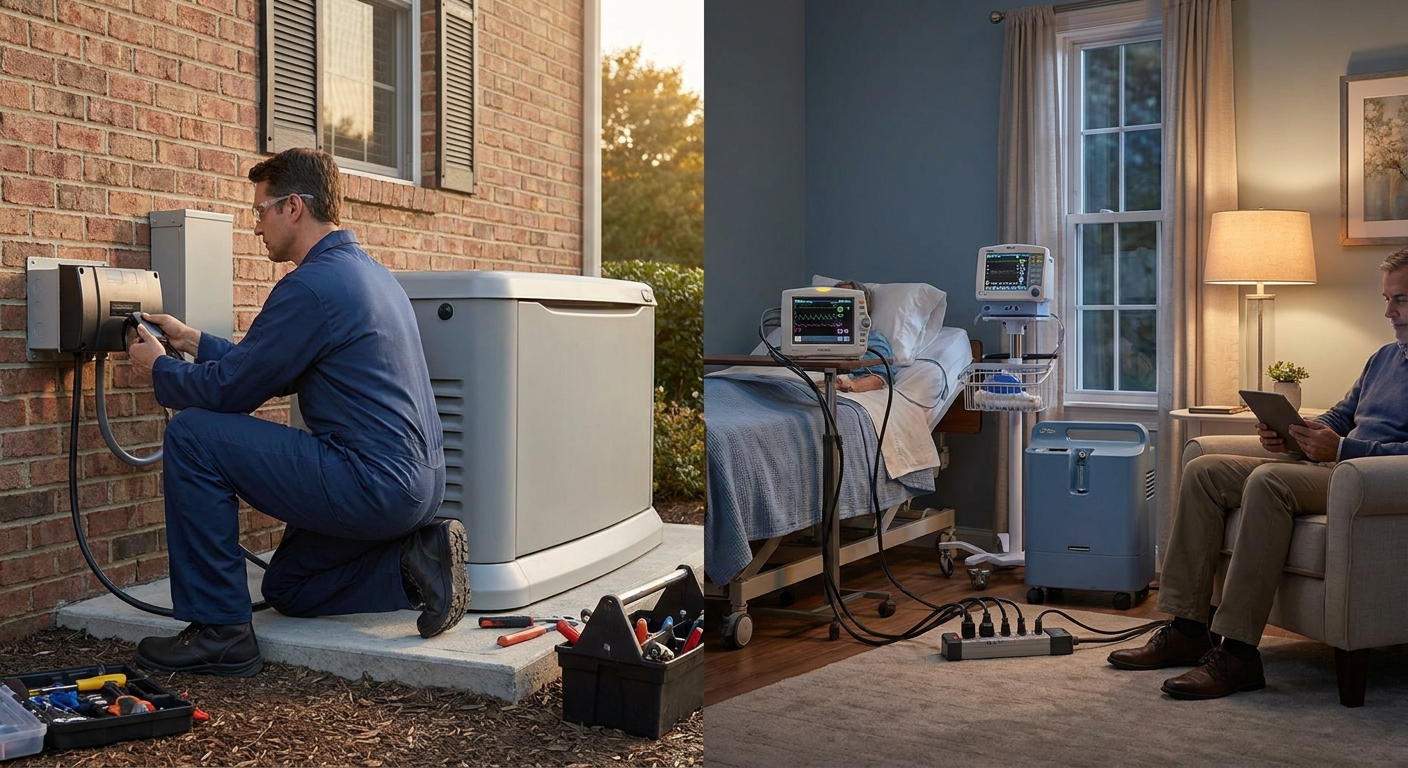
Oxygen concentrators, dialysis machines, and ventilators should run on a dedicated circuit wired directly into the transfer switch panel, not sharing a circuit with kitchen appliances or general household loads. A licensed electrical contractor identifies which circuits are essential and wires the transfer switch to prioritize them.
Fuel source reliability
Natural gas and propane-fed standby units run continuously as long as the fuel supply holds, unlike gasoline generators that need refueling every 8 to 12 hours. For a household where the generator might need to run for days after a hurricane, a natural gas hookup or a properly sized propane tank removes the refueling problem entirely.
Remote monitoring and self-test cycles
Standby units from Kohler, Generac, and Honeywell run scheduled self-test cycles (often weekly) to confirm the unit starts and the battery holds charge. Look for a system with remote monitoring or an app alert, so you know before a storm hits whether the unit is ready, not during the outage when it's too late to fix.
Licensed installation and permitting
Generator installation involves gas line work, electrical panel modification, and local permitting in Baldwin County municipalities. A licensed, insured electrical contractor pulls the permits, sizes the system correctly, and inspects the transfer switch wiring - an unlicensed install risks code violations and, more importantly, a system that fails when a medical device needs it most.
Top picks for medical-dependent households
Generac - the popular pick. Generac's residential standby line covers 14kW to 24kW, with WiFi-enabled monitoring that alerts you to a failed self-test before an outage happens. For a household running an oxygen concentrator plus HVAC, the 22kW model with a 200-amp transfer switch is a common fit. Buy for most medical-equipment households needing broad circuit coverage.
Kohler - the quiet-running pick. Kohler standby units run noticeably quieter at full load, which matters if the generator sits near a bedroom window where a patient is trying to rest during an extended outage. The 20kW model handles a dedicated medical circuit plus central air without issue. Buy if noise near living space is a concern.
Honeywell - the budget-conscious pick. Honeywell (built on Generac's platform) offers similar transfer-switch technology at a lower entry point, typically in the 14kW to 20kW range. It covers essential medical circuits and HVAC for smaller homes. Consider for a single-story home under 2,000 square feet; Skip if you need to run a larger home with multiple HVAC zones.
Briggs & Stratton - the value pick. Briggs & Stratton standby units cover the 10kW to 20kW range and handle basic medical equipment plus lighting circuits reliably. They lack some of the app-based monitoring features of Generac and Kohler. Consider if budget is the primary driver and you're comfortable with manual self-test checks instead of remote alerts.
Portable inverter generators - the tempting shortcut. These run $500 to $2,000 and seem like an easy stopgap. They require manual start, manual refueling every several hours, and can't be wired into a dedicated medical circuit safely without a manual transfer switch and constant supervision. Skip for any household with a life-sustaining medical device.
What to avoid
- Undersized units marketed as "whole-home" that only cover 8-10 circuits. Some budget standby packages advertise whole-home coverage but actually shed HVAC and non-essential circuits during heavy load - check the load management settings before assuming your medical circuit stays powered under full draw.
- Extension cords from a portable generator into the house. This is a fire hazard and it also can't sustain the steady voltage a sensitive medical device needs - it's a backfeed risk to top it off.
- Skipping the load calculation to save on the installation quote. A generator sized on a guess instead of an actual electrical load assessment is the single most common reason a standby system fails to run HVAC and medical equipment simultaneously.
Verdict comparison
| Brand | kW Range | Transfer Switch Speed | Remote Monitoring | Verdict |
|---|---|---|---|---|
| Generac | 14kW–24kW | ~10 seconds | Yes (app) | Buy |
| Kohler | 12kW–20kW | ~10 seconds | Yes (app) | Buy |
| Honeywell | 14kW–20kW | ~10 seconds | Limited | Consider |
| Briggs & Stratton | 10kW–20kW | ~10 seconds | Basic | Consider |
| Portable inverter | N/A (manual) | Manual, minutes | No | Skip |
FAQ
What's the best generator size for a home with an oxygen concentrator? A 14kW to 22kW standby generator covers an oxygen concentrator, refrigeration for medication, and central HVAC in most single-family homes. The exact size depends on square footage and how many circuits need coverage - a licensed contractor runs the load calculation.
Is a standby generator better than a portable for medical equipment? Yes. A standby generator with an automatic transfer switch starts within about 10 seconds of an outage with no manual intervention, while a portable requires someone to fuel and start it by hand - a gap that matters for equipment running on limited battery backup.
How much does home generator installation for medical equipment cost? Costs vary by home size, unit capacity, and whether gas line or panel work is needed - get a site-specific quote rather than relying on a generic estimate, since medical-priority circuit wiring adds to a standard install.
Can Medicare or insurance help pay for a generator for medical equipment? Some insurance plans and Medicare Advantage plans cover portable backup power for specific durable medical equipment, but whole-home standby systems are typically not covered - check directly with your provider before assuming coverage.
How often should a standby generator be tested? Most standby units run an automatic self-test weekly, cycling the engine for several minutes to confirm it starts. Confirm the self-test schedule with your installer and don't wait for hurricane season to find out it's not running.
Do I need a permit to install a home generator in Baldwin County? Yes. Generator installation involving gas lines and electrical panel work requires local permitting, and a licensed electrical contractor handles that as part of the install.
How long can a standby generator run during an extended outage? A natural gas or properly sized propane unit can run continuously for as long as the fuel supply holds, which is why fuel source matters more for extended outages than for a quick evening blip.
What happens if the generator fails during a storm? Remote monitoring alerts you to a failed self-test or low fuel before the storm hits, which is why monitoring matters more for medical-dependent households than for a household that just wants the lights on.
One last thing
The detail most households miss isn't the generator size - it's the transfer switch amperage. A 22kW generator paired with an undersized 100-amp transfer switch still won't run HVAC and a dedicated medical circuit at the same time under full load; the switch, not just the generator, has to match the home's total demand. Ask your installer to confirm the transfer switch amperage matches your panel size before signing off on a 2026 install, not after the first outage exposes the gap.