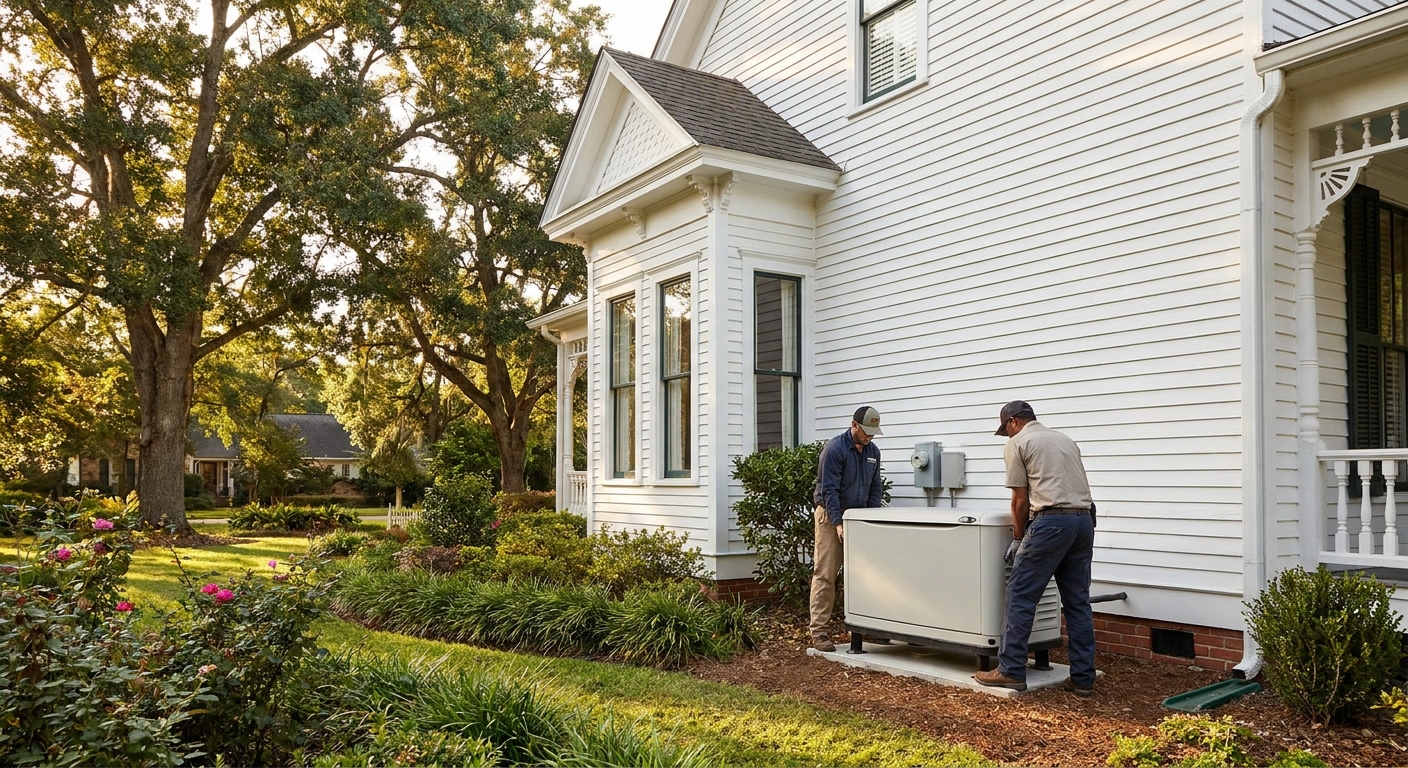
Historic homes in Fairhope, Daphne, and downtown Foley come with electrical panels older than the people living in them, plus preservation rules that don't care how badly you want a generator during hurricane season. Here's what actually gets a standby unit installed on a historic property in Baldwin County without a permitting fight or a blown panel.
- Generator installation for historic homes in Baldwin County starts with a panel inspection, not a generator brand - buy the unit second.
- Kohler and Generac units in the 20-24kW range cover most 1920s-1960s Fairhope and Daphne homes with original 100-amp service upgraded to 200-amp. Buy.
- Historic district review boards in Fairhope and Daphne require screening and setback documentation before install - budget 2-4 weeks for approval in 2026.
- Skip any installer who wants to run new circuits through original knob-and-tube wiring without a full panel replacement first.
Why this matters
A standard generator install assumes a modern 200-amp panel, a flat concrete pad location with no setback conflicts, and no one asking what the enclosure looks like from the street. None of that holds in Baldwin County's older neighborhoods.
Fairhope's historic district and parts of downtown Daphne have architectural review requirements that apply to visible mechanical equipment, generators included. Homes built before 1960 frequently still carry partial original wiring even after a panel upgrade, and older brick or pier-and-beam foundations don't always support a generator pad the way a modern slab does. Get any of this wrong and you're looking at a failed inspection or a rejected permit in 2026, not just a delay.
Who this is for
This guide is for owners of pre-1960 homes in Fairhope, Daphne, Foley, or Gulf Shores - especially properties inside a designated historic district or on a local historic register - who want a whole-home or partial-home standby generator installed without violating preservation rules or overloading original electrical infrastructure.
What to look for in generator installation for historic homes
Panel age and amperage
Most pre-1970 homes in coastal Alabama started with 60-amp or 100-amp service, and a chunk of them were upgraded to 200-amp at some point without full documentation. Confirm the panel's actual amperage and age before sizing a generator - an undersized panel forces a costly upgrade mid-project instead of a planned one.
Historic district permitting rules
Fairhope's historic overlay district and similar zones in Daphne require review of exterior equipment placement, and that includes generator enclosures. Applications submitted without screening or setback details get bounced back, adding weeks to a project that should take days.
Placement and setback compliance
Historic lots tend to be narrower and have less usable side-yard space than newer subdivisions. Local code typically requires 5 feet of clearance from windows, doors, and property lines - on a historic lot with a narrow side yard, that measurement can rule out the obvious spot and force a rear-yard install instead.
Noise near historic streetscapes
Historic neighborhoods in Fairhope and downtown Daphne have closer-set homes and more foot traffic than newer developments. A generator running at 65-68 decibels at 23 feet - the rated level for most residential 20-24kW air-cooled units - is noticeable in a tight historic streetscape in a way it wouldn't be on a half-acre suburban lot.
Foundation and pad support
Pier-and-beam and brick pier foundations common in pre-1950s Baldwin County homes don't automatically give you a stable, level surface for a generator pad. The pad needs its own engineered base independent of the home's original foundation - skipping this step is the single most common reason a generator settles or shifts within its first year.
Existing wiring compatibility
Any remaining knob-and-tube or ungrounded circuits need to be identified before a transfer switch goes in. Running a modern automatic transfer switch off wiring that predates 1960 without full remediation creates a fire risk the switch can't compensate for.
Get a historic-home site evaluation
Baldwin County Generators checks your panel, wiring, and setback before quoting a unit.
Top picks for historic Baldwin County homes
Kohler 20kW-24kW air-cooled - the safe pick. Runs a 200-amp home with central HVAC, and the enclosure options include smaller footprints that fit tighter historic side yards. Sound rating around 67 dB at 23 feet keeps it workable in close-set neighborhoods. Buy if your panel is already at 200 amps.
Generac 22kW Guardian series - the volume pick, easy to source parts and service for across coastal Alabama. Standard footprint runs roughly 48 by 25 inches, which needs careful setback math on a narrow historic lot. Buy if your side yard clears 5 feet from the property line and you want fast local parts availability.
Honeywell 20kW standby - the value pick for homes where budget matters more than brand recognition. Comparable output to the Kohler and Generac options in this range at a lower typical price point, but confirm local parts and service support before committing. Consider for secondary or lower-priority historic properties.
Briggs & Stratton 17kW-20kW - the smaller-footprint pick for tight historic lots where a full 24kW unit's enclosure won't clear setback rules. Lower output means selective circuit coverage rather than whole-home, so plan which circuits matter most. Consider if lot size is the deciding constraint, not budget.
Portable generator with manual transfer switch - the stopgap, not the standby solution. No permanent enclosure, no historic district screening review required, but manual startup during a storm and limited circuit coverage. Skip for a primary home; fine as a temporary bridge while a permanent unit is on order.
What to avoid
- Oversized liquid-cooled units built for large modern homes - the footprint and required clearances rarely work on a historic lot, and most historic-home electrical loads don't need that output anyway.
- Non-compliant screening or enclosure colors that violate a historic district's visual standards - this is the single most common reason permits get rejected in Fairhope's overlay district.
- Any installer proposing a transfer switch tie-in before verifying the panel and remaining original wiring - this looks like a fast install and turns into a rework project once an inspector flags it.
Verdict comparison
| Generator | Typical output | Footprint fit | Sound at 23 ft | Verdict |
|---|---|---|---|---|
| Kohler air-cooled | 20-24kW | Compact, historic-lot friendly | ~67 dB | Buy |
| Generac Guardian | 22kW | Standard, needs setback check | ~67 dB | Buy |
| Honeywell standby | 20kW | Standard | ~68 dB | Consider |
| Briggs & Stratton | 17-20kW | Smallest of the group | ~65 dB | Consider |
| Portable + manual switch | Varies | No fixed enclosure | Varies | Skip (primary use) |
FAQ
Do historic homes in Fairhope need special permits for generator installation?
Yes, homes inside Fairhope's historic overlay district need architectural review for exterior equipment placement, including generator enclosures. Budget 2-4 weeks for review in 2026 on top of standard permitting time.
What size generator does a historic home in Baldwin County need?
Most pre-1960 homes with an upgraded 200-amp panel run well on a 20-24kW air-cooled unit. Homes still on 100-amp service need a panel upgrade first, which changes the sizing math.
Can a generator be installed without disturbing original wiring?
A properly installed transfer switch taps into the main panel and doesn't require rewiring the whole house, but any remaining knob-and-tube or ungrounded circuits should be identified and remediated first. Skipping that step is a fire risk, not a shortcut.
How close can a generator sit to a historic home's windows?
Most local codes require 5 feet of clearance from windows, doors, and property lines regardless of the home's age. Historic lots with narrow side yards often force a rear-yard placement instead of the obvious side location.
Is Kohler or Generac better for a historic home installation?
Both perform similarly in the 20-24kW range for sound and output; Kohler's compact enclosure options tend to fit tighter historic lots slightly better, while Generac offers faster local parts availability across coastal Alabama.
Does a historic home need a foundation inspection before generator installation?
Yes. Pier-and-beam and brick pier foundations common in pre-1950s homes don't automatically support a generator pad, so the pad needs its own engineered base independent of the original foundation.
How loud is a standby generator near a historic streetscape?
Most residential 20-24kW air-cooled units run 65-68 decibels at 23 feet, which is noticeable in a tight historic neighborhood with close-set homes compared to a suburban half-acre lot.
Can a portable generator work instead of a standby unit for a historic home?
A portable generator with a manual transfer switch works as a temporary bridge but requires manual startup during a storm and covers fewer circuits. It's not a substitute for a permanent standby installation on a primary residence.
One last thing
The part most homeowners miss isn't the generator - it's the panel. A 2026 install on a historic Baldwin County home that starts with the generator choice instead of the panel inspection ends up redone within the first year more often than not, because the amperage or wiring gets discovered after the unit is already on order.
A site evaluation that checks panel age, remaining original wiring, setback distances, and foundation type before quoting a unit is the difference between a permit approved on the first pass and one bounced back twice.