Farms across Baldwin County lose power just as often as they lose patience with it - a downed line during calving season or a dead well pump during peak irrigation can cost more in a single day than a generator costs installed. This guide breaks down what a working farm actually needs from a standby system, not what a homeowner catalog assumes you need.
- Generator installation for farms starts at 22kW for a well pump and barn circuit, scales past 48kW for dairy or poultry operations.
- Kohler and Generac units with automatic transfer switches are the safe pick for coastal Alabama farms in 2026.
- Propane systems with 500-gallon-plus tanks outlast diesel for week-long outages after hurricane season storms.
- Skip undersized portable units for livestock ventilation and grain dryers - they trip breakers under real load.
Why this matters
A residential-grade generator sized for a kitchen fridge and a few lights does nothing for a barn running ventilation fans, a milking parlor, or a well pump pulling water for 200 head of cattle. Agricultural properties in coastal Alabama face two compounding risks: hurricane season outages that stretch days, not hours, and equipment loads that residential installers routinely underestimate.
Generator installation for farms is a different sizing and fuel-planning problem than a suburban standby install, and getting it wrong means losing a season's crop or a herd's water supply during the exact week you can least afford it.
Who this is for
This guide is for owners of working farms, ranches, and agricultural operations in and around Daphne, Fairhope, Foley, and Gulf Shores who run equipment that can't tolerate a multi-day outage - well pumps, barn ventilation, milking equipment, grain dryers, walk-in coolers, or poultry house climate control. If your property is a single residence with no outbuildings or livestock, a standard whole-home unit covers you and you don't need farm-specific sizing.
What to look for in generator installation for farms
Fuel type and on-site tank capacity
Most farms outrun diesel supply chains faster than they expect during a regional storm event, because fuel trucks prioritize hospitals and municipal accounts first. A propane system with a 500-gallon or 1,000-gallon tank gives a farm 5-10 days of continuous runtime on a mid-size unit without a refill, which matters when hurricane season cuts off delivery roads for 72 hours or more.
kW capacity matched to actual farm load
A well pump alone can pull 3-5kW under startup surge, and adding barn lighting, ventilation fans, a milking parlor, or a grain dryer stacks that number fast. Farms typically need 22kW to 48kW depending on outbuilding count and equipment, not the 14kW-20kW range that covers a typical house.
Automatic transfer switch and three-phase power
An automatic transfer switch (ATS) flips power within 10-20 seconds of an outage, which keeps a well pump or a walk-in cooler compressor from sitting dead for hours while someone drives out to start a manual unit. Larger equipment - grain dryers, some milking systems - runs on three-phase power, and a farm generator install has to account for that from the start, not retrofit it later.
Weatherproofing built for coastal exposure
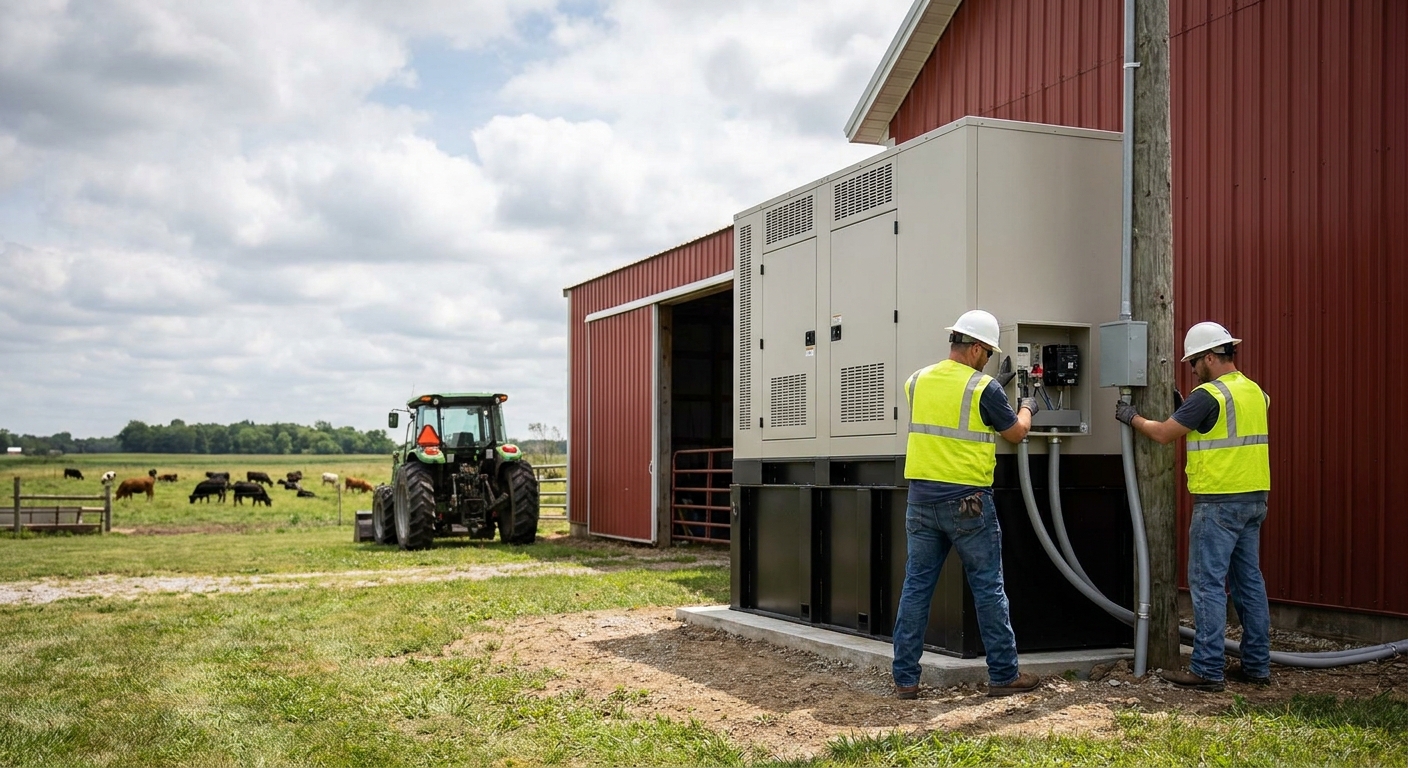
Salt air and storm-force wind chew through unprotected enclosures faster along the Gulf Coast than almost anywhere else in the country. A concrete pad, corrosion-resistant housing, and proper elevation above flood-prone ground keep a unit running through the outage it was bought for instead of failing alongside the grid.
Maintenance access and service response time
A generator sitting unused for eleven months only proves it works when a licensed technician has serviced it on schedule - oil changes, load-bank testing, battery checks. Farms in rural stretches of Baldwin County need to confirm a provider actually dispatches out to the property, not just to town addresses.
Top picks for farm and agricultural installs
Kohler 48RCLB - the safe pick for large operations. This unit handles 48kW of continuous output, enough for a farm running a well pump, barn ventilation, a milking parlor, and house circuits simultaneously. Kohler's automatic transfer switch integration is standard on this class, and it's built for the three-phase demand larger equipment needs. Buy if the property runs livestock or dairy equipment year-round.
Generac Protector Series - the workhorse pick. Sized from 22kW to 45kW, this line covers mid-size farms with a well pump, grain storage climate control, and multiple outbuildings without over-spending on capacity nobody uses. Generac's dealer network in coastal Alabama keeps parts and service turnaround fast, which matters when a unit needs repair during peak growing season. Buy for farms with 2-4 outbuildings and moderate equipment load.
Honeywell standby units - the budget-conscious pick. These run smaller kW ranges, generally 14kW to 20kW, which fits a small hobby farm or a single well pump plus house circuits but not a full livestock operation. Consider only if the property has one or two critical loads and no three-phase equipment.
Briggs & Stratton - the wildcard pick. Known more for smaller residential and light-commercial installs, Briggs & Stratton units in the 20kW-26kW range work for farms whose biggest load is a well pump and a couple of barns. Consider for smaller acreage; skip if the property has a grain dryer or dairy parlor pulling three-phase power.
Custom multi-unit systems - the specialist pick. Some agricultural properties with dispersed outbuildings need two smaller units instead of one oversized system, each covering a zone of the property independently. Buy this approach when barns and the residence sit far enough apart that a single generator location can't serve both efficiently.
Get your farm sized correctly
A load assessment covers well pumps, barns, and equipment before you buy anything.
What to avoid
- Portable gas generators as a primary system. They look like a budget win on paper but stall under the surge load of a well pump plus ventilation fans starting at once, and they need someone physically present to run fuel and restart them every 8-10 hours.
- Single-phase units for equipment that needs three-phase power. Grain dryers and some milking systems simply won't run correctly on the wrong phase configuration, no matter how much kW capacity the unit has on paper.
- Undersized tanks paired with oversized generators. A 48kW unit on a 250-gallon propane tank burns through fuel in under two days under full farm load, defeating the point of buying a large system in the first place.
Verdict comparison
| Brand / System | kW Range | Best For | Verdict |
|---|---|---|---|
| Kohler 48RCLB | Up to 48kW | Dairy, livestock, multi-building farms | Buy |
| Generac Protector | 22-45kW | Mid-size farms, well pump + outbuildings | Buy |
| Honeywell Standby | 14-20kW | Hobby farms, single well pump | Consider |
| Briggs & Stratton | 20-26kW | Small acreage, no three-phase load | Consider |
| Custom multi-unit | Varies | Dispersed outbuildings | Buy (case-by-case) |
FAQ
What size generator does a farm need?
Most working farms need 22kW to 48kW depending on the number of outbuildings and whether equipment like grain dryers or milking parlors run on three-phase power. A single well pump and house circuits can sometimes run on a smaller 14-20kW unit, but adding barn ventilation or livestock equipment pushes requirements up fast.
Is propane or diesel better for farm generators?
Propane wins for most Baldwin County farms because a 500-gallon or larger tank gives 5-10 days of runtime without a refill, while diesel supply often gets prioritized to hospitals and municipal accounts during regional storm events. Diesel still makes sense for very large continuous-duty operations with existing fuel infrastructure.
How much does generator installation for farms cost?
Installed cost ranges widely based on kW size, fuel tank capacity, and electrical work needed for outbuildings, with larger farm systems running well above typical whole-home installs. A licensed electrical contractor can quote an exact number after a load assessment of the property's equipment.
Do I need an automatic transfer switch for a farm generator?
Yes, an automatic transfer switch is standard for any farm generator install because it restores power within 10-20 seconds of an outage without anyone needing to be on-site. Manual-start systems leave well pumps and refrigeration dead for however long it takes someone to reach the property.
Can one generator power multiple barns on a farm?
One properly sized unit can power multiple barns if they're wired into a single distribution system, but properties with widely dispersed outbuildings often do better with two smaller units instead. The right setup depends on distance between structures and total combined load.
How long do farm generators last during hurricane season?
A properly sized propane system with a 500-gallon-plus tank runs continuously for 5-10 days without refueling, covering most hurricane season outage windows in coastal Alabama. Diesel systems depend on stored fuel volume and refill access, which can be unreliable when roads are blocked.
What's the difference between residential and farm generator installation?
Farm installation accounts for three-phase power, larger continuous kW loads from equipment like grain dryers and milking parlors, and multi-building electrical distribution that a standard whole-home install doesn't need to handle. Sizing and fuel planning both scale up significantly for working agricultural properties.
One last thing
The most overlooked detail in farm generator installs isn't kW capacity - it's tank placement relative to flood-prone low ground, since a fuel source underwater during a storm surge defeats the entire system regardless of how well the generator itself is rated. Get the pad elevation right before worrying about brand.