Daycare and childcare centers in coastal Alabama can't treat a power outage like a snow day. Refrigeration, HVAC, security systems, and licensing compliance all depend on power staying on, and generator installation for daycare centers is the fix that keeps a center open when Baldwin County loses grid power for days at a time.
- A 20kW to 24kW standby unit covers most single-building daycare centers under 6,000 square feet in 2026.
- Generac and Kohler both offer commercial-grade automatic transfer switches built for licensed care facilities - Buy either.
- Portable generators with manual switches don't meet continuous-operation needs for refrigeration and medication storage - Skip.
- Centers with commercial kitchens or two HVAC systems need 36kW to 48kW, not the standard residential size.
- Installation before June 1, 2026 avoids the pre-hurricane-season backlog that pushes bookings into July.
Why this matters
Gulf Coast hurricane seasons routinely knock out grid power for 48 to 96 hours across Baldwin County towns like Daphne, Fairhope, Foley, and Gulf Shores. A licensed childcare center can't just wait that out. Formula and medication need refrigeration, infants and toddlers need climate control, and a dark building with no security system is a liability problem before it's anything else.
The generator that gets installed at a home doesn't automatically work for a facility with commercial refrigeration, multiple HVAC zones, and code inspectors checking for continuous, automatic backup power. Sizing and switch type matter more here than for a residential job, and getting either wrong means the unit trips offline exactly when the center needs it most. Baldwin County Generators sizes and installs standby systems specifically for commercial and licensed-care buildings across the region.
Who this is for
This guide is for owners and directors of licensed daycare and childcare centers in coastal Alabama who need continuous backup power for refrigeration, HVAC, and life-safety systems during extended outages - not for households looking for a portable unit to run a few appliances.
What to look for in generator installation for daycare centers
Correct kW sizing for your building's real load
Undersizing is the single most common mistake in commercial installs. A 14kW unit sized for a small house will stall the moment a walk-in cooler compressor and two HVAC units try to start at once, and a stalled generator during a hurricane is worse than no generator at all. Most single-building daycare centers under 6,000 square feet run well on 20kW to 24kW; centers with commercial kitchens or two AC systems need 36kW to 48kW.
Automatic transfer switch, not manual
A manual switch means someone has to be on-site to flip power over during an outage, which doesn't work for a facility that may be evacuated or short-staffed during a storm. An automatic transfer switch detects the outage and starts the generator within seconds, restoring power to refrigeration and HVAC without anyone touching a panel.
Fuel type and runtime
Propane-fueled standby units run on a dedicated tank and don't depend on natural gas lines staying pressurized during a storm, which matters when the whole point is riding out a multi-day outage. Natural gas units run indefinitely if the gas utility stays up, but that's not guaranteed after a direct hit. Either works - the choice depends on what's already run to the property.
Noise and placement near play areas
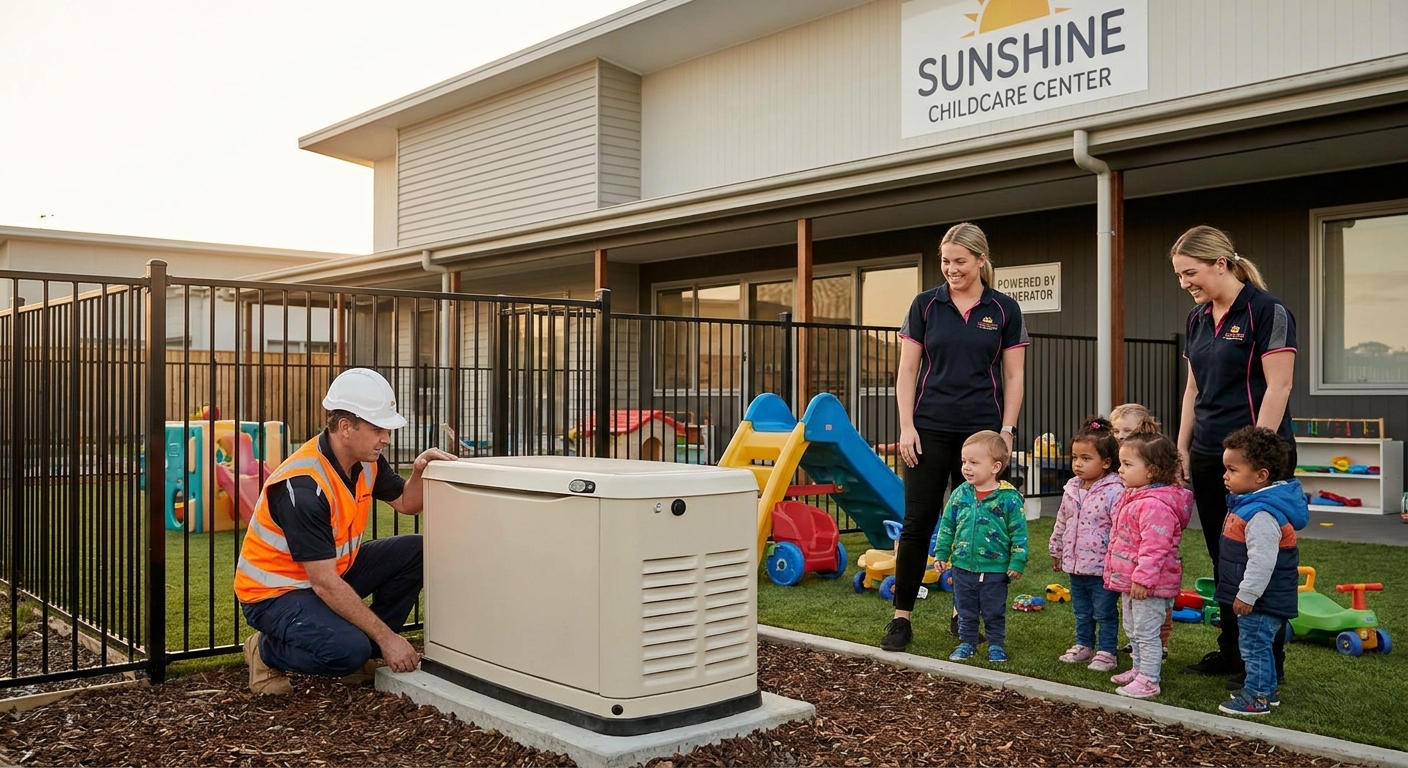
A generator installed six feet from an outdoor play yard is a nuisance for staff and a hazard for exhaust exposure near small children. Placement needs to account for setback codes, exhaust direction, and enough distance from windows and doors that daily operations aren't disrupted every time the unit does its weekly self-test.
Maintenance timed to storm season
A generator that hasn't been serviced since last year is a coin flip when it matters. Annual maintenance scheduled before June 1 - the start of Atlantic hurricane season - catches battery, fuel line, and transfer switch issues before a storm makes them urgent.
Installation lead time
Booking in March or April 2026 beats booking in July 2026, when every licensed contractor in Baldwin County has a backlog of storm-prep installs. Centers that wait until a hurricane watch is issued are looking at weeks of delay, not days.
Top picks for daycare and childcare center generators
Kohler 20kW - the code-compliant baseline. This tier handles refrigeration, one HVAC zone, lighting, and security for centers under 5,000 square feet, and it pairs with a commercial-rated automatic transfer switch. Buy for single-building centers without a commercial kitchen.
Generac 24kW - the workhorse. Slightly more headroom than the 20kW tier, this size covers centers with a small kitchen or a second refrigeration unit without pushing into commercial-scale sizing. Buy for centers that run close to the 20kW ceiling.
Generac 48kW - the full-building unit. This size is built for centers with commercial kitchens, two HVAC systems, and higher occupant counts where code requires more continuous load capacity. Buy for larger licensed facilities, Consider for anything mid-sized that might grow into it.
Honeywell 20kW - the budget-conscious option. Comparable output to the Kohler tier at a lower equipment cost, suited to centers with straightforward single-zone HVAC and no commercial kitchen. Consider if the site load is genuinely light.
Briggs & Stratton residential-tier units - the wildcard. These are built for home use and generally undersized for a licensed facility's continuous-duty requirements once refrigeration and multiple HVAC zones are added up. Skip for anything beyond a very small, single-room in-home daycare.
“If the generator can't carry the walk-in cooler and both HVAC units at once, it's undersized for licensing.”
What to avoid
- Portable generators with extension cords or manual switches. They look like a cheaper fix, but they require someone on-site to run them and can't legally back up hardwired refrigeration or HVAC circuits the way a permitted standby system can.
- Undersized "good enough" units. A generator that runs the lights but trips when the AC compressor kicks on isn't backup power - it's a false sense of security until the first real outage.
- Skipping the permit and inspection. Standby generator installs for commercial and licensed-care buildings need electrical permits and inspection sign-off; skipping that step can jeopardize licensing status, not just warranty coverage.
Verdict comparison
| Tier | Size | Fuel | Best for | Verdict |
|---|---|---|---|---|
| Kohler 20kW | 20kW | Propane/NG | Centers under 5,000 sq ft, no commercial kitchen | Buy |
| Generac 24kW | 24kW | Propane/NG | Centers near the 20kW load ceiling | Buy |
| Generac 48kW | 48kW | Propane/NG | Commercial kitchen, two HVAC zones | Buy / Consider |
| Honeywell 20kW | 20kW | Propane/NG | Light single-zone HVAC load | Consider |
| Briggs \u0026 Stratton residential | 12-17kW | Propane/NG | Very small in-home daycare only | Skip for licensed centers |
Size your daycare's generator now
Get a load calculation and quote before hurricane season starts in 2026.
FAQ
What size generator does a daycare center need?
Most single-building daycare centers under 6,000 square feet need 20kW to 24kW of standby power. Centers with a commercial kitchen or two HVAC zones typically need 36kW to 48kW to avoid overloading the unit.
Is a portable generator enough for a licensed childcare center?
No, a portable generator with a manual switch doesn't provide the continuous, automatic backup that refrigeration, HVAC, and security systems need during a multi-day outage. Licensed centers need a permitted standby system with an automatic transfer switch.
How long does generator installation take for a daycare center?
A commercial standby installation typically takes several days from electrical permitting through final inspection, longer than a residential job because of the added load calculation and switch sizing. Booking before June 2026, ahead of hurricane season, avoids the peak-season backlog.
Is Generac or Kohler better for a daycare center?
Both brands make commercial-rated units suited to licensed care facilities, and the right choice depends on the building's specific load, not brand alone. A 24kW Generac and a 20kW Kohler often land in the same price and capability range for a mid-sized center.
How much runtime does a standby generator provide during a hurricane?
A propane-fueled standby generator can run for as long as the dedicated tank holds fuel, which is typically enough to cover multi-day outages common after Gulf Coast storms. Natural gas units can run indefinitely as long as the gas utility stays pressurized.
Does a daycare center need a permit for generator installation?
Yes, commercial standby generator installs require an electrical permit and inspection, and licensed childcare facilities should keep that documentation on file for inspections. Skipping the permit step can create licensing complications beyond just the equipment warranty.
Where should a generator be placed at a daycare center?
Generators need enough setback from windows, doors, and outdoor play areas to keep exhaust and noise away from children and staff during daily self-tests. Local code sets minimum clearance distances that a licensed electrical contractor will size the installation around.
One last thing
Most daycare directors size for refrigeration and lighting and forget the security system. A generator that keeps the lights on but drops the door access control and camera feed during a storm still leaves a licensed center out of compliance on the safety side, not just the comfort side. Size the load calculation to include every hardwired system before picking a kW tier, not just the obvious ones.