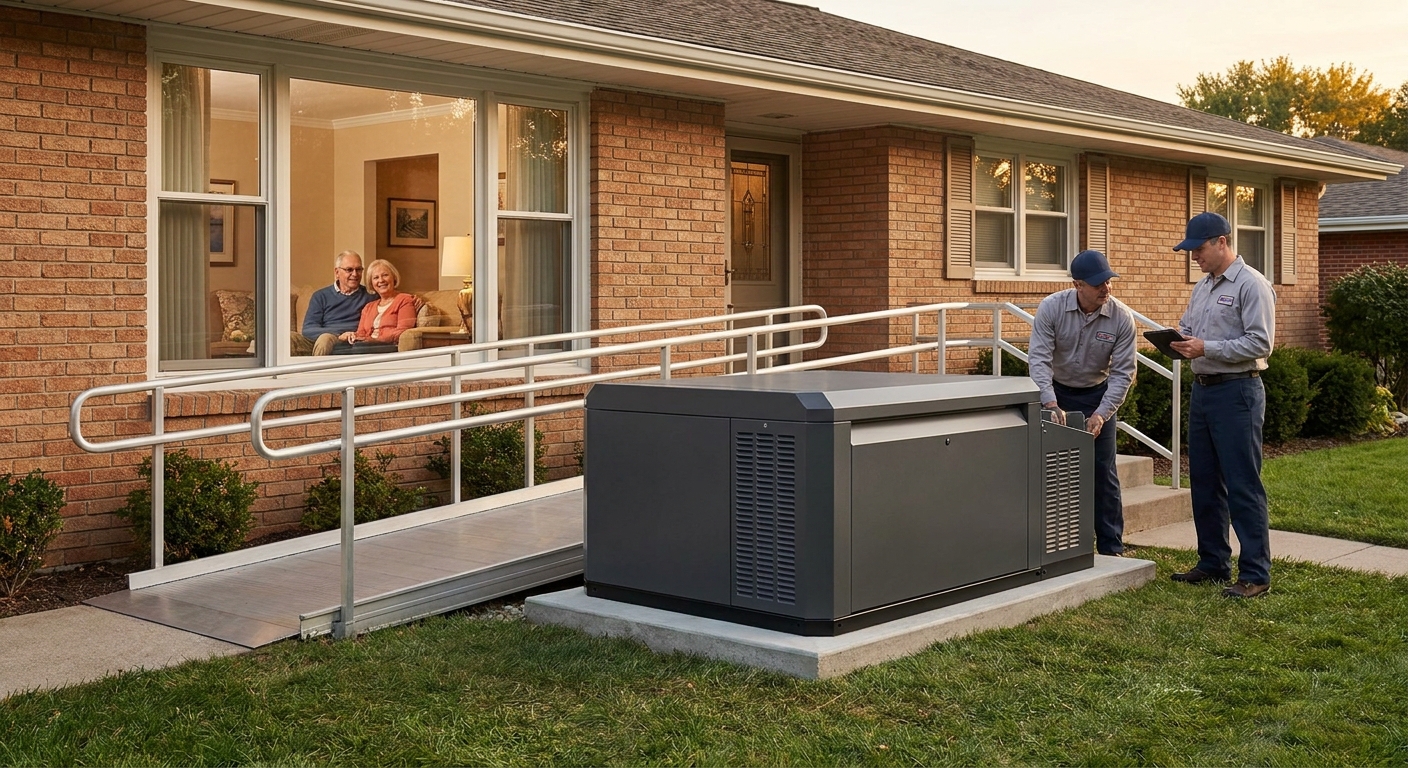
Aging-in-place homes and small assisted living residences can't afford a power outage the same way a typical household can - medical equipment, climate control, and mobility aids depend on continuous electricity, and hurricane season along coastal Alabama makes that risk immediate rather than theoretical.
- Generator installation for assisted living and aging-in-place homes should target 22kW-26kW whole-home units, not portables - Buy verdict for automatic standby systems.
- A 10-second automatic transfer switch is the baseline for medical equipment and stairlifts; anything slower is a Skip for this use case.
- Baldwin County Generators installs Kohler, Generac, Honeywell, and Briggs & Stratton standby units sized for continuous medical-grade power in Daphne, Fairhope, Foley, and Gulf Shores.
- Noise output matters more here than in a standard home install - look for units rated near 65 dB at 23 feet, not the loudest job-site generators.
Why this matters
A power outage is an inconvenience for most families. For a resident on oxygen concentrators, a stairlift, or a refrigerated medication supply, it's a medical event. Coastal Alabama sees extended outages during tropical storm season almost every year, and outages that stretch past 4-6 hours start to matter for anyone dependent on climate control or powered mobility equipment.
Standby generator installation for these homes is not the same project as a standard residential job. Sizing, transfer switch speed, noise, and placement all shift when the people inside the house can't simply wait out a blackout in a hotel room. Get a free quote from Baldwin County Generators before storm season locks up installation schedules - that's the first concrete move, and everything below explains how to evaluate what you're being sold.
Who this is for
This guide is for adult children managing a parent's aging-in-place home, small licensed assisted living operators with 4-10 residents, and homeowners planning to stay in their house through mobility changes rather than move to a facility. If the household runs a CPAP machine, an electric wheelchair charger, a stairlift, or refrigerated medications, standard portable generators and "good enough" sizing decisions stop being acceptable.
What to look for in a generator for assisted living and aging-in-place homes
Automatic transfer switch speed
An automatic transfer switch (ATS) detects the outage and starts the generator without anyone flipping a breaker. For a household with mobility or medical equipment, a 10-second transfer window is the standard to hold installers to - that's fast enough that a stairlift mid-ride or an oxygen concentrator doesn't lose power long enough to matter. Manual-start systems require someone physically present and capable of starting the unit, which defeats the purpose for a resident living alone.
Sizing for medical equipment loads
A typical 3-bedroom home gets by on 20-22kW. A home running oxygen concentrators, powered wheelchairs on charge, a stairlift, and full HVAC simultaneously needs headroom above that baseline - 24kW to 26kW is a common target once medical equipment is added to the load calculation. Undersizing means the generator trips offline exactly when it's needed most.
Noise output near living and sleeping areas
Standby units run in the 60-68 dB range at 23 feet, which is closer to a normal conversation than a lawnmower, but placement still matters when a bedroom window sits 15 feet from the pad. For assisted living settings with multiple residents sleeping on different schedules, ask the installer for the exact dB rating and confirm setback distance from bedroom windows before the unit is sited.
Run time and fuel source reliability
Natural gas hookups give effectively unlimited run time as long as the gas utility stays operational, which is the more common failure-resistant choice for continuous medical loads. Propane requires a tank sized for the expected outage duration - undersized propane tanks are the single most common reason a "whole-home" generator runs dry on day three of an extended outage.
Maintenance contract and response time
A generator that isn't maintained is a generator that fails on the one day it's needed. Ask whether the installer offers scheduled maintenance visits and what their emergency response time looks like during active storm events - a contractor stretched thin across hundreds of calls during a hurricane isn't useful to a resident who needs power restored within hours, not days.
Licensed electrical work, not a handyman install
Standby generator installation involves gas line work, electrical panel integration, and permitting - this is licensed electrical contractor work, not a weekend DIY project or a handyman side job. Confirm the installer carries an electrical contractor license and pulls permits with the local jurisdiction before signing anything.
Top picks for assisted living and aging-in-place installs
Kohler 26kW standby - the safe pick. This unit pairs with a 10-second ATS and covers a full medical-equipment load without derating in Gulf Coast summer heat, which matters because ambient temperature above 95°F reduces output on some competing units. Buy for households running 3+ pieces of powered medical equipment simultaneously.
Generac Guardian 22kW - the value pick. Widely available with fast parts turnaround along the Gulf Coast, this size covers most single-resident aging-in-place homes without medical equipment beyond a CPAP and standard HVAC. Buy for single-occupant homes with modest electrical loads; Consider upgrading to 24kW+ if a stairlift or additional medical device gets added later.
Briggs & Stratton 20kW - the budget-conscious pick, best suited to a smaller aging-in-place home without heavy medical equipment. It handles refrigeration, lighting, and standard HVAC but leaves little headroom for add-ons. Consider only if the household load is confirmed under 18kW after a proper load calculation; Skip if a wheelchair charger or oxygen equipment is already in the house.
Honeywell 48kW commercial-grade unit - the wildcard for small licensed assisted living facilities with 6+ residents. This size supports multiple HVAC zones, commercial refrigeration, and several medical devices running at once, but it requires three-phase or heavier single-phase electrical service most residential homes don't have. Buy for licensed facility operators; Skip for a single-family aging-in-place home - it's oversized and the fuel consumption doesn't justify it.
What to avoid
- Portable generators as a primary power source. They require someone present to refuel and start them every 8-10 hours, which fails the entire point of unattended, automatic backup for a resident who can't manage that themselves.
- Undersized units "to save money." A generator that trips offline under a full medical-equipment load during a 2026 storm event is worse than no generator at all, because the household stops planning for alternatives once they believe they're covered.
- Skipping the load calculation. Installers who quote a size without walking the house and listing every circuit are guessing, and guessing is how a stairlift stalls mid-flight during an outage.
“A generator sized without a medical-equipment load calculation is a generator that fails on the one day it matters.”
Verdict comparison
| Unit | Size | ATS speed | Best for | Verdict |
|---|---|---|---|---|
| Kohler 26kW | 26kW | 10 sec | Multiple medical devices | Buy |
| Generac Guardian 22kW | 22kW | 10 sec | Single-resident, modest load | Buy |
| Briggs & Stratton 20kW | 20kW | 10 sec | Light load, no medical equipment | Consider |
| Honeywell 48kW | 48kW | 10 sec | Small licensed facility | Buy (facility only) |
FAQ
What size generator does an assisted living home need?
Most small assisted living homes with 4-10 residents need 24kW to 48kW depending on medical equipment, HVAC zones, and commercial refrigeration. A licensed installer should run a full load calculation before quoting a size in 2026.
Is a portable generator enough for aging-in-place power backup?
No, a portable generator is not enough for a household with medical equipment or mobility devices. It requires manual startup and refueling every 8-10 hours, which doesn't work for a resident living alone or unable to manage the equipment.
How fast does an automatic transfer switch restore power?
A standard automatic transfer switch restores power within 10 seconds of an outage being detected. That speed matters for stairlifts, oxygen concentrators, and other equipment that can't tolerate long gaps.
Are Kohler or Generac generators better for medical equipment loads?
Both Kohler and Generac make standby units in the 22kW-26kW range suited to medical equipment loads, and the right choice comes down to the specific load calculation for the house. Kohler units tend to hold rated output better in extreme Gulf Coast heat.
Do assisted living facilities need a commercial-grade generator?
Licensed facilities with multiple residents and commercial refrigeration typically need 40kW or larger, often requiring heavier electrical service than a standard home has. Single-family aging-in-place homes rarely need commercial-grade sizing.
How often does a standby generator need maintenance?
Standby generators typically need a scheduled maintenance visit at least once a year, with additional checks before hurricane season along the Gulf Coast. Skipping maintenance is the leading cause of failure during actual outages.
What fuel source is most reliable for continuous medical equipment power?
Natural gas offers effectively unlimited run time as long as the utility stays operational, making it the more reliable choice for continuous medical loads compared to a propane tank that can run dry mid-outage.
How much does generator installation cost for an aging-in-place home?
Cost depends on unit size, electrical panel work, and gas line routing, and it varies enough by house that a site visit is the only accurate way to get a number. Check current pricing directly with a licensed installer for an exact quote.
One last thing
The detail most families miss isn't the generator size - it's the transfer switch speed. A 26kW unit with a slow or manual transfer switch protects the house no better than a 20kW unit with a fast automatic one, and for a resident depending on a stairlift or oxygen equipment, that 10-second window is the entire point of the installation.
Baldwin County Generators handles standby generator installation across Daphne, Fairhope, Foley, and Gulf Shores for exactly this kind of household, and 2026's storm season is the deadline that matters - installation schedules fill fast once the first named storm shows up in the forecast.