Standard Generac installation methods don't work on a mobile home chassis, and getting this wrong voids warranties and fails inspections across coastal Alabama.
TL;DR: A Generac 22kW or 24kW air-cooled standby unit is the Buy pick for most single and double-wide mobile homes in Daphne, Fairhope, Foley, and Gulf Shores, provided it's mounted on an engineered pad set back from the HUD-code skirting and paired with an automatic transfer switch sized to the home's panel. Generac generator installation mobile homes requires a licensed electrical contractor familiar with manufactured-home wiring, not a general handyman. Skip portable units and DIY transfer switch kits for anything beyond short-term emergency power.
Why this matters
Mobile and manufactured homes lose power faster than site-built houses during named storms because they sit on above-grade utility connections that are easier to knock out. Baldwin County has seen multiple named storms cross the Gulf Coast since 2020, and 2026's hurricane season is already shaping up the same way forecasters warned about in prior years - active through November.
A mobile home also has tighter electrical service, usually 100-amp rather than 200-amp, which changes which Generac model actually fits the load. Get the sizing wrong and you'll trip the generator every time the AC and water heater run together. Baldwin County Generators handles this sizing calculation as part of every mobile home installation quote, not as an afterthought.
Who this is for
This guide is for owners of single-wide, double-wide, and triple-wide manufactured homes in coastal Alabama who lose power for days, not hours, during tropical storms and want a standby system that starts automatically without anyone flipping a breaker in the rain. It's also for park residents who need to confirm HOA or park rules before a permanent installation, since some manufactured home communities restrict pad-mounted equipment.
What to look for in Generac installation for mobile homes
HUD-code clearance and mounting
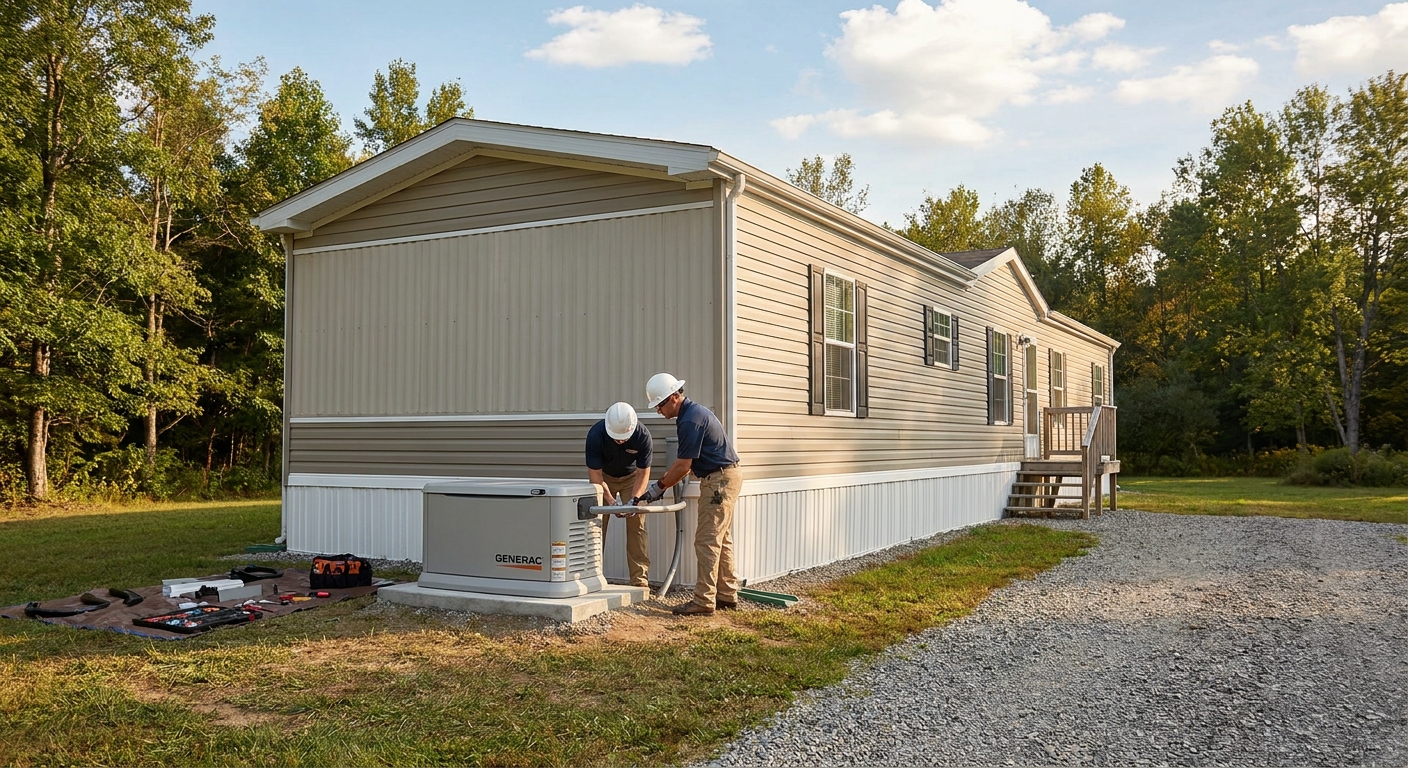
Generacs mount on a concrete or composite pad, not directly against manufactured home skirting. Code generally requires 18 to 36 inches of clearance from windows, doors, and the home's exterior wall depending on local jurisdiction, and mobile home skirting makes this tighter than a stick-built foundation. Get this wrong and the unit fails inspection before it ever runs.
Transfer switch rated for park or panel power
An automatic transfer switch has to match the home's actual service - 100-amp panels are common in older manufactured homes, 200-amp in newer double-wides built after 2010. A transfer switch sized for the wrong panel either underpowers the home or overloads circuits the first time a storm knocks out utility power.
Wind rating for coastal exposure
Gulf Shores and Foley sit in higher wind-load zones than inland Baldwin County. Generac's pad-mounted enclosures are rated for sustained winds well above standard hurricane thresholds, but the anchoring method (concrete pad vs. composite pad with ground anchors) has to match the local wind zone, not just the generic install manual.
Fuel source access
Mobile home lots frequently run on propane rather than natural gas, especially outside city limits in Foley and unincorporated Baldwin County. Confirm propane tank size and regulator pressure before ordering a specific kW model - undersized tanks starve larger units during extended outages.
Licensed installation and permit compliance
A licensed electrical contractor pulls the permit, coordinates the gas or propane connection, and signs off on the transfer switch tie-in. Unpermitted installs create resale problems and insurance claim denials after storm damage - a real risk in a region where homeowners insurance already scrutinizes electrical work.
Panel capacity match
Check the home's main panel amperage before choosing a kW size. A 22kW unit paired with a 100-amp panel can still deliver whole-home backup, but a 26kW unit on the same panel wastes capacity the home's wiring can't use.
Top picks for mobile home standby power
The reliable standard - Generac 22kW Guardian series. Air-cooled, roughly 800 pounds, sized for single-wide and most double-wide homes running central AC plus a well pump. Pairs cleanly with a 100-amp or 200-amp automatic transfer switch. Verdict: Buy for most manufactured homes under 2,000 square feet.
The bigger double-wide pick - Generac 24kW. Adds headroom for homes with two HVAC zones or an electric range running simultaneously with a well pump, common in triple-wide layouts. Runs on propane or natural gas depending on lot access. Verdict: Buy for larger manufactured homes with 200-amp service.
The high-load option - Generac 26kW. Makes sense when a home has added a workshop, guest unit, or heavy well system pulling extra amps beyond the base household load. Overkill for a standard single-wide. Verdict: Consider only if you've confirmed the added electrical load in writing.
The compact footprint - smaller 20kW-class units. Fits tighter mobile home lots where pad clearance is limited, at the cost of running fewer circuits simultaneously during peak draw. Verdict: Consider for smaller single-wides with modest AC and no well pump.
Portable generators wired through a manual switch. Cheap upfront, requires someone to physically start it and manage fuel every 8 to 12 hours during an extended outage. No automatic transfer, no whole-home coverage. Verdict: Skip for anyone who wants hands-off storm protection in 2026.
What to avoid
- Generic "universal" transfer switch kits sold online without a licensed electrician's sizing - these frequently mismatch amperage on manufactured home panels.
- Ground-mount installs without an engineered pad - mobile home lots often have softer or sloped soil than a site-built foundation, and a generator that shifts during a storm is a liability, not backup power.
- Undersized units bought on price alone - a 14kW model looks affordable but stalls out running AC and a well pump together, which defeats the purpose of standby power during a 2026 storm season outage.
Verdict comparison
| Model class | Best for | Panel match | Verdict |
|---|---|---|---|
| Generac 22kW Guardian | Single/double-wide, standard AC | 100A or 200A | Buy |
| Generac 24kW | Larger double/triple-wide | 200A | Buy |
| Generac 26kW | Added workshop or heavy well load | 200A | Consider |
| 20kW-class compact | Tight lots, modest load | 100A | Consider |
| Portable + manual switch | Short outages only | N/A | Skip |
FAQ
What size Generac do I need for a mobile home? Most single-wide and double-wide manufactured homes run well on a 22kW Generac, while triple-wides or homes with two HVAC zones typically need 24kW to 26kW. Panel amperage (100A vs 200A) determines the ceiling more than square footage alone.
Is Generac generator installation for mobile homes different from a regular house install? Yes - mobile home installs require pad mounting set back from HUD-code skirting, careful clearance measurements, and a transfer switch matched to typically lower panel amperage than a stick-built home.
Can I install a Generac myself on a mobile home? No - a licensed electrical contractor has to pull the permit, tie in the transfer switch, and connect the fuel line. Unpermitted installs risk insurance denial after storm damage in coastal Alabama.
How much clearance does a Generac need from a mobile home? Expect 18 to 36 inches minimum from windows, doors, and exterior walls depending on local code, plus additional clearance from the propane tank if the home runs on propane.
Does a mobile home need a bigger propane tank for a Generac? Often yes - a 22kW to 26kW Generac under extended run time draws more propane than a typical mobile home tank holds, so tank size and regulator pressure need checking before installation.
Will a Generac work if my mobile home park has an HOA? Check park rules first - some manufactured home communities restrict pad-mounted equipment or require setback approval before a permanent standby generator goes in.
How long does a Generac installation take for a mobile home? A typical single-wide install runs one to two days once the permit is approved, covering pad pour, unit set, gas or propane hookup, and transfer switch wiring.
Is a portable generator good enough for a mobile home during hurricane season? Only for short outages - a portable generator requires manual starting and refueling every 8 to 12 hours and doesn't cover whole-home circuits automatically the way a standby Generac does.
One last thing
The detail most mobile home owners miss isn't the generator size - it's the propane tank. A 22kW Generac running continuously during a multi-day outage burns through a standard 250-gallon tank faster than most owners expect, and running out of fuel on day three of a 2026 storm outage defeats the entire point of standby power. Confirm tank size and delivery access before the unit ever gets installed, not after the first outage.