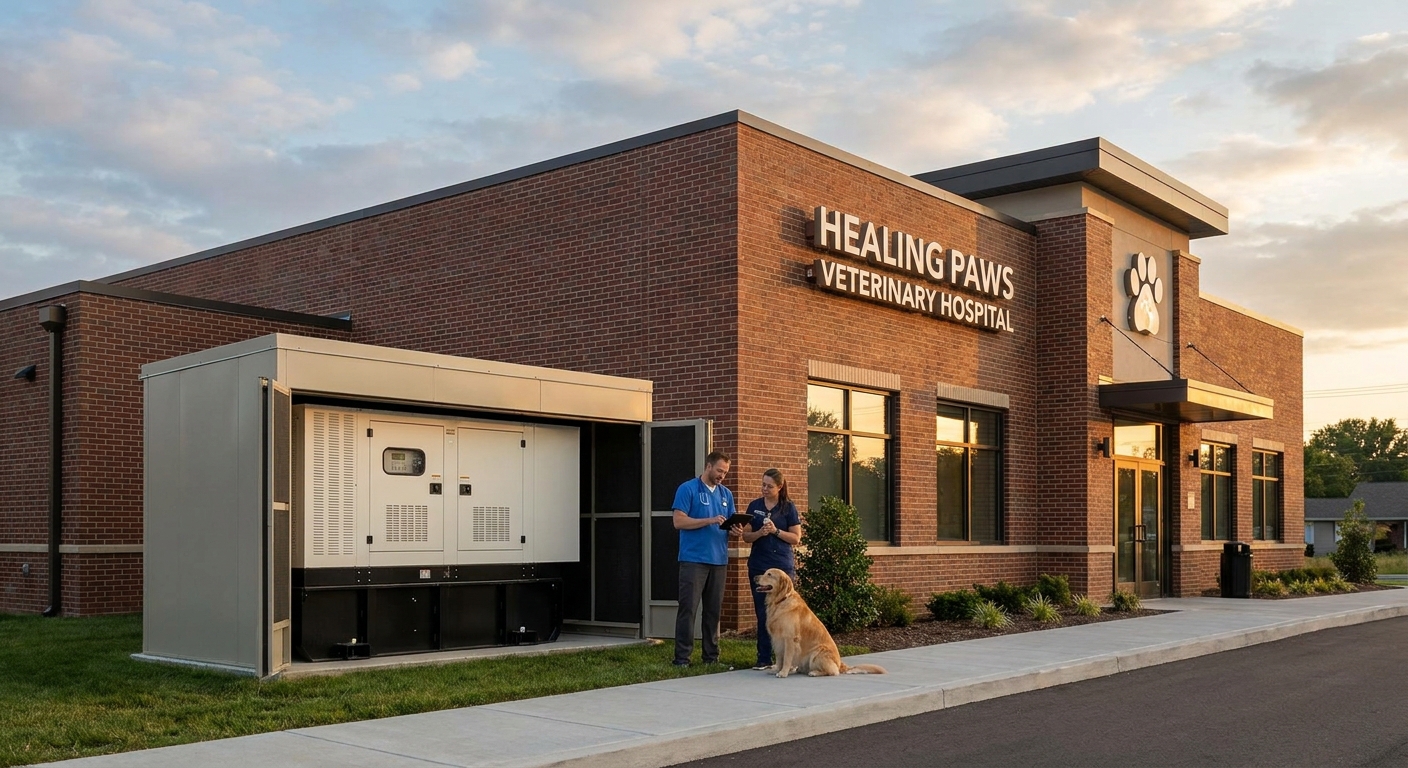
Veterinary clinics run refrigerated vaccines, surgical suites, oxygen concentrators, and diagnostic equipment that can't tolerate a power gap longer than a few seconds - this guide ranks the standby generator classes that actually protect an animal hospital through Baldwin County's 2026 storm season.
- A 24kW Generac Guardian standby unit covers most single-doctor veterinary clinics and carries surgical loads without cycling. Buy.
- Kohler's 20RESA runs quieter than comparable units, which matters for boarded animals and post-op recovery wards. Consider.
- Portable generators cannot legally or safely run a clinic's refrigeration and anesthesia gas systems unattended. Skip.
- Best generators for veterinary clinics in 2026 start at 20kW and scale to 48kW+ for multi-doctor hospitals with imaging equipment.
Why this matters
A vaccine fridge that loses power for six hours is a write-off, and a surgical suite mid-procedure has zero tolerance for delay. Gulf Coast hurricane outages in Baldwin County routinely run 48 to 96 hours, not the 20-minute blip a lot of clinic owners plan around.
An undersized generator is almost as bad as no generator - it trips on inrush load the moment an autoclave or HVAC compressor kicks on. Sizing has to account for surgical equipment startup surge, not just steady-state draw, and that's where most DIY generator shopping goes wrong.
How this list was ranked
The ranking below weighs four factors that matter specifically for animal hospitals: startup surge handling for surgical and imaging equipment, noise output near recovery kennels, run-time reliability during multi-day outages, and installation complexity for a working clinic that can't shut down for a week. Manufacturer specification sheets and standard commercial sizing guidance for 2026 inform the kW ranges cited - actual sizing always needs a load calculation specific to the building's panel and equipment schedule.
General commercial sizing guidance puts a small single-doctor clinic (exam rooms, one surgical suite, refrigeration, basic HVAC) in the 20kW to 24kW range. Multi-doctor hospitals running digital radiography, CT, or multiple surgical suites typically need 36kW to 48kW or higher. Every clinic on baldwincountygenerators.com should still get a licensed electrical contractor to run an actual load calculation before buying anything on this list - square footage alone doesn't tell you what a panel needs.
The ranked list
1. Generac Guardian Series (22kW-24kW) - the workhorse pick
This is the size range most single-doctor veterinary clinics land in for 2026 installs. It handles a surgical suite, an anesthesia machine, refrigeration for vaccines and medications, and basic HVAC without nuisance tripping on startup surge.
What it does: runs the whole clinic panel on a whole-building transfer, not just a handful of circuits, so nothing gets manually re-plugged during an outage. Why now: hurricane season puts multi-day outages on the table every year for coastal Alabama clinics, and a unit this size clears most single-practice load calculations with margin to spare. Verdict: Buy.
2. Kohler 20RESA (20kW) - the quiet operator
Kohler's 20RESA sits a size class below the Generac pick but runs noticeably quieter, which matters when boarded animals or post-op patients are recovering feet from the enclosure. Noise-sensitive practices - exotic animal specialists, feline-only clinics - weight this heavier than raw kW.
It covers refrigeration, lighting, and a single surgical suite comfortably, but tight margins show up fast if a clinic adds imaging equipment later. Verdict: Consider for smaller practices; size up if growth is planned within the next two to three years.
3. Honeywell 20kW standby - the value entry point
Honeywell's standby line competes on price at the 20kW tier without cutting corners on the automatic transfer switch, which is the component that actually matters during an unattended overnight outage. A clinic that closes overnight and doesn't board animals can lean on this tier without over-buying capacity nobody uses.
The tradeoff: fewer dealer-support networks locally compared to Generac or Kohler, so installation and warranty service scheduling can take longer during peak storm season. Verdict: Consider for budget-constrained single-suite practices; Skip if the clinic boards animals overnight or runs 24-hour emergency intake.
4. Briggs & Stratton 20kW standby - the reliable backup
Briggs & Stratton's commercial standby line is built around simpler maintenance intervals, which appeals to practice owners who want fewer service calls between annual checkups. It handles the same load profile as the Honeywell and Kohler entries at this tier - one surgical suite, refrigeration, basic HVAC.
It doesn't scale as cleanly into paralleled multi-unit setups if a clinic later adds a second building or wing. For a stable, single-location small-animal practice, that ceiling rarely matters. Verdict: Buy for practices with no expansion plans on the horizon.
5. Generac Protector Series (48kW-150kW) - for multi-doctor hospitals
Animal hospitals running digital radiography, CT, in-house lab equipment, and multiple surgical suites simultaneously need to be in this tier, not the 20kW-24kW range. Undersizing here is the single most common and most expensive mistake practice owners make.
A 48kW unit at the low end of this series covers a two-to-three-doctor hospital with imaging; anything larger needs a formal load study before purchase. Installation is more involved - larger units often need three-phase service and a bigger propane or natural gas supply line. Verdict: Buy for growing or multi-doctor hospitals; get the load calculation done first.
6. Portable and towable generators - the stopgap, not a fix
A portable unit can keep a chest freezer or a single exam room lamp running, but it cannot legally or safely power anesthesia gas delivery, refrigeration circuits, and HVAC on an unattended cycle. Someone has to be on-site to refuel it every 8 to 10 hours, which defeats the purpose during a multi-day outage when staff can't reach the clinic.
There's no automatic transfer switch, no whole-panel coverage, and no code compliance path for a commercial medical facility running one as primary backup. Verdict: Skip as a clinic's primary backup plan; fine as an emergency loaner for a single freezer.
Get a clinic-specific sizing quote
A licensed electrical contractor sizes the load before you buy, not after.
Comparison table
| Generator | Typical size | Best fit | Noise profile | Verdict |
|---|---|---|---|---|
| Generac Guardian | 22kW-24kW | Single-doctor clinic | Moderate | Buy |
| Kohler 20RESA | 20kW | Noise-sensitive, boarding | Quiet | Consider |
| Honeywell standby | 20kW | Budget, no overnight boarding | Moderate | Consider |
| Briggs & Stratton standby | 20kW | Stable single-location practice | Moderate | Buy |
| Generac Protector | 48kW-150kW | Multi-doctor, imaging equipment | Moderate-high | Buy |
| Portable/towable | 3kW-10kW | Emergency loaner only | Loud | Skip |
What to avoid
- Sizing off square footage alone. A 3,000 sq ft clinic with a CT scanner needs a different generator than a 3,000 sq ft clinic with two exam rooms - the equipment schedule drives the number, not the floor plan.
- Skipping the load calculation to save on the site visit. Undersized units trip on surgical equipment startup surge, which is worse than having no generator during a live procedure.
- Buying a residential-grade unit for a commercial panel. Residential units aren't rated for the duty cycle a working clinic panel demands day after day.
Where to buy
- Work with an authorized dealer for whichever brand fits the load calculation - Generac, Kohler, Honeywell, and Briggs & Stratton all sell through licensed installer networks, not big-box retail.
- Confirm the installer is a licensed electrical contractor who pulls the local permit; unpermitted commercial standby installs create liability problems for the clinic later.
- Get the fuel source locked down before ordering - propane and natural gas units have different supply-line requirements, and that decision affects which size options are even available on-site.
FAQ
What size generator does a veterinary clinic need?
Most single-doctor veterinary clinics need 20kW to 24kW to cover refrigeration, a surgical suite, and basic HVAC. Multi-doctor hospitals with imaging equipment typically need 36kW to 48kW or more, based on a formal load calculation.
What are the best generators for veterinary clinics in 2026?
The Generac Guardian Series (22kW-24kW) and Generac Protector Series (48kW+) rank highest for whole-panel commercial coverage in 2026, with Kohler's 20RESA as the quieter alternative for boarding practices.
Can a portable generator power a veterinary clinic?
A portable generator cannot safely power a clinic's refrigeration, anesthesia gas delivery, or HVAC on an unattended cycle. It works only as a short-term emergency loaner for a single appliance, not as primary backup.
Is Kohler or Generac better for an animal hospital?
Kohler's 20RESA runs quieter, which matters near recovery kennels, while Generac's Guardian and Protector series scale higher for multi-doctor hospitals with imaging equipment. The right pick depends on the clinic's noise sensitivity and growth plans.
How long can a standby generator run during an outage?
A natural gas or propane-fed standby generator can run indefinitely as long as fuel supply holds, unlike a portable unit that needs manual refueling every 8 to 10 hours. This is the main reason clinics choose standby over portable units.
Does a veterinary clinic generator need a permit?
Yes, commercial standby generator installs require a local permit pulled by a licensed electrical contractor. Skipping the permit creates liability and inspection problems for the clinic later.
What happens if a generator is undersized for a clinic?
An undersized generator trips or stalls when high-surge equipment like autoclaves or surgical lighting starts up, cutting power at the worst possible moment. This is why a load calculation matters more than square footage when sizing.
One last thing
The detail most practice owners miss: startup surge from a single autoclave or imaging unit can spike two to three times its running wattage for a few seconds, and that spike - not the steady-state load - is what actually determines whether a generator trips during a real outage in 2026.
“An undersized generator is almost as bad as no generator at all - it trips the moment surgical equipment starts up.”