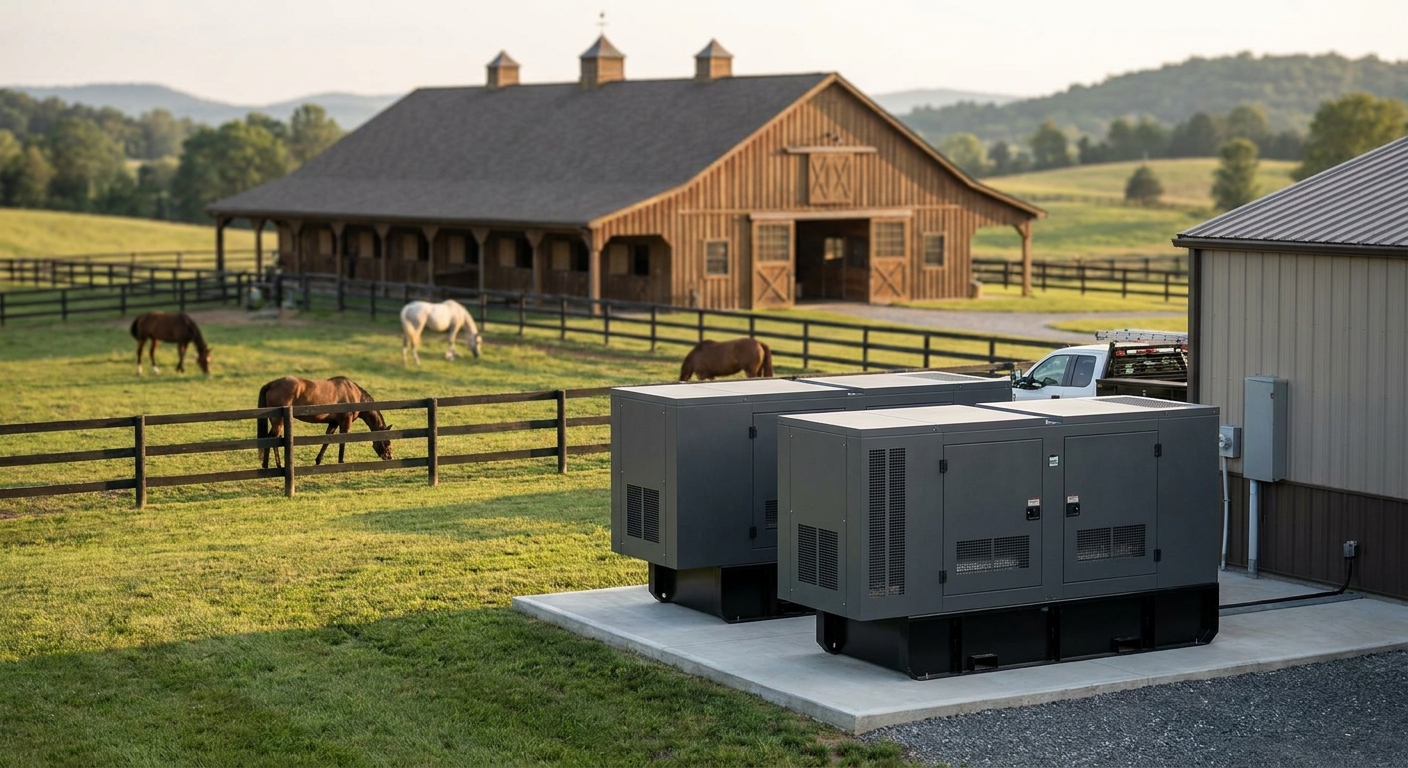
Horse barns lose power at the worst possible time - during a named storm, in the middle of foaling season, or when the well pump quits and 40 stalls need water. This guide ranks the generator types and brands that actually hold up for equestrian facilities in coastal Alabama, with sizing and fuel guidance you can use before you call a dealer.
- A 48kW Kohler or Generac standby unit covers most mid-size barns with well pumps, ventilation fans, and climate control - Buy.
- Portable and PTO generators fail equestrian facilities during multi-day outages because horses need continuous water and airflow, not intermittent power - Skip for primary backup.
- Propane-fueled standby generators outperform diesel for barns without existing fuel infrastructure - Consider.
- Facilities with 100+ stalls or indoor arenas need 80kW or larger with automatic transfer switches rated for three-phase equipment - Buy.
- Hurricane season 2026 runs June through November, and Baldwin County barns without standby power average multi-day outages after a direct hit.
Why this matters
Horses are 1,000-pound animals that drink 5 to 10 gallons of water a day and depend on well pumps, not municipal lines, in most of rural Baldwin County. Cut power for 48 hours and a 30-stall barn runs out of water before the storm clears the county. Ventilation fans, misting systems, and foaling barn heat lamps carry the same urgency - a generator sized for a house does not carry a barn.
The licensed team at Baldwin County Generators installs standby systems across Daphne, Fairhope, Foley, and Gulf Shores, and equestrian properties show up on that list every hurricane season because the stakes are higher than a lost freezer of meat. Getting the size and fuel type right the first time matters more here than in almost any other residential or light-commercial application.
How this list was ranked
Rankings below weigh four factors specific to equestrian use: continuous-duty capacity (barns run generators for days, not hours), well pump starting wattage, automatic transfer switch reliability, and fuel availability during regional shortages that follow major storms. Authorized dealer brands sold in coastal Alabama - Kohler, Generac, Honeywell, and Briggs & Stratton - are compared against the specific demands of stalls, arenas, and wash racks rather than generic whole-home use. Portable and towable units are included for contrast, not because they belong in a primary backup plan for livestock.
The ranked list
1. Kohler standby generators - the safe pick for well-pump-dependent barns
Kohler's automatic transfer switches are built around a fast start sequence that matters when a submersible well pump needs a hard inrush of power to kick on. A 26kW unit handles a single well pump, a few ventilation fans, and barn lighting; move to 48kW once you add a second pump, an indoor arena, or climate-controlled tack and feed rooms. Kohler standby generators are a Buy for barns of 10 to 40 stalls running one to two wells.
2. Generac standby generators - the workhorse for larger facilities
Generac's commercial-grade line scales past 100kW, which matters once a facility adds an indoor riding arena with three-phase lighting or a wash rack building with its own electrical panel. The Mobile Link monitoring available on newer Generac units lets a barn manager check run status from a phone during an active outage instead of walking the property every few hours. Generac is a Buy for facilities running 60+ stalls, multiple structures, or any three-phase equipment.
3. Honeywell standby generators - the value pick for smaller operations
Honeywell units come in at accessible sizes (14kW to 20kW) that fit small hobby barns and boarding operations under 15 stalls where the load is mostly lighting, a single well pump, and a box fan or two. They are not built for continuous multi-day industrial-scale runs, so anything past a mid-size boarding operation outgrows this line fast. Honeywell is a Consider for small barns on a tighter budget, and a Skip once stall count or well pump count climbs past a single unit.
4. Briggs & Stratton standby generators - the propane specialist
Briggs & Stratton's standby line runs clean on propane, which matters for rural Baldwin County properties without a natural gas line but with an existing propane tank feeding barn heaters or a house. Sizing runs from 20kW to 26kW in the range relevant to horse properties, enough for a well pump, arena lighting, and a heated tack room. Briggs & Stratton is a Buy for propane-equipped properties in the 15 to 30 stall range.
5. Portable and towable generators - the wildcard that fails barns during real storms
A towable 20kW unit looks like a budget answer on paper, but it requires someone on-site to refuel it every 8 to 12 hours and manually manage load, which does not work when a barn owner evacuates ahead of a storm or loses cell service during the outage. Fuel runs out, water stops, and horses go without ventilation exactly when the storm has made roads impassable. Portable and towable units are a Skip as primary backup for any facility housing live animals - keep one only as a secondary unit for a single well pump.
Comparison table
| Brand | Best size range for barns | Fuel type | Best fit | Verdict |
|---|---|---|---|---|
| Kohler | 26kW-48kW | Natural gas or propane | Well-pump-dependent barns, 10-40 stalls | Buy |
| Generac | 48kW-100kW+ | Natural gas, propane, or diesel | Large facilities, arenas, multi-building | Buy |
| Honeywell | 14kW-20kW | Natural gas or propane | Small hobby barns under 15 stalls | Consider |
| Briggs & Stratton | 20kW-26kW | Propane | Rural properties without gas lines | Buy |
| Portable/towable | 5kW-20kW | Gasoline or diesel | Secondary backup only | Skip |
What to avoid
- Undersizing for well pump startup load. A well pump's starting wattage can run 3x its running wattage, and a generator sized only for steady-state use will stall the moment the pump kicks on.
- Skipping the automatic transfer switch. A generator without an ATS means someone has to manually flip breakers during a storm at 2am - not realistic when horses need continuous water.
- Choosing gasoline-only portable units as a primary source. Gasoline supply chains break down fastest after a hurricane, and a barn cannot wait in a three-hour gas line while animals go without ventilation.
Where to buy
- Work with a licensed, insured installer that carries authorized dealer status for Kohler, Generac, Honeywell, or Briggs & Stratton - authorized status matters for warranty coverage on a unit running daily for years.
- Get the well pump's starting wattage and the barn's full electrical load (fans, lighting, arena, wash rack) measured on-site before sizing - a phone estimate undersizes barns more often than not.
- Confirm propane tank capacity and refill scheduling with your fuel supplier before hurricane season 2026 starts in June, since demand spikes hard in the days before a storm makes landfall.
Get your barn storm-ready
Free on-site sizing quote for standby generators across coastal Alabama.
FAQ
What are the best generators for horse barns in 2026?
Kohler and Generac standby generators in the 26kW to 48kW range are the best generators for horse barns with a single well pump and standard ventilation load. Larger facilities with indoor arenas or multiple structures need 80kW to 100kW+ from Generac's commercial line.
How big of a generator do I need for a horse barn?
Most 10 to 40 stall barns with one well pump need 26kW to 48kW of standby capacity. Facilities with indoor arenas, wash racks, or multiple wells should size at 80kW or higher.
Is propane or diesel better for a barn generator?
Propane works better for most rural Baldwin County properties that already run a propane tank for heaters, since it avoids diesel's gelling risk in cold snaps and stores longer without degrading. Diesel makes sense for facilities already running diesel equipment on-site.
Can a portable generator power a horse barn during a hurricane?
A portable generator can run a single well pump for a short outage but fails during multi-day hurricane outages because it needs manual refueling every 8 to 12 hours. Standby generators with an automatic transfer switch are the safer choice for continuous animal care.
How long can a standby generator run continuously?
Natural gas and propane standby generators from Kohler, Generac, Honeywell, and Briggs & Stratton are built for continuous multi-day operation as long as fuel supply holds. This is the main reason they outperform portable units for barns during extended outages.
Do horse barns need an automatic transfer switch?
Yes, an automatic transfer switch is essential for horse barns because it restores power within seconds of an outage without anyone on-site to flip breakers manually. Barns without one risk hours without water or ventilation before someone notices the outage.
What size generator do I need for a well pump in a barn?
A single well pump typically needs a generator sized at 26kW or higher to handle the startup surge, which can run three times the pump's steady running wattage. Adding a second well pump or arena lighting pushes that requirement toward 48kW.
One last thing
The detail most barn owners miss: sizing a generator for today's stall count guarantees it's undersized in three years, since equestrian facilities tend to add wash racks, indoor arenas, or a second well long before they replace fencing. Size one tier up from current load if expansion is even a possibility - the cost difference is smaller than a mid-storm resize.