Choosing the wrong transfer switch is the fastest way to turn a whole-home generator into an expensive lawn ornament during the next Gulf Coast outage. This guide ranks the main transfer switch options homeowners in coastal Alabama actually choose between in 2026, with a clear buy/hold/skip call on each.
TL;DR
For most Baldwin County homes, an automatic transfer switch (ATS) rated 200A is the best generator transfer switch option in 2026 - it switches power in under 10 seconds with zero manual action during a storm. A manual transfer switch is the Buy pick only for smaller budgets or partial-home backup, and a service-entrance-rated ATS is the right call for full-house 20kW-26kW standby systems. Skip bare sub-panel switches for anything beyond a single circuit - they leave too much of the house dark when Baldwin County loses grid power.
Why this matters
A generator without the correct transfer switch is a code violation waiting to happen and a backfeed hazard for utility line workers. NEC Article 702 requires an approved transfer mechanism for any permanently connected standby generator - no exceptions for homeowners in Daphne, Fairhope, Foley, or Gulf Shores. The switch you pick determines how many circuits stay live, how fast they come back on, and whether your system passes inspection after the next named storm rolls through in 2026.
Most outage calls Baldwin County Generators technicians run during hurricane season trace back to one of two problems: an undersized switch that can't carry the connected load, or a manual switch nobody remembers how to operate at 2 a.m. in a downpour. Getting this right up front avoids both.
How we ranked these
Each option below is scored against four factors coastal Alabama homeowners care about most: switching speed, amp capacity relative to typical home panels (100A-400A), installation complexity for a licensed electrician, and how well it holds up through repeated storm-season cycling. Rankings weight real-world reliability during grid failure over sticker simplicity, since a transfer switch that works perfectly in a showroom but hesitates during a hurricane is a switch that failed at its one job.
The ranked list
1. Automatic transfer switch (ATS), 200A - the standard pick
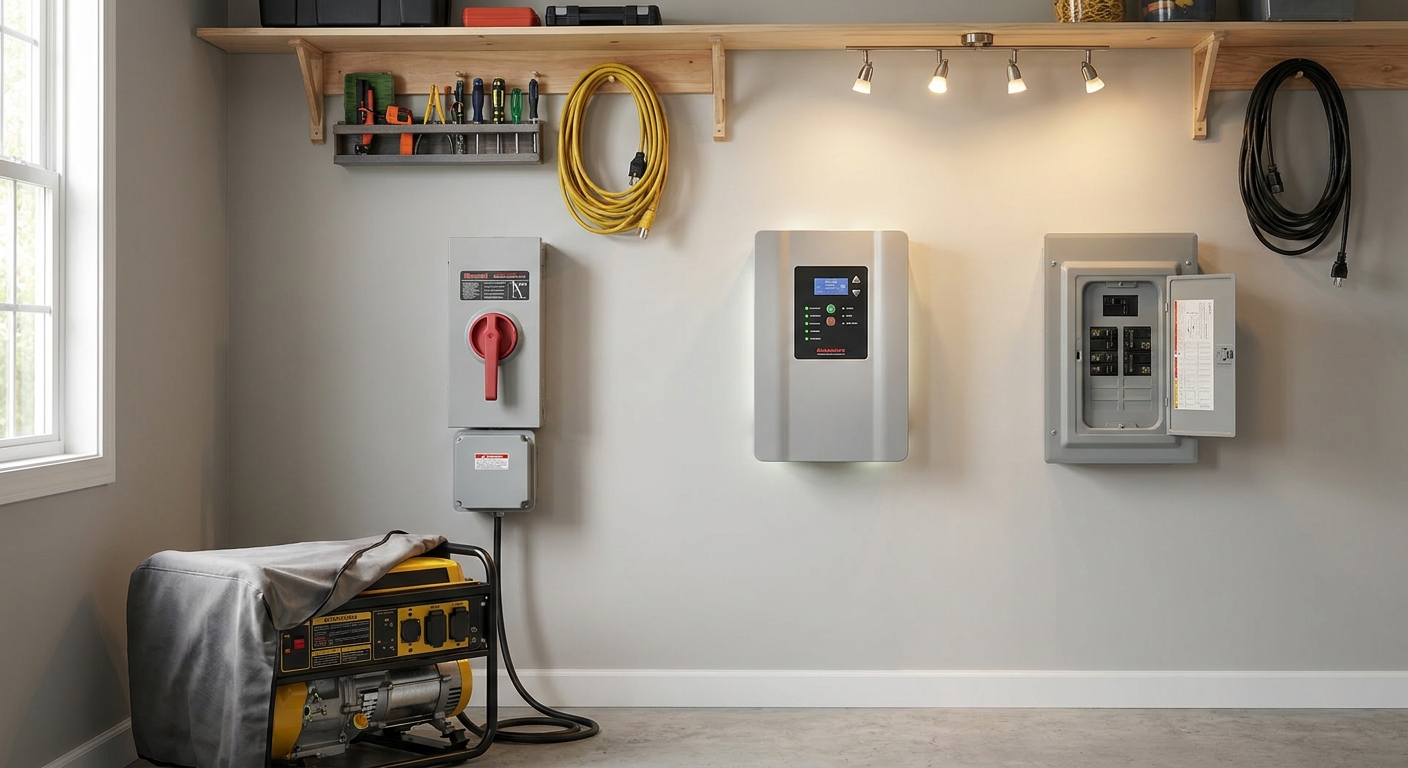
The workhorse of whole-home standby setups in 2026. A 200A ATS matches the service size of most single-family homes built in the last three decades and handles generators in the 14kW-22kW range without derating.
It senses utility loss, starts the generator, and switches the load automatically - typically within 10-20 seconds, no homeowner action required. That matters at 3 a.m. when a storm knocks out power and nobody's awake to flip anything.
Verdict: Buy. This is the default recommendation for full-home coverage in Fairhope, Daphne, and Foley homes with standard 200A service.
2. Manual transfer switch - the budget pick
A manual switch runs a limited number of circuits - usually 6 to 10 - through a sub-panel, and the homeowner physically flips breakers to route generator power after startup. No automatic sensing, no automatic start.
It costs less to install and works fine for homeowners who only need the refrigerator, well pump, and a few lights running during an outage. The tradeoff is manual operation every single time, storm or no storm, day or night.
Verdict: Consider. Fine for partial backup or tighter budgets, but not the right call for anyone who wants true whole-home coverage.
3. Service-entrance-rated ATS, 400A - the whole-house pick
Built for larger homes or properties with 400A service, this switch handles the full panel - HVAC, well pump, pool equipment, everything - without a sub-panel workaround. Pairs with 22kW-26kW standby units, the size range most common for larger Gulf Shores and Orange Beach properties.
Installation is more involved since it sits at the service entrance itself, which means coordination with the utility and a licensed electrician who's pulled permits in Baldwin County before. Once in, it's the closest thing to "never notice the outage happened" available in 2026.
Verdict: Buy for larger homes on 400A service; Skip if your panel is standard 200A - you're paying for capacity you won't use.
4. Smart, app-connected ATS - the tech pick
Same automatic switching as a standard ATS, plus remote monitoring so you can check generator status, fuel level, and run history from a phone. Useful for owners who split time between a coastal second home and a primary residence inland.
The switching hardware underneath is identical to a standard ATS - the value here is entirely in the monitoring layer, not the transfer speed itself.
Verdict: Consider if remote visibility matters to you; Hold if you're on-site full time and don't need the app layer.
5. Sub-panel manual switch (single circuit) - the wildcard
The smallest option: a manual switch wired to run one circuit, sometimes just a single appliance or a sump pump. Cheap, simple, fast to install in under an hour by a licensed electrician.
It does exactly one job and nothing more. Fine as a stopgap for a specific piece of equipment, but it's not a home backup solution by any reasonable definition.
Verdict: Skip for whole-home planning; Buy only if you have one specific critical circuit and no broader backup plans.
Comparison table
| Option | Typical amp rating | Switch speed | Best for | Verdict |
|---|---|---|---|---|
| Automatic transfer switch (200A) | 200A | 10-20 sec | Standard whole-home coverage | Buy |
| Manual transfer switch | Sub-panel, 6-10 circuits | Manual, minutes | Budget or partial backup | Consider |
| Service-entrance ATS (400A) | 400A | 10-20 sec | Larger homes, 400A service | Buy (large homes) |
| Smart app-connected ATS | 200A-400A | 10-20 sec | Remote monitoring needs | Consider |
| Sub-panel manual (single circuit) | Single circuit | Manual, minutes | One critical appliance | Skip (whole-home) |
Where to buy
- Match the switch to your generator's kW output and your panel's amp rating first. A 200A ATS paired with a 26kW unit on 400A service will bottleneck the system - get the sizing confirmed before you buy anything.
- Buy through an authorized dealer with licensed, insured electricians on staff, not a big-box shelf unit. Transfer switch installation on a live service panel is not a DIY project and NEC 702 compliance requires it be done right the first time.
- Confirm the switch carries UL 1008 listing for automatic transfer switches - this is the baseline safety certification inspectors in Baldwin County check for during permit sign-off.
FAQ
What's the best generator transfer switch option for a typical Baldwin County home? A 200A automatic transfer switch is the best fit for most single-family homes with standard 200A electrical service, since it matches typical generator sizing (14kW-22kW) and switches power automatically within 10-20 seconds of an outage.
Is an automatic transfer switch better than a manual one? For whole-home backup, yes - an ATS switches power without anyone home to flip a breaker, which matters during nighttime storms common in hurricane season. Manual switches still make sense for smaller budgets or partial-circuit backup.
Do I need a permit to install a transfer switch in Alabama? Yes. Any permanently connected standby generator system falls under NEC Article 702 and requires a permitted installation by a licensed electrician, with inspection before the system is signed off.
Can I install a transfer switch myself? No - transfer switches tie into a live service panel, and an improperly installed switch creates a backfeed hazard for utility line workers. This is licensed-electrician work, not a weekend DIY project.
How much amperage do I need for a whole-home transfer switch? Most homes need a 200A switch to match standard service size; larger homes on 400A service need a service-entrance-rated switch to match. Undersizing the switch bottlenecks the generator no matter how big it is.
How fast does an automatic transfer switch respond to an outage? Typically 10 to 20 seconds from utility loss to generator power reaching the panel, once the generator has started and stabilized.
Does a smart transfer switch switch power faster than a standard one? No - the switching mechanism and speed are identical to a standard ATS. The difference is remote monitoring through an app, not faster transfer.
What happens if my transfer switch fails during a storm? The generator may run but never actually power the house, or backfeed can occur if a manual switch is operated incorrectly - both are reasons annual maintenance checks matter heading into hurricane season each year.
One last thing
The switch matters more than the generator brand. A 26kW Kohler or Generac unit paired with an undersized or poorly maintained transfer switch performs worse in a real outage than a smaller unit matched correctly - sizing the switch to the panel and the load is the step homeowners skip most often, and it's the one that decides whether the lights actually come on. Baldwin County Generators handles the sizing, permitting, and installation together so the switch and the generator get matched correctly the first time, before hurricane season 2026 tests the system for real.