Running a car wash on a generator that's too small doesn't just risk a shutdown - it strands cars mid-cycle, floods the bay, and burns out motors that weren't built to restart under load. Here's how to size and install backup power that keeps a tunnel or self-serve wash running through a Gulf Coast outage.
- Automatic tunnel washes need 60-150 kW; self-serve bays run fine on 20-40 kW.
- Generac and Kohler both build commercial units rated for the constant-load cycling a car wash demands - buy either, sized correctly.
- Briggs & Stratton fits smaller self-serve setups but stalls under tunnel-wash blower and dryer loads - skip it for full-service tunnels.
- Generator installation for car washes in coastal Alabama should be locked in before June 1, not after the first named storm.
Why this matters
A car wash isn't a house. The load isn't a few lights and a refrigerator cycling on and off - it's high-torque motors, air compressors, dryers, and vacuum stations all pulling amperage at once, often starting simultaneously when the tunnel resets after an outage. Undersized generators trip breakers or fail to start the largest motor at all, which means a wash that looks "backed up" on paper still goes dark during a storm.
Coastal Alabama sees hurricane season run June 1 through November 30, and a wash that loses power for even two days during peak summer traffic loses real revenue on top of the repair bill for water damage or motor burnout from a bad restart. Sizing and installing generator backup before the season starts, not during it, is the entire game here.
Who this is for
This guide is for car wash owners and operators in Daphne, Fairhope, Foley, Gulf Shores, and the surrounding coastal Alabama market who run a self-serve bay, an automatic tunnel, or a full-service operation and need standby power that survives grid outages without damaging equipment or losing a shift's worth of cars mid-wash.
Baldwin County Generators handles sizing, licensed electrical installation, and ongoing service for exactly this kind of commercial load - not residential backup dressed up as commercial.
What to look for in generator installation for car washes
Starting wattage, not just running wattage
Car wash motors - blowers, vacuum units, high-pressure pumps - draw two to three times their running wattage the instant they start. A generator sized only for running load will brown out or shut down the moment the tunnel's largest motor kicks on after an outage, so sizing has to account for simultaneous motor starts, not steady-state draw.
Automatic transfer switch response time
A transfer switch that takes too long to detect an outage and switch over means motors sit mid-cycle with partial power, which is exactly what burns windings. Commercial-grade automatic transfer switches cut over in 10 seconds or less, fast enough that a wash in the middle of a cycle doesn't stall.
Fuel type and on-site supply
Natural gas units run as long as the gas line holds pressure, which is the deciding factor for a business that can't schedule a fuel delivery mid-storm. Propane and diesel units need on-site tanks sized for at least 48-72 hours of runtime if the wash plans to stay open through an extended outage.
kW rating matched to the actual load, not the building size
A 200-foot tunnel wash and a 4-bay self-serve operation on the same square footage have wildly different electrical loads. Self-serve bays typically run on 20-40 kW; automatic tunnel washes with dryers, blowers, and reclaim pumps need 60-150 kW depending on equipment count.
Licensed commercial installation, not a residential contractor's side job
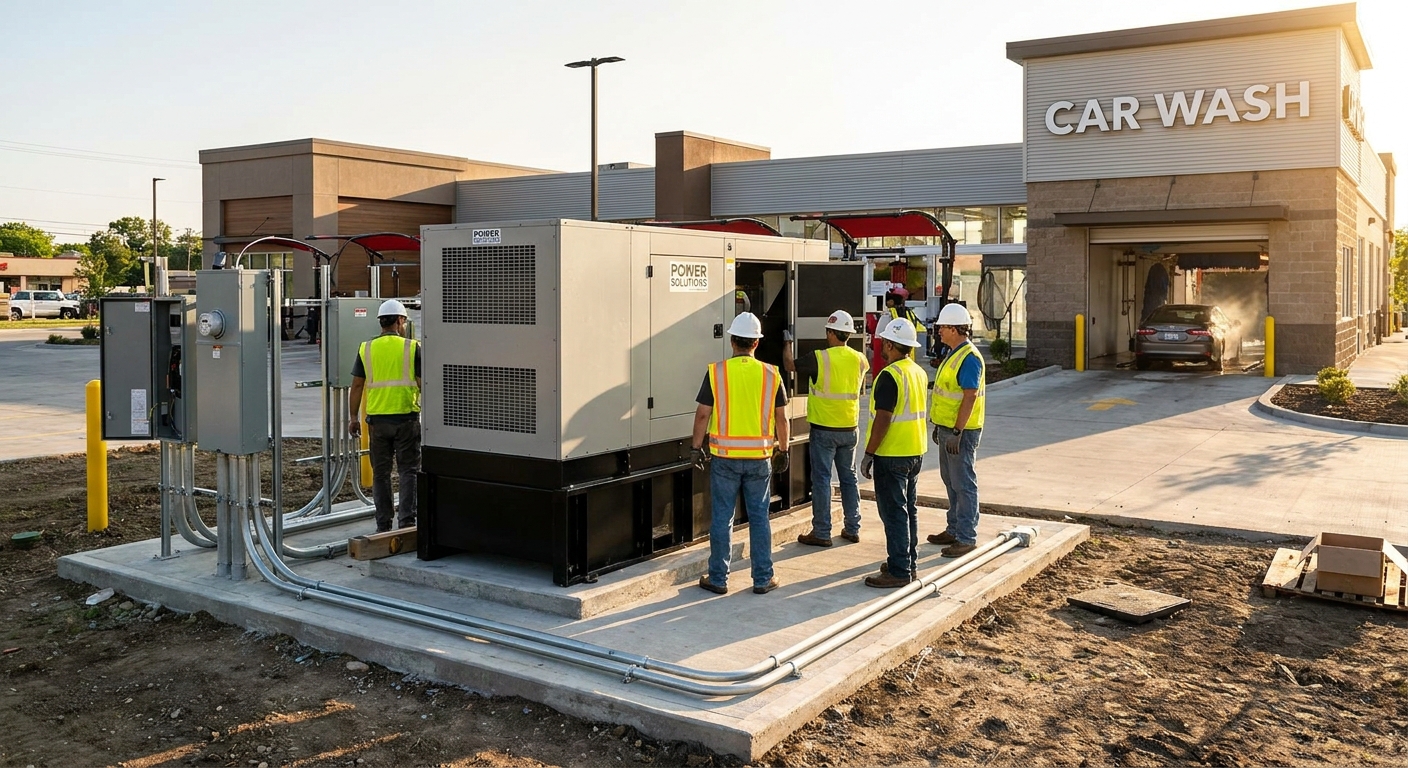
Commercial three-phase service, load calculations for simultaneous motor starts, and permitting for a business site are different from a homeowner's whole-house unit. A licensed electrical contractor familiar with commercial standby systems avoids the rework that comes from an installer who's only ever wired residential Generac units.
Maintenance contract that matches wash hours
A generator that only gets tested once a year on a quiet Sunday isn't proven for a wash running 12-hour days, seven days a week. Quarterly load-bank testing and oil service scheduled around actual operating hours catches a failing unit before hurricane season does.
Get your wash sized for backup power
Load calculations and a written quote before storm season starts.
Top picks
Generac commercial standby (60-150 kW range) - the safe pick. Generac's commercial line covers the exact kW spread most tunnel washes need, and parts availability across coastal Alabama is strong enough that service calls don't wait on backordered components. Rated for 100% continuous duty at full load, which matters when a wash runs a full shift on generator power during a multi-day outage. Buy for tunnel washes running 60 kW and up.
Kohler commercial standby (48-150 kW range) - the reliability pick. Kohler's commercial units are built around the same load-bank testing standard used in hospital and data center backup, which is overkill for most homes but exactly right for a business that can't afford a failed restart mid-cycle. Runtime on natural gas is effectively unlimited as long as the gas utility stays online. Buy for washes prioritizing long-duration reliability over lowest upfront cost.
Honeywell commercial-grade units (20-48 kW range) - the self-serve pick. Honeywell's mid-range units fit self-serve bays and smaller automatic washes that don't need triple-digit kW output, and the automatic transfer switch response time keeps pace with a 4-6 bay operation. Consider for self-serve or single-bay automatic setups; skip for full tunnels - it undersizes fast once dryers and reclaim pumps get added.
Briggs & Stratton commercial units (20-38 kW range) - the budget pick. Lower upfront cost than Generac or Kohler in the same kW bracket, which works for a self-serve wash with modest vacuum and air compressor load. Starting wattage headroom is thinner than the other three brands, so a wash planning to add equipment later outgrows it quickly. Consider only for small self-serve operations with no expansion plans; skip for anything approaching tunnel-wash load.
What to avoid
- A residential whole-home unit resized "close enough" for commercial use. Home-grade generators aren't built for the continuous duty cycle a wash running 12+ hours a day demands, and warranty coverage typically excludes commercial application entirely.
- A generator sized to running wattage alone. This is the single most common undersizing mistake - it looks adequate on a spec sheet and fails the moment two motors start at once.
- Skipping the load-bank test after installation. A unit that starts fine on a quiet afternoon can still fail under the actual simultaneous-start load of a full wash cycle; a proper commercial install includes a load-bank test before sign-off, not just a startup check.
Verdict comparison
| Brand | kW range | Best fit | Verdict |
|---|---|---|---|
| Generac | 60-150 kW | Automatic tunnel washes | Buy |
| Kohler | 48-150 kW | Long-duration reliability priority | Buy |
| Honeywell | 20-48 kW | Self-serve or single-bay automatic | Consider |
| Briggs & Stratton | 20-38 kW | Small self-serve, no expansion planned | Consider |
FAQ
What size generator does a car wash need?
A self-serve car wash needs 20-40 kW, while an automatic tunnel wash with dryers and blowers needs 60-150 kW depending on equipment count. Sizing has to account for simultaneous motor starts, not just steady running load, or the largest blower will stall the system.
How much does generator installation for car washes cost in 2026?
Commercial installs in the 60-150 kW range typically run well into five figures once transfer switch, fuel supply, and permitting are included in 2026. Self-serve installs in the 20-40 kW range cost noticeably less since the load and switch gear are smaller.
Is Generac or Kohler better for a car wash?
Both brands cover the commercial kW range a tunnel wash needs and are rated for continuous duty, so the choice usually comes down to parts availability and service network in your area. Kohler leans slightly toward long-duration reliability testing; Generac leans toward wider commercial parts availability in coastal Alabama.
Can a self-serve car wash run on a smaller generator?
Yes, a self-serve bay with modest vacuum and air compressor load typically runs fine on 20-40 kW. A Honeywell or Briggs & Stratton commercial unit in that range covers most self-serve operations without the cost of tunnel-wash-sized equipment.
How fast does the transfer switch need to be for a car wash?
Commercial-grade automatic transfer switches should cut over in 10 seconds or less. Anything slower risks a motor sitting on partial power mid-cycle, which is a common cause of burned windings after an outage.
When should a car wash install backup power before hurricane season?
Installation should be finished before June 1, when hurricane season starts in coastal Alabama, not after the first storm watch is issued. Permitting, fuel line work, and load-bank testing take time that a wash doesn't have once a storm is already forecast.
Does natural gas or propane work better for a car wash generator?
Natural gas runs as long as the utility line holds pressure, which suits a wash that can't schedule fuel deliveries mid-storm. Propane or diesel needs an on-site tank sized for at least 48-72 hours if the wash plans to stay open through an extended outage.
Do car washes need a licensed electrical contractor for generator installation?
Yes, commercial three-phase service and load calculations for simultaneous motor starts require a licensed electrical contractor familiar with commercial standby systems. A residential-only installer commonly undersizes or misconfigures the transfer switch for this kind of load.
One last thing
The detail most car wash owners miss isn't the generator brand - it's the transfer switch speed. A 10-second cutover keeps a mid-cycle motor from sitting on partial power long enough to burn its windings, and that single spec matters more to equipment survival than whether the unit says Generac or Kohler on the side.