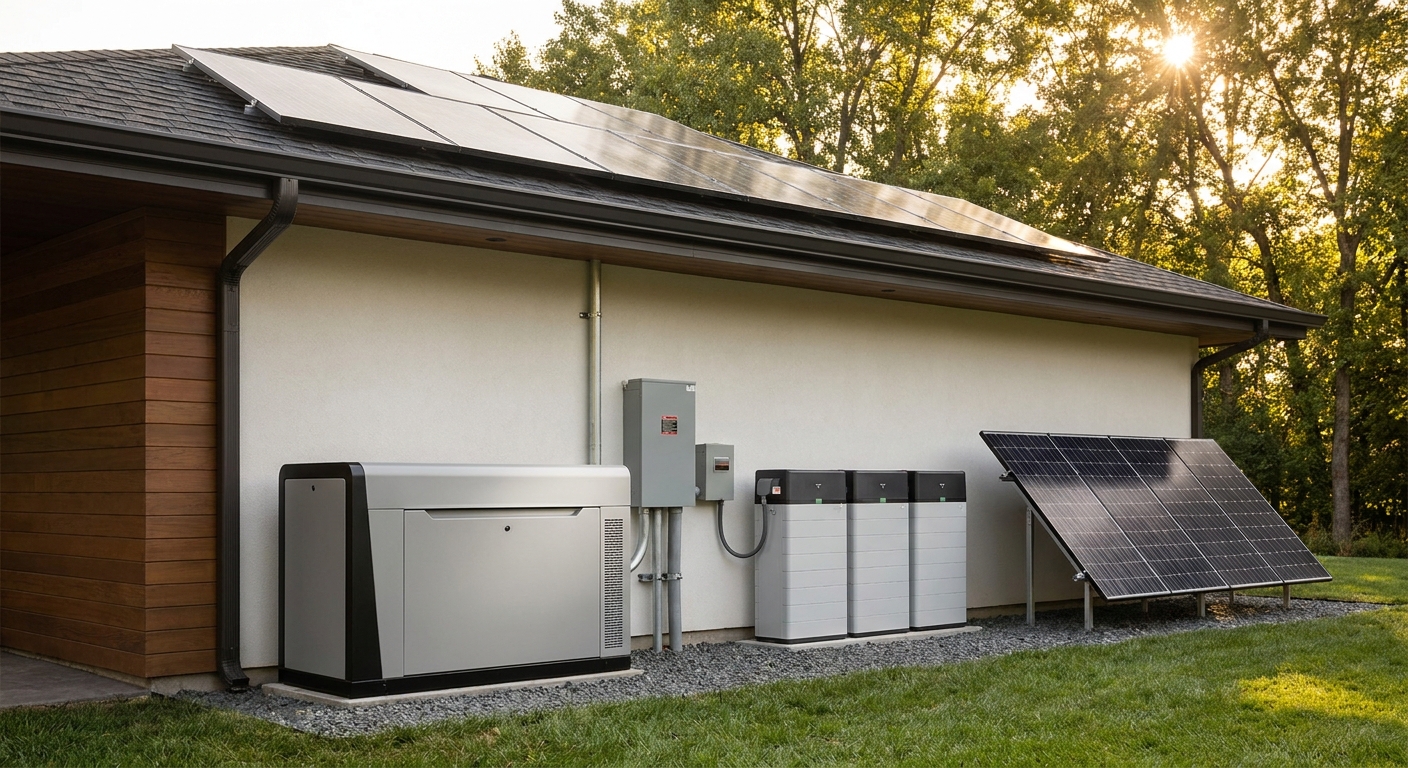
Solar panels and a battery bank change what you need from a standby generator. A generator that ignores state of charge and kicks on the second the grid drops burns fuel you don't need and shortens its own service life - the models below either talk to your battery system or they don't, and that single fact decides most of these verdicts.
- Generac Guardian 24kW paired with a PWRcell battery is the top pick among best generators for homes with solar and battery storage in 2026 - Buy.
- Kohler 20RESV pairs cleanly with Kohler inverter and battery hardware - Buy for homes already on that platform.
- Honeywell 22kW runs on Generac's own architecture at a lower price point - Consider for budget-focused buyers.
- Briggs & Stratton 20kW Standby lacks smart battery-aware switching - Hold unless your solar setup is minimal.
- Portable and sub-15kW standby units can't carry a whole coastal Alabama home through a multi-day outage - Skip.
Why this matters
A generator sized and wired for a plain grid-tied home will often start up even when your battery bank has 80% state of charge left to give. That's wasted fuel, unnecessary run hours, and in some setups, a fight between the generator's frequency and the inverter's. Baldwin County Generators installs and services Kohler, Generac, Honeywell, and Briggs & Stratton standby units across Daphne, Fairhope, Foley, and Gulf Shores, and the sizing question comes up on nearly every solar-equipped home in coastal Alabama.
Most solar-plus-battery homes in the 2,500 to 3,500 square foot range need a 16 to 26 kW standby unit, depending on whether well pumps, HVAC, and an EV charger are on the load list. Alabama's hurricane season runs June through November, and outages after a named storm regularly stretch past a week - which is exactly when a battery-blind generator burns through propane or diesel it didn't need to.
How this list was ranked
Each generator on this list was weighed against four factors that matter specifically for solar-plus-battery homes: whether the transfer switch reads battery state of charge before starting, fuel type and run-time economics, compatibility with existing rooftop solar inverters, and how the unit performs during extended outages typical of a Gulf Coast storm season. Models that only handle a bare grid-outage scenario got marked down even if they're well-built generators on their own. Pricing reflects typical 2026 installed ranges for coastal Alabama, not sticker price alone.
The ranked list
1. Generac Guardian 24kW + PWRcell - the integration pick
Generac's Guardian 24kW paired with a PWRcell battery runs through one control system, so the generator only fires when the battery bank and solar can't cover the load. That single detail is what separates it from every other unit on this list for homes that already run PWRcell.
It handles whole-home loads including HVAC and well pumps, and it's the unit Baldwin County Generators sees requested most often on solar retrofits in Fairhope and Daphne. Run time on propane at half load stretches past 100 hours with a 500-gallon tank, which matters when storm season knocks out the grid for a week or more. Verdict: Buy for any home with PWRcell already installed or planned for 2026.
2. Kohler 20RESV + Kohler battery - the safe pick for Kohler households
Kohler's 20RESV is built to hand off cleanly with Kohler's own inverter and battery hardware, which makes it the obvious choice if you're not mixing brands. It's a 20kW air-cooled unit rated for whole-home service on a standard 3,000 to 3,500 square foot footprint.
The transfer switch logic prioritizes stored battery power first, generator second, which cuts fuel use during short outages that don't need a full generator cycle. Kohler's dealer network across coastal Alabama keeps parts turnaround reasonable, which matters when a storm creates regional demand spikes. Verdict: Buy if you're already on Kohler batteries or inverters.
3. Generac Guardian 22kW (standalone) - the wildcard
Drop the PWRcell and the Guardian 22kW is still a capable whole-home unit that works with any solar system through a standard automatic transfer switch, not just Generac's own battery hardware. That flexibility is the wildcard here - it won't talk to your battery the same way the 24kW-plus-PWRcell combo does, but it will run reliably with third-party inverters already installed on older solar systems.
At 22kW it covers most 2,000 to 2,800 square foot homes without derating under full HVAC load. Verdict: Consider for homes with existing solar that isn't Generac-branded.
4. Honeywell 22kW - the budget pick
Honeywell's standby generators are built on Generac's own manufacturing platform, so the core engine and transfer switch technology track closely with the Guardian line at a lower price point in 2026. That makes it a reasonable stand-in for buyers priced out of the PWRcell bundle.
It handles the same 22kW output and similar run-time economics, but Honeywell's battery-integration options are more limited than Generac's own branded pairing. Verdict: Consider for budget-focused buyers who still want hybrid-ready switching.
5. Briggs & Stratton 20kW Standby - hold for now
Briggs & Stratton builds a solid 20kW air-cooled standby unit with a strong reputation for engine durability, but its transfer switch doesn't read battery state of charge the way Generac and Kohler's newer switches do. That means it starts on a straight grid-loss trigger regardless of how much battery capacity is sitting unused.
For a home with minimal solar or no battery bank, that's a non-issue. For a home leaning on battery storage first, it means unnecessary generator hours. Verdict: Hold unless your solar system is small or absent.
6. Portable and sub-15kW standby units - skip
Anything under 15kW, portable or fixed, isn't built to carry a whole coastal Alabama home with HVAC, well pump, and appliances running simultaneously through a multi-day outage. These units work for a handful of circuits, not a whole-home hybrid setup. Verdict: Skip for any home serious about solar-plus-battery backup.
Comparison table
| Generator | Output | Battery-aware switching | Best for | Verdict |
|---|---|---|---|---|
| Generac Guardian 24kW + PWRcell | 24kW | Yes, full integration | Homes with or planning PWRcell | Buy |
| Kohler 20RESV + Kohler battery | 20kW | Yes, full integration | Kohler inverter/battery households | Buy |
| Generac Guardian 22kW (standalone) | 22kW | Standard ATS only | Existing third-party solar | Consider |
| Honeywell 22kW | 22kW | Limited | Budget buyers wanting hybrid-ready | Consider |
| Briggs & Stratton 20kW Standby | 20kW | No | Minimal/no solar homes | Hold |
| Sub-15kW portable/standby | Under 15kW | No | Not recommended for solar+battery homes | Skip |
Get your generator sized right
A licensed electrician can match generator size to your solar and battery setup.
Where to buy
- Buy through a licensed, insured electrical contractor that also handles the transfer switch programming - a generator that isn't wired to recognize your battery's state of charge behaves like a plain backup unit no matter what the spec sheet says.
- Confirm the installer is an authorized dealer for the brand you're buying. Warranty claims and firmware updates for hybrid transfer switches often route through the dealer, not the manufacturer directly.
- Get the fuel source locked down before ordering. Propane tank sizing and natural gas line capacity both affect run time during the extended outages that follow a Gulf Coast hurricane, and retrofitting fuel lines after installation costs more than planning for it upfront.
FAQ
What's the best generator for a home with solar and battery storage in 2026?
The Generac Guardian 24kW paired with a PWRcell battery is the top pick for 2026 because it manages solar, battery, and generator output through one control system. Kohler's 20RESV is the equal choice for homes already on Kohler battery hardware.
Do I still need a standby generator if I have solar and battery storage?
Yes, most home battery banks cover a few hours to a couple of days depending on usage, not the week-plus outages common after a named storm in coastal Alabama. A standby generator covers the gap once stored battery power runs out.
Is a Generac or Kohler generator better for solar homes?
Both work well, and the right choice depends on what inverter and battery brand is already installed. Generac's Guardian line pairs natively with PWRcell, while Kohler's 20RESV pairs natively with Kohler's own battery hardware.
How much does a whole-home generator cost installed in 2026?
Whole-home standby generators typically run $10,000 to $20,000 installed in coastal Alabama in 2026, depending on size, fuel type, and whether battery integration is part of the install. Larger 24kW-plus units with hybrid switching sit toward the higher end.
Can any generator connect to an existing solar battery system?
No. A standard automatic transfer switch will run alongside solar but won't read battery state of charge, so the generator starts on grid loss regardless of stored power. Only battery-aware switching, like Generac's PWRcell pairing or Kohler's inverter integration, avoids that.
What size generator do I need for a home with solar panels?
Most 2,500 to 3,500 square foot homes with solar need a 16 to 26 kW standby unit, depending on HVAC size, well pump load, and whether an EV charger is on the circuit. A licensed electrician should size the unit against your actual panel and battery specs, not square footage alone.
Does Honeywell make its own generators or use Generac parts?
Honeywell's standby generators are built on Generac's manufacturing platform, sharing core engine and switching technology at a lower price point. Battery-integration options are more limited than Generac's own branded PWRcell pairing.
One last thing
The detail most homeowners miss: a battery-aware transfer switch doesn't just save fuel, it cuts generator run hours, which is the single biggest factor in engine wear over a 10-plus year service life. A Guardian or 20RESV that only fires when the battery is actually depleted will log a fraction of the hours a battery-blind unit racks up over the same storm season - and fewer hours means fewer service calls in 2026 and beyond.