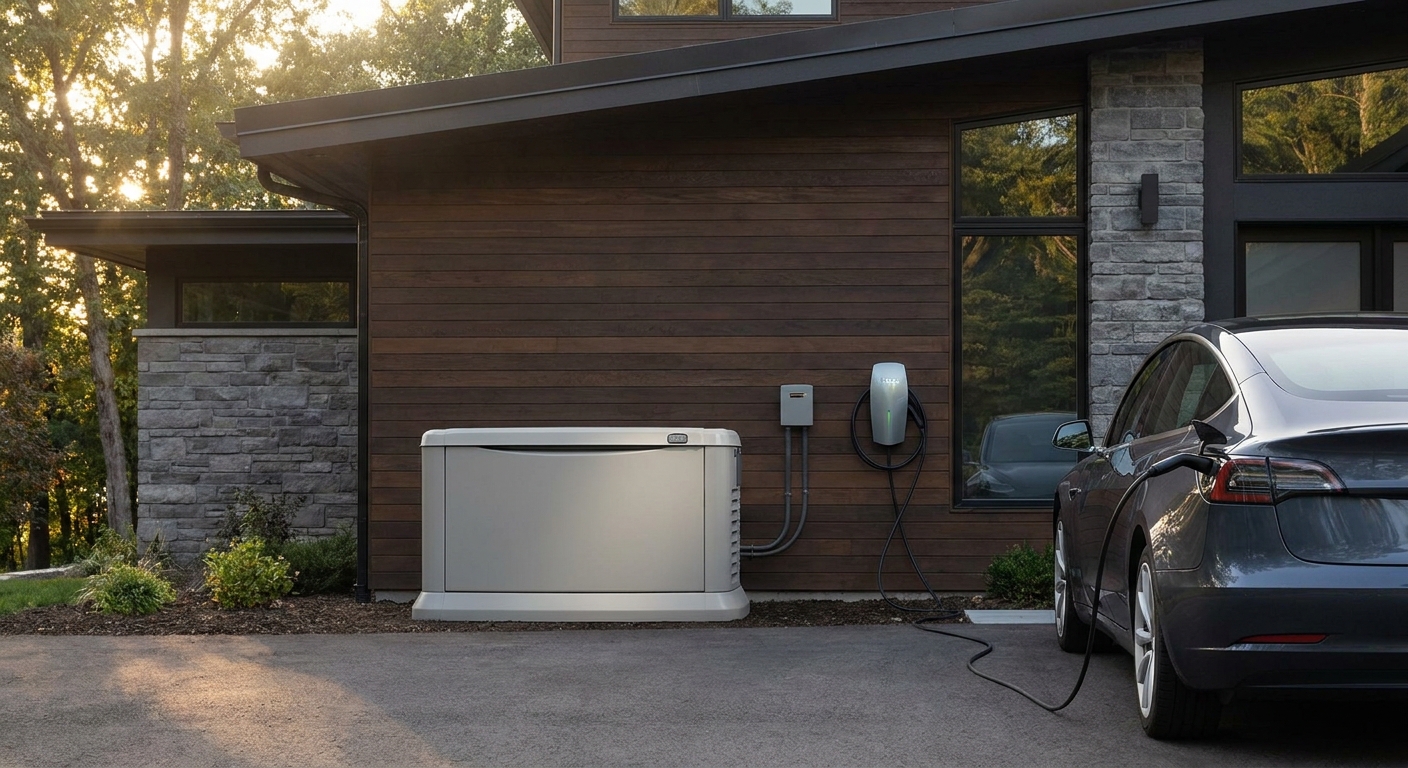
Homes with a Level 2 EV charger need more standby generator than a typical whole-house setup, and picking the wrong kW size means the transfer switch shuts down your charger during an outage. This guide ranks the standby generators that handle a home plus an EV charger without derating your comfort circuits.
- Generac Guardian 22kW is the safe pick for most Baldwin County homes running one Level 2 EV charger - Buy.
- Generac Guardian 24kW with a Smart Management Module is the best whole house generator for homes with EV chargers pulling 40+ amps - Buy.
- Kohler 20RESA covers a home and EV charger only with a load-shedding module installed - Consider.
- Anything under 20kW forces a choice between the charger and your AC during a storm - Skip for EV households.
Why this matters
A standard 16kW to 20kW standby generator was sized for a home before EV chargers became common on Baldwin County driveways. Add a 40-amp Level 2 charger pulling 9.6kW continuous, and that same generator now has to shed your AC, water heater, or the charger itself the moment demand spikes.
During a grid outage after a named storm, that's the wrong appliance to lose. Homeowners in Daphne, Fairhope, Foley, and Gulf Shores who added an EV charger after their generator was installed are the most common callback Baldwin County Generators sees for resizing and load-management retrofits in 2026.
The fix isn't complicated, but it does mean sizing up and adding a management module in most cases. That's the whole point of this list.
How this list was ranked
Every generator here is ranked on three things: continuous kW output relative to a typical 2,500-3,000 square foot coastal home plus one EV charger, compatibility with a load management or smart transfer switch, and installed cost range for 2026 based on the brands Baldwin County Generators carries - Kohler, Generac, Honeywell, and Briggs & Stratton.
Units under 20kW are included only to flag why they don't work for this specific use case. A generator that runs your kitchen fine but can't hold the EV charger and central air at the same time isn't a whole house generator for an EV household - it's a partial-home generator with an asterisk.
The ranked list
1. Generac Guardian 22kW - the safe pick
The Generac Guardian 22kW is the volume seller for coastal Alabama homes adding a single Level 2 EV charger to an existing whole-house setup. Paired with Generac's Smart Management Module, it manages up to two additional loads so the charger, the AC, and the water heater don't compete for the same 22,000 watts.
Installed cost typically runs in the $12,000 to $16,000 range for 2026 in Baldwin County, transfer switch and permit included. It runs on natural gas or propane and holds a 200-amp service without a service upgrade in most existing homes.
Verdict: Buy. This is the right size for one EV charger plus a normal home load in 2026.
2. Generac Guardian 24kW with Smart Panel - the EV-first pick
The Generac Guardian 24kW, run with Generac's Smart Panel instead of a basic load-shedding module, is built for homes with two EVs or a single charger pulling closer to 48 amps. The Smart Panel manages up to eight circuits individually instead of shedding whole categories, so the charger keeps running while the generator prioritizes based on real-time load.
Expect an installed price around $15,000 to $19,000 in 2026, higher than the 22kW because of the panel hardware and additional wiring for individual circuit control.
Verdict: Buy for households charging two EVs or running a charger above 40 amps.
3. Kohler 20RESA - the value pick with a catch
The Kohler 20RESA is priced competitively and holds up well in coastal humidity, but at 20kW it's tight for a home plus EV charger unless you add Kohler's load management accessory. Without it, the charger gets shed automatically whenever the AC compressor kicks on, which in a Gulf Shores July means the car doesn't charge much at all during an outage.
With the load management module added, installed cost lands around $11,000 to $14,000 for 2026.
Verdict: Consider - only with the load management module specified up front, not as an afterthought.
4. Honeywell 20kW - the budget-adjacent option
Honeywell standby units are built on Generac engines and share much of the same platform, which is why the 20kW Honeywell runs close in price to the Kohler 20RESA. It's a reasonable whole-home unit on its own, but at 20kW it hits the same wall as the Kohler once an EV charger enters the load calculation.
Installed pricing sits around $10,500 to $13,500 in 2026, making it one of the more affordable 20kW-class options on this list.
Verdict: Consider for homes without central air or with a Level 1 charger only - otherwise size up.
5. Briggs & Stratton 20kW - the wait-and-see pick
The Briggs & Stratton 20kW standby unit is a capable generator for a home without an EV, but for EV households it needs the same size correction as the other 20kW units on this list, and Briggs' load management accessories are less widely stocked in coastal Alabama than Generac's.
That means longer lead times if a homeowner needs the management module added mid-project in 2026.
Verdict: Wait until sizing is confirmed with an EV load calculation, or move to a 22kW-class unit instead.
Comparison table
| Generator | Output | EV Charger Compatible | Installed Cost (2026) | Verdict |
|---|---|---|---|---|
| Generac Guardian 22kW | 22kW | Yes, with Smart Management Module | $12,000–$16,000 | Buy |
| Generac Guardian 24kW + Smart Panel | 24kW | Yes, individual circuit control | $15,000–$19,000 | Buy |
| Kohler 20RESA | 20kW | Only with load management add-on | $11,000–$14,000 | Consider |
| Honeywell 20kW | 20kW | Limited, Level 1 charging only | $10,500–$13,500 | Consider |
| Briggs & Stratton 20kW | 20kW | Needs resizing for EV load | $10,000–$13,000 | Wait |
Where to buy
- Get an EV-specific load calculation before quoting kW size. A generic whole-house quote from a big-box installer often skips the EV charger amperage entirely, which is how homeowners end up with a 16kW unit that can't hold the car and the AC at once.
- Confirm the load management module is in the quote, not sold separately later. Kohler and Honeywell units especially get quoted bare, with the management hardware added as a change order after install.
- Use a licensed electrical contractor familiar with coastal wind and flood code, since transfer switch placement and generator pad height matter more in Fairhope and Gulf Shores than in most inland markets.
FAQ
What is the best whole house generator for a home with an EV charger?
The Generac Guardian 22kW paired with a Smart Management Module is the best whole house generator for most homes with one EV charger in 2026. Homes with two EVs or a 48-amp charger should size up to the 24kW Guardian with a Smart Panel.
How many kW do I need to run a house and an EV charger?
Most coastal Alabama homes need at least 22kW to run a full house plus a Level 2 EV charger without shedding the AC. A 20kW unit works only with a load management module installed.
Can a 20kW generator run an EV charger and central air at the same time?
Not reliably without a load management accessory, since a 20kW generator has little headroom left once the AC compressor and a 9.6kW charger draw simultaneously. Adding the module lets the generator prioritize circuits instead of failing outright.
How much does a whole house generator cost installed in 2026?
Installed cost for a 22kW to 24kW standby generator in Baldwin County runs $12,000 to $19,000 in 2026, including the transfer switch and permits. Smaller 20kW units without EV load management run closer to $10,000 to $14,000.
Does a Generac generator automatically manage an EV charger during an outage?
Only with a Smart Management Module or Smart Panel added at install. Without it, the generator's built-in load-shedding logic may cut the charger off whenever another high-draw appliance turns on.
Is Kohler or Generac better for a home with an EV charger?
Generac has a wider range of load management accessories readily stocked for EV households in 2026, which makes sizing and retrofits faster. Kohler's 20RESA works fine with its own load module but requires that add-on specified up front.
Do I need a bigger generator if I add an EV charger after installation?
In most cases yes, since a generator sized before the charger was added likely doesn't account for the extra 7kW to 9.6kW of continuous draw. A load calculation confirms whether a management module alone solves it or the unit needs to be replaced.
One last thing
The number that trips up most EV households isn't generator size - it's the charger's amperage setting. A 48-amp Level 2 charger pulls nearly double the load of a 32-amp unit on the same circuit, and that difference alone can push a home from a 20kW generator into 24kW territory. Check the charger's amperage before locking in a quote, not after.